Google’s New /goto Search Redirects: What They Mean for Your SEO Strategy
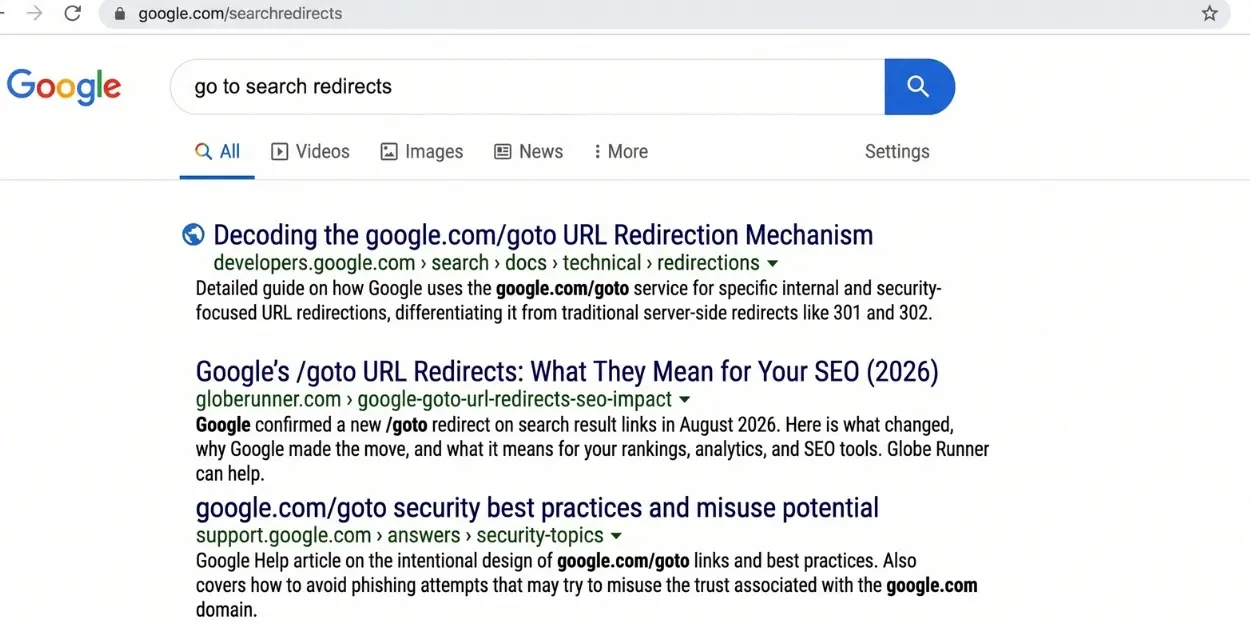
Have you clicked a Google search result lately and noticed something different happening? Instead of a clean URL, you may have landed on an address containing google.com/goto?url= followed by a long string of encoded characters.
If you manage a website or a marketing budget, you may have some real questions. Is your organic traffic safe? Will this affect your analytics? Are your keyword rankings at risk?
The short answer: your website is not in danger. Google confirmed this update on August 26, 2026, and it changes how search clicks are routed, not how pages rank. Here is what’s actually happening and what it means for your strategy.
What Is a /goto URL Redirect?
In the past, clicking a Google search result took your browser straight to the destination page, or through a redirect that clearly showed where you were headed.
With the new /goto format, Google adds a routing step. When someone clicks an organic result, their browser is sent first to a Google-owned address like:
google.com/goto?url=[encoded string]
The destination site is no longer written out in plain text. It’s encoded, and Google’s server resolves it and issues a 302 redirect to the real page. For the person doing the searching, the click still works the same way. They land on the same page, just by way of one extra server-side hop.
Why Did Google Make This Change?
Google confirmed the rollout to Search Engine Land, calling it a technical measure against evolving forms of abuse. Google did not say who or what it’s targeting. AI companies and rank-tracking tools are the industry’s guess, not Google’s.
Here are the practical effects of the change:
- It raises the cost of scraping. SEO tools, competitor rank trackers, and AI models have long pulled ranking data by reading the links on a results page. With the destination hidden behind an encoded value, a tool now has to follow each redirect individually to find out where it leads. Across a page with hundreds of results, that adds up fast.
- It supports bot and abuse detection. Routing every click through a Google-owned checkpoint gives Google another point to evaluate whether traffic is coming from a real person or an automated script.
Taken together, this looks like an effort to protect proprietary search data from being harvested at scale by anyone, whether that’s a rank-tracking tool, a competitive intelligence platform, or an AI model pulling in search results to train on.

How This Affects Your Digital Marketing Strategy
Here is what matters for your day-to-day operations.
Rankings are not affected. Google is changing the container that delivers a click, not the algorithm that decides who ranks first. Strong content, sound technical health, and a legitimate backlink profile still drive results the same way they did before this update.
Search Console data is unaffected. Google’s own indexing and reporting systems still see your real page, and the redirect is a temporary (302) status, which signals it isn’t meant to replace your URL in any index.
Analytics attribution is worth watching, not worrying about. Because searchers still land on your actual page after the redirect, organic traffic should continue tracking normally in platforms like GA4 or HubSpot. Public reporting on this change hasn’t addressed referrer data or attribution edge cases directly, so we recommend clients watch organic traffic trends over the next few weeks rather than assume everything is unaffected by default. If you want a second set of eyes on your data and analytics tracking during this transition, that’s exactly the kind of thing we monitor for clients.
Your SEO tools may see some turbulence. Keyword tracking and SERP monitoring platforms now have to re-engineer how they collect ranking data. Expect temporary reporting glitches, and don’t be surprised if some providers raise prices to cover the added computing cost of following redirects at scale.
The Bigger Picture
This update is a reminder that the search landscape keeps shifting, and most of those shifts happen behind the scenes. This one is largely a backend measure aimed at automated data collection, not a signal that your SEO strategy needs an overhaul.
The best move right now is the same move that always works: keep your technical SEO foundation clean, keep publishing content that genuinely answers what your audience is searching for, and keep an eye on your reporting instead of reacting to every infrastructure change on day one.
As AI-generated search results and AI crawlers become a bigger part of how people find businesses online, moves like this one are also worth watching through the lens of AI Optimization, since visibility across both traditional and AI-driven search increasingly runs through the same technical groundwork.
If you want a strategy audit to confirm your site is holding steady through this update, schedule a call with our team. Globe Runner can help.