












9 Tips for Optimizing Email Marketing
In today’s digital marketing landscape, email remains an important tool for customer communication and conversion, yet many businesses struggle to unlock its full potential. This comprehensive guide will provide you with 10 expert strategies to transform your email marketing approach, helping you craft more engaging campaigns that not only capture attention but also drive meaningful results and maximize your return on investment.
1. Define Your Target Audience & Segment Your List
Defining a target audience for email marketing is a crucial step in creating effective campaigns that resonate with subscribers and drive results. Start by analyzing your existing customer data, including demographics, purchase history, and engagement metrics. This information can provide valuable insights into who is most likely to be interested in your products or services. Additionally, gather feedback directly from your audience through surveys or polls to understand their preferences, pain points, and needs.
To further refine your target audience, consider segmenting your email list based on various criteria. This can include demographic factors like age, gender, and location, as well as psychographic elements such as interests, values, and lifestyle choices. Behavioral data, such as past purchases, email engagement levels, and website interactions, can also be used to create more targeted segments. By combining these different segmentation strategies, businesses can create highly specific customer personas that allow for personalized and relevant email content, ultimately leading to improved engagement and conversion rates.
2. Craft Compelling Subject Lines
Crafting compelling email subject lines is an art that requires strategic thinking and audience understanding. The key is to create concise, specific lines that immediately communicate value and spark curiosity. Start by using action-oriented verbs and keeping your subject line short—ideally around 7 words or 41 characters—to ensure it’s fully visible on mobile devices. Focus on clearly articulating the benefit to the recipient, such as using specific promises like “Increase your open rates by 50% today” instead of generic statements.
To make your subject lines more engaging, incorporate techniques like asking compelling questions, using numbers, and leveraging power words that evoke emotion. For example, a subject line like “Are you making these SEO mistakes?” or “5 ways to boost email open rates” can pique curiosity and encourage opens. Additionally, personalize your subject lines when possible, and consider using techniques that create a sense of urgency or exclusivity. Remember that the goal is to stand out in a crowded inbox by being specific, relevant, and immediately valuable to your target audience.
3. Leverage Email Automation
Email automation can significantly enhance your email marketing efforts, improving efficiency and effectiveness. By implementing automated workflows, you can send timely, personalized messages triggered by specific customer actions or behaviors, such as signing up for a newsletter, abandoning a cart, or making a purchase. This approach allows for highly targeted communication that resonates with subscribers, leading to increased engagement and conversion rates. In fact, automated emails have been shown to generate 320% more revenue compared to non-automated emails.
Using email automation can also help streamline your marketing processes, saving time and resources while maintaining consistent communication with your audience. Set up automated sequences for various purposes, such as welcome series, re-engagement campaigns, and post-purchase follow-ups, ensuring that customers receive relevant content at the right moment in their journey. This not only enhances the customer experience but also helps to nurture leads, boost customer retention, and ultimately drive sales on autopilot. Moreover, most automation tools provide detailed analytics and reporting, allowing you to continually optimize your email strategies based on performance data.
4. Optimize Calls-to-Actions (CTAs)
To optimize calls to action (CTAs) in email marketing, focus on several key strategies:
- Use Action-Oriented Language – Employ clear, compelling verbs that guide recipients toward the desired action. For example, instead of vague phrases like “Click here,” use specific actions such as “Buy now and get 15% off” or “Check out our spring collection”.
- Create a Sense of Urgency – Incorporate techniques that encourage immediate action, such as limited-time offers or countdown timers. This can motivate recipients to act quickly, increasing engagement and conversion rates.
- Personalize CTAs – Tailor your CTAs to different audience segments based on their preferences, behaviors, or past interactions. This personalized approach can significantly improve the relevance and effectiveness of your emails.
- Optimize Design and Placement – Make CTAs visually distinct by using buttons with contrasting colors and clear fonts. Ensure they are easily clickable and optimized for various devices and screen sizes.
- Keep it Concise and Clear – Craft short, straightforward CTAs that clearly communicate the benefit to the user. For instance, “Browse New Collection 10% Off” is more effective than simply “Visit Website”.
- Focus on Value – Highlight the benefits the recipient will gain by clicking the CTA. This approach appeals to the user’s self-interest and makes the offer more compelling.
- A/B Test Your CTAs – Continuously experiment with different elements of your CTAs, including copy, colors, and placement. Use data-driven insights to refine and improve your email marketing effectiveness.
- Ensure Consistency – Connect your CTA to both the email content and the destination page. This alignment creates a seamless experience for the user and increases the likelihood of conversion.
- Use Accessibility Best Practices – Make your CTAs accessible to all users by following email accessibility guidelines, including optimizing for dark mode and screen readers.
5. Personalize Email Content
If you are looking to optimize your email marketing through personalization, try these key strategies:
- Tailor content to audience segments/personas – This allows for more targeted and relevant content.
- Implement Dynamic Content – Utilize real-time data to customize email content, including product recommendations, imagery, and layouts based on individual preferences and behaviors.
- Personalize Subject Lines and Sender Names – Use the subscriber’s name in subject lines and consider personalizing the sender name to increase open rates.
- Offer Personalized Recommendations – Suggest products or content based on the recipient’s purchase history, browsing behavior, or stated preferences.
- Use Interactive and Personalized Imagery – Include visuals that resonate with the recipient’s interests or recent activities to boost engagement.
- Customize Email Timing and Frequency – Optimize send times based on individual subscriber behavior or preferences to improve open rates.
- Leverage Live Content – Incorporate real-time elements like countdown timers, live polls, or interest signals to create more engaging and dynamic emails.
- Continuously Test and Refine – Regularly A/B test different personalization elements and include fallback options to ensure a smooth experience for all recipients.
6. Ensure Mobile Optimization
Mobile optimization is crucial for email marketing success so it’s essential to use a responsive email design that automatically adjusts layouts across different devices. This means creating single-column templates, designing touch-friendly elements like larger CTA buttons, and ensuring content is concise and easily readable on smaller screens. Focus on swift load times, scalable images, and mobile-friendly visuals that capture attention quickly.
To effectively optimize for mobile, thoroughly test emails across various devices and email clients, paying close attention to subject lines, preheader text, and overall accessibility. Key strategies include using responsive templates, crafting brief and engaging content, implementing large, tappable buttons, and monitoring mobile-specific metrics like open and click-through rates. By prioritizing mobile user experience, you can significantly improve email engagement and ensure your marketing messages are effectively received by an increasingly mobile-first audience.
7. Set SMART Goals
Companies optimizing email marketing should set SMART goals: Specific, Measurable, Achievable, Relevant, and Time-bound. For example, “Increase email open rates by 10% within the next six months” or “Grow our email subscriber list by 20% in the next quarter”.
Goals should focus on key metrics like open rates, click-through rates, conversion rates, and list growth. They should be aligned with broader business objectives and based on current performance data. Companies should set realistic targets that challenge the team while remaining attainable. Regular monitoring and adjusting of goals is crucial to ensure continuous improvement in email marketing performance
8. Monitor & Improve Email Deliverability
Email deliverability rates are critical to the success of your efforts. To improve email deliverability, businesses should focus on these key strategies:
- Implement authentication protocols (SPF, DKIM, DMARC) to verify email legitimacy and improve inbox placement.
- Maintain a clean, engaged email list using reputable list-building methods and double opt-in processes. Regularly remove inactive subscribers and make unsubscribing easy.
- Monitor sender reputation and conduct proactive blacklist checks. Review metrics like spam complaints and bounce rates to address issues promptly.
- Create relevant, engaging content and segment email lists for better personalization. This improves engagement rates, which positively influences deliverability.
- Maintain consistent sending frequency and schedule to build trust with ISPs and recipients.
9. Optimize Send Times
Optimizing email marketing send times is crucial for maximizing engagement and effectiveness. While there’s no one-size-fits-all solution, several key strategies can help businesses improve their email timing:
Target Working Hours
Send emails during typical business hours, generally between 9 am and 5 pm. Studies show that emails sent between 10 am and 3 pm tend to perform well. Specifically, 9-11 am and 1-2 pm are often cited as optimal times.
Focus on Mid-Week
Tuesday, Wednesday, and Thursday are generally considered the best days for sending marketing emails. These mid-week days typically see higher open and click-through rates.
Consider Industry-Specific Timing
Different industries may have unique optimal send times:
- Ecommerce: 10 am
- Software/SaaS: 2-3 pm
- Marketing Services: 4 pm
- Hospitality/Online Retail: 8-10 am
- Professional Services (B2B): 8-10 am
- Nonprofits: 3-4 pm
Avoid Weekends and Late Nights
Saturday and Sunday generally see lower engagement rates. Similarly, sending emails outside of business hours (7 pm to 7 am) is often less effective.
Test and Analyze
While general guidelines are helpful, it’s crucial to test different send times and analyze your specific audience’s behavior. Use A/B testing and email analytics to determine the best times for your unique subscriber base.
Implement Send Time Optimization
Many email marketing platforms offer send time optimization features that use AI to determine the best time to send emails to individual subscribers based on their past behavior.
Consider Time Zones
For businesses with a global audience, segment your list by time zone or use a “follow the sun” approach to ensure emails arrive at appropriate local times
Take Your Email Marketing to the Next Level
Ready to elevate your digital marketing strategy and drive meaningful results? Connect with the professionals at Globe Runner today. We can create personalized email marketing, SEO, and content marketing solutions that will help your business soar.
How to write a great email for your upcoming campaign
Whether you’re sending a single email or crafting one that will be distributed to thousands, there are a number of things you can’t overlook if you want to get the most opens and clicks possible. Sure, you could get lucky and achieve the metrics you’re looking for, but why leave it up to chance? Counting on luck is a bad digital marketing decision.
Subject Line
The email subject line is so important that, if it isn’t carefully crafted, the following suggestions may prove moot. Without it, there’s a pretty good chance they won’t open the email and get to the body copy and the holy grail of digital marketing–the CTA (Call to Action).
The key to creating a great Subject Line is to not give away too much information, but just enough to make the viewer want to open it. Great examples are “What they never tell you about when you file for bankruptcy” or “Don’t do this when applying for a job” or “Are you positive you’re safe from ransomware?”. You don’t want to mislead recipients, but give them just enough info to make them want to peer inside.
Personalizing the Subject Line with the recipient’s first name can vastly improve your open rate. Several studies indicate that doing so enhances opens by anywhere from 35-50%. Also, use your, or another person’s, actual email address so that it shows up as being Sent From. If they receive an email from Sales@ or Marketing@, your open rates will suffer.
Clear, concise; yes, less is more
Sure, you want to display your writing prowess, but don’t get sucked in to writing for yourself. It’s a common mistake, but, remember, you’re writing to get recipients to act on your CTA. Be concise and remember that less is more. Try and keep the email copy to under 200 words and break up the text into a few paragraphs. You don’t want a single, solid one; that will make your 200 words look like a lot more. If you open an email and are hit with several hundred words, your mind immediately calculates the time you’ll have to invest to get through those words. Get to the point, and fast. Your goal is to get them to take action as soon as possible.
Don’t forget the white space. Without it, even the most concisely written copy can appear too long. White space combats clutter, the enemy of good content.
Using images? Include alt-text
Breaking up copy with an image is fine, just make sure it isn’t overpowering. Also, make sure it includes alt-text so it can be displayed on whichever browser the recipient may be using. No alt-text, no image, no good.
It’s all about the CTA
Don’t make CTAs hard to find. They should be prominently displayed, whether it’s clicking on a button, hitting a link, or filling out a form. Remember, that’s the ultimate goal—getting recipients to act on the CTA. You can include additional touchpoints, like social media icons linking to your page, but make sure they don’t interfere with your CTA.
Know your personas
Think about who will be receiving the emails and create personas for them. What will they act on, what will turn them off? If your campaign is targeting C-level professionals, your copy needs to address the types of responsibilities maintained by that level of employee. For them, you may not include as much granular information about a product or service, but more about how it can enhance ROI and affect things like CAPEX or OPEX. In other words, know your audience and write to them.
Words to avoid, lists to exclude
Steer clear of words that can trigger spam filters, like guarantee, winner, order now, free, risk-free, congratulations, etc. They can send your carefully crafted email straight into recipients’ spam folders. And while we’re on the subject, sending out to purchased email lists is another good way to get your emails flagged. If you’re using an Email Service Provider (ESP) and you send to a purchased list, you’re playing with fire. They often contain spam traps, which are emails included in the lists that signal the ESP that it’s a purchased list (they don’t like purchased lists). In other words, the ESP will know that this isn’t a list of recipients who have opted-in to receive the email. And if recipients flag your email as spam, the ESP will soon reach out to you wanting more information on the list, how you got it, etc. Also, purchased lists will often have a lot of hard bounces (bad email addresses), which is another red flag for the ESP.
Don’t forget to Test
Take the time to conduct A/B testing, which tests 2 versions of the email. For instance, you may want to test 2 Subject Lines, so a small percentage of the list receives email A, the other email B. The winning email (the one with the most opens) is then sent to the rest of the list. You can test subject lines, email copy, images, promotions, CTAs, etc. It’s a great way to hone your messaging and efficiently get the most effective version in front of the most amount of people.
Also, test your email in different browsers and on mobile devices. There’s a good chance that at least 50% of your emails will be viewed on a smartphone, and if it doesn’t look right, you’ve essentially scrapped half of the messages sent, maybe more.
Contact the experts
If you need the help of an online marketing agency with more than a decade of experience, Globe Runner is your partner. We are here to help inject your digital marketing initiatives with rocket fuel and launching it to success. If you’re ready to blast off, call us at (972) 472-8528 for a free digital marketing consultation.

INVENTIVE TACTICS TO DOUBLE YOUR EMAIL LIST
People are wary of email soliciting. Maybe it’s junk mail fatigue, maybe it’s genuine distrust, but on the extreme end, ask for an address and you may as well be requesting their social security number.
Still, we all know companies whose email list numbers in the thousands with impressive open rates to boot. So how do marketers overcome the skepticism and keep subscribers engaged over the long haul?
That, my friend, is today’s aim.
Looking for inventive ways to double your email subscribers? These tools and tricks are designed to do just that.
Why Prioritize List Growth?
You’re still reading so that means you are at least partially invested in growing your email list. Great!
For those of you still on the fence or who need to make a case to the higher-ups, what if we told you that with no email growth strategy in place, you’re likely to lose about half of your list within two years.
According to Hubspot, email marketing databases degrade by about 22.5% every year. Some of your subscribers change companies, others actively unsubscribe part way through the year, and many fed you an inactive yahoo email from the beginning and haven’t logged in since 2007.
We repeat, the time to double your email list is now!
Here are five essential, creative practices to implement starting with your next email campaign.
- Use buyer personas to list segment. You know we’re big proponents of both buyer personas and email segmentation. The two go together as naturally as search marketing and increased sales. Certain users will respond better to certain content. It’s your job to use the demographic information you have about your subscribers to send them pointed emails with information that’s most likely to speak to their specific interests. We also recommend segmenting by action so you know if a reader is more likely to follow a certain CTA or consume particular pieces of content.
- Host an event. Workshops, speaking engagements, and networking events are great ways to bring in fresh potential subscribers. Whether you invite industry leaders, contact social media influencers, or just give out free snacks, there’s no shortage of options to draw a crowd. Simply look within your immediate community to create a killer panel. Or, if you’re like us, consider promoting a cause. In our case, we decided to turn our office into a gallery space, inviting talented local artists to show their work a few times a year. Whatever type of event you host, make sure to use a site like Eventbrite to register guests, send tickets, and capture their emails in the process.
- Offer a guest WiFi. You’ve done it a thousand times at the airport waiting for your plane to board. The security line was a breeze and you now have an hour to kill before takeoff. You shore up appropriate WiFi networks on your laptop and see the Boingo Hotspot or free airport guest WiFi. With the flick of the keyboard you enter your email address, hop online, and never give it a second thought. Similarly, offering a free guest free WiFi option to your patrons or clients who visit your office is a great way to grow your email list without much work. Apps like Gazella make the collection even easier, integrating the collected contacts into platforms like Constant Contact.
- Run a paid ad. Paid search is everywhere these days. It’s a critical part of any digital marketing strategy that can help you knock out all variety of end goals. While most people think it’s designed to increase your web traffic or improve your page views, you can also use it exclusively as an email capture. We’ve seen plenty of clients have great success creating a Facebook paid ad that steered browsers to their email sign-up sheet, effectively doubling their email subscribers in the span of the campaign.
- Go analog. We’re living in a digital world, but don’t underestimate the value of good ‘ol pen and paper. You might try sending out postcards to former customers with a QR code that takes them to your subscription page. Or you could simply create email sign up sheets on rotation at trade shows, your brick and mortar stores, or at the receptionist area of your office.
These email list growth tips only scratch the surface of all the many ways you can increase your subscribers.
Want us to talk you through additional email marketing strategies? Make contact – see you in our inbox!
MAKE YOUR MARKETING AUTOMATION EMAILS WORK HARDER
by Alicia Kan
No matter how successful your marketing automation work flow is, each element can always benefit from occasional testing and refinement. We’ve compiled some of the best recommendations in our Testing To-Do list that seem worthy of the experimentation given the stellar results reported. They may inspire similar improvements on your end:
A/B test a fully designed email with a plain text one
For some time now, it’s been marketers’ common struggle for their emails to even make it to recipients’ inboxes — Gmail famously shunts Mailchimp, Constant Contact and other promotional emails to the Promotions tab where they languish unless a recipient marks an email as something they’d like to see in the main folder. (Or, senders go through the labor-intensive process of DKIM to get Google’s rubber stamp of approval.)
Perhaps dialing down the design elements and making an email seem ‘official’, i.e. just plain text, circumvents the rerouting. Sharpspring reports that click-through rates for plain text emails are double those of emails using a decorative template.
The Customer Acquisition Consultant reports similar results when he did an A/B test. His take: Plain text emails are less likely to be caught in spam filters, don’t look like ads, and feel more personal. “Ugly could be effective,” was his verdict.
Send a welcome email that’s a keeper
How many of us have received the canned ‘thank you for subscribing’ email and immediately deleted it? Whether you’re an online retailer or a professional services firm, the humble thank you email can be elevated into a missive that brings your prospect closer to being a customer. Some food for thought:
Customize the email with the recipient’s first name. That prospect has just signed up; get to a first-name basis with your welcome email. This Harvey Nichols example via Ometria is simple, spare and makes the recipient feel like the center of their universe:
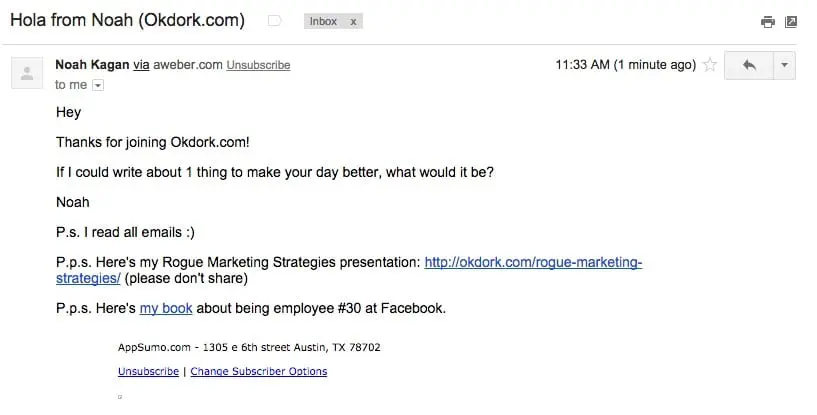
Give away something of value. Via Teachable: Noah Kagan, co-founder of the very successful AppSumo, has a short welcome email that gives away a presentation on his best rogue marketing strategies as well as a book on his days at Facebook (he was employee #30). Obviously an email not meant for the junk folder.
If you’re a retailer, get them to start shopping while they’re in the mood. Your recipient is feeling expansive after sharing his or her email address. Capitalize on the endorphin rush by dangling instant gratification images and calls-to-action.
This Crate and Barrel welcome email has an irresistible picture — imagine yourself entertaining al fresco! — and a solitary call-to-action button. It’s just one of many excellent retail examples shared by Smiley Cat.

Make people think twice about unsubscribing
Unsubscribe numbers are among the hardest to view among marketing automation metrics, but some creative marketers have managed to make the breakup process harder with their emails. Some techniques you may consider for your own sequence:
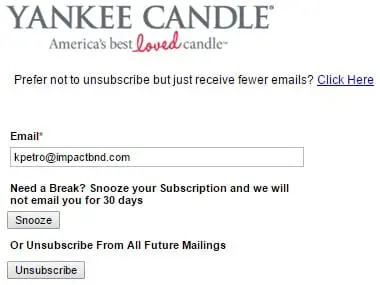
Give people the choice of taking a break. From Contently comes this clever Yankee Candle email that offers a ‘snooze’ option for 30 days, a fantastic option for the holidays when email marketing goes into overdrive.
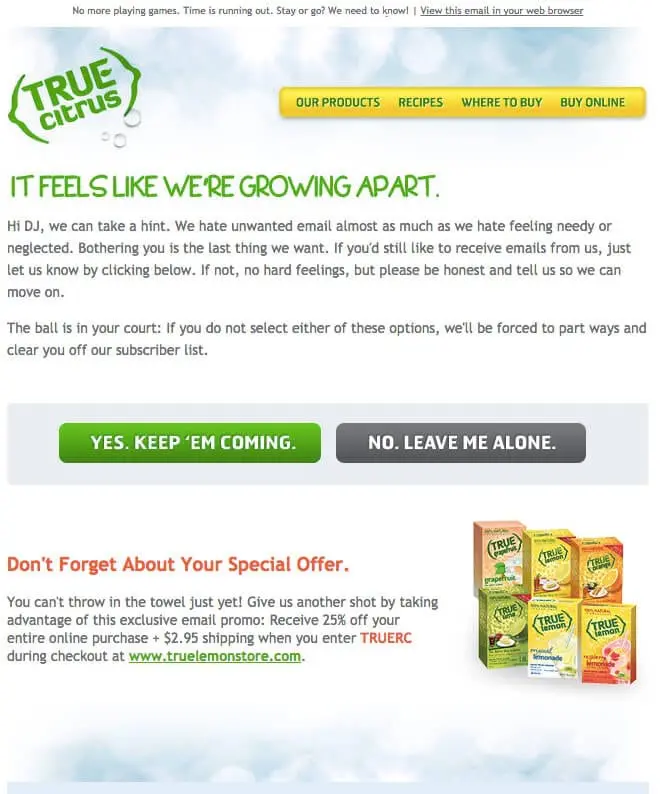
Get ’em to smile. It is possible with an unsubscribe email, as True Citrus shows below. This example via Jellyvision ticks all the boxes: It gets to the heart of the matter; it’s witty; it makes a (classy) last-ditch attempt to keep the subscriber. Honestly, would you unsubscribe with this level of effort?
And if they really, really want to go? Set them free and four weeks later:
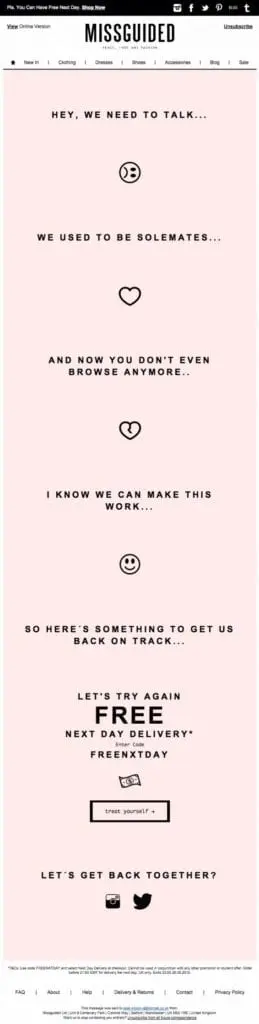
Schedule a re-engagement email. The caveat is you must have a great message and an irresistible offer, like this Missguided example provided by the good folks at Emma.
Got any more fantastic examples to add to the above? Post a link in the comments section.
Image: Good marketing automation is like this Wasabi sushi conveyor belt — every part works as hard as it can to create an effective work flow.
EMAIL SEGMENTATION: A QUICK GUIDE
Delivery is the foundation of good story-telling. Any comedian will tell you that if you deliver a bad joke the right way, you can make it funny. The same goes for email marketing. How you currently break up and deliver your email communications and segment your audience based on what they do (in addition to what they say) is what determines its efficacy.
Segmentation Based on Action
You may already be segmenting your emails based on groups i.e. business groups, demographic types and membership (paid, free, lapsed). Even if this has proven to be effective, it can be even more helpful to segment according to action; segment based on the behavior or action that your audience takes relative to the service you’re offering.
Why is action louder than words? Instead of connecting with people based just on their membership type or whether they’re male or female, connect with them based on what they do—helping to foster a more personal connection. For example, say someone downloaded a whitepaper or opened an article on your website. Instead of getting caught up on getting their personal information, focus on communicating with them based on what they did by offering them a next step or a subtle call-to-action.
Segment Your Segments
If the customer who downloaded a whitepaper or article identifies themselves as someone familiar in your trade of business, you can create narrowly focused segmentations based on this information. Use this information to develop engaging and relative content.
Although it may seem cumbersome, and far from the foundation of automated email marketing, you’re more likely to get results with email segmentation.
MailChimp scanned their users who use segmentation tools and compared the list of segmented campaigns to the results of the same customers’ non-segmented campaigns. “When we measured stats ‘across all segmented campaigns,’ segmented campaigns performed markedly better than their non-segmented counterparts.”

What your customers do may be more telling than what they say which can help your email communications be more relevant and successful.
Do you use email segmentation? How much do you depend on user information over their actions?
Let us know via Twitter.
HOW TO AVERT GMAIL INBOX FULL FAILURE – THE ULTIMATE GUIDE
We recently had an issue where one of our inboxes was nearly full. So we reached out and did some research to find the best method of reliably backing up a Gmail inbox and clearing it. We found that the best method is with getmail, a Linux utility that fetches mail through IMAP. It is very powerful and flexible, providing a lot of options. There are several different methods as well (outlined below).
Overall, we recommend using getmail. By trying several different approaches, getmail is by far the best. It is a little confusing at first, but not a hard pill to swallow:
How do you install getmail?
Ubuntu:
sudo apt-get install dovecot-imapd getmail4
Arch Linux:
pacman -S getmail
Centos:
yum install getmail*
Here are some resources for backing up gmail with Linux:
getmail:
- Matt Cutts explains how to backup gmail with getmail
- Linode documentation goes over getmail setup
- Getmail documentation
- Configuring getmail
If you don’t like getmail there are several different options out there:
BagoMa:
Fetchmail:
- Life hacker explains how to backup gmail with fetchmail
- Periodically backing up your email with fetchmail
W4RJ8XDCJ8DS
EMAIL MARKETING AND CONVERSION OPTIMIZATION
We caught up with Email marketing expert and Conversion Scientist Brian Massey at last night’s DFW SEM meeting- always a treat, we love Brian. Check it out!
Transcript
Eric: Hi, it’s Eric from Globe Runner SEO, and tonight we’re at DFW SEM. We love coming to these events because of the great speakers that they bring, and to tonight I’m talking with Brian Massey, the conversion scientist, one of the smartest guys I know. Brian and I have actually known each other for about a year now. I originally saw you at PubCon. We scheduled a phone call. You helped me out with one of my websites, and you gave me a lot of great insight. I thought I’ve got to pull Brian aside, take a few minutes to talk to you.
One of the things that I know you’re really great at is email marketing. We have several clients right now doing email marketing campaigns, and I wanted to get your advice on that.
Brian: OK.
Eric: I wanted also to kind of let everybody out there know that we love to use you for conversion optimization on either email or website optimization campaigns. If you guys are already a client of ours, call me, talk to me about working with Brian because if you want to convert your website better, this is the guy to talk to.
Brian, let’s focus a little bit on email marketing. I know you like to do it. I subscribe to your email list. I get it all the time. It’s got great content in it. How do you make that work? What’s the secret sauce to emails?
Brian, I’ll tell you the problem with email is there’s a recipe that the Wizard Academy which is an interesting and enigmatic business communication school talks about, Roy Williams says that salience equals frequency times relevance. Salience is that magic moment when somebody gets what you’re saying. They move your brand into their chemical memory as opposed to digital electrical memory.
Eric: OK.
Brian: Salience is important. It’s what builds brands, relevance and frequency. These are the challenges in email, relevance and frequency. To be relevant, I have to understand something about my folks, my higher subject matter experts who write that content.
Eric: Right, right.
Brian: What we end up doing is getting into this monthly newsletter that has three fully written articles, and that doesn’t give us the frequency that we need. I think blogs are where it is, and this has really worked for me. Every time I have an article some place else, I do a little blog post about it, and my blog drives my email marketing.
Eric: You mean, you write an article somewhere else, or you read an article somewhere else?
Brian: I’ll write an article on Search Engine Land or Clicksy. Rather than link to that, I will write a blog post summarizing one of the things or excerpting. I’m using my blog as the content source, and then I have what is called a RSS to email service. Mail Chimp, AWeber offer these things.
Eric: Yeah, we like Mail Chimp actually ourselves.
Brian: Once a week, weekly I would consider the minimum for effective email.
Eric: OK.
Brian: Once a week, Mail Chimp goes and looks at my RSS feed. If there’s new blog posts, it puts them into a template and sends it to my list. It manages my opt-outs and everything for me, and it’s hands off. I write the blog. I go about my business, and Mail Chimp takes care of that once a week. I’ve got relevance because I’m dealing with articles that I have written specifically for my audience. I’ve got frequency in getting something out once a week.
Eric: Right.
Brian: That’s creating that salience where people get what I’m about, a thought leader in my space.
Eric: And they think, conversions, Brian.
Brian: That’s exactly right, and it works very well for me. Don’t get wrapped around the axle on doing your monthly newsletter. Do your weekly blog post and summary.
Eric: Do you like doing it once a week where it aggregates your one to three posts, or however many you needed, or the other option at Mail Chimp is, I know, that you can have them do it every night. Every time that you do a post, it’ll pop. What do you think of that? Is that too much?
Brian: The rule of email is this. You send as often as your content allows. As an extreme example American Airlines sent me five emails within the space of an hour.
Eric: But you were going to miss your flight if you didn’t get it.
Brian: They were giving me flight updates, so I wanted that. That’s high relevance.
Eric: Right.
Brian: If you can’t write, I know some entrepreneurs who can write a daily email. They’re short. They’re punchy, but they’re interesting, and they keep people on their list, writing daily.
Eric: I wish I could do that.
Brian: Every one of them has an offer in it. It works for folks like that. You decide.
Eric: OK.
Brian: A blog is usually a wide range of topics, so I think once a week or twice a week is probably sufficient. If you try to do that daily, it’s probably a little more hit, miss and less relevant. A daily thing might be a little stretching it, but I did a test last summer which I had four, eight days sent an email every day.
And so, I got to study what we call list shake. People who don’t want that are getting off, but they’re probably not buyers anyway.
Eric: Right. Maybe, that was OK. Let’s talk about a couple of the high sticky points in emails that I think about a lot is the headline in the email, and then also the call to action email. Do I need to have a call to action in my email, and then, if so, do I need it at the top?
Do I need it at the bottom? How strong does it need to be? Should it be like my landing page, like a PPC landing page where I have a really clear button that says Do This Now? Or do you suggest, like your emails, in fact, are probably a little softer where they’re a little more on content, and I’m not driving you to buy something right now. In email, it depends on what you’re selling.
Brian: Email is a promotional… We’re marketers. It is a promotional medium. We do want to promote.
Eric: Right.
Brian: I recommend the best place to put offers is in the copy. You write your email or you write your blog post such that it ends up going in with this offer, that offer you can have what we talked about.
Eric: Right.
Brian: That’s the most important place. If you put it in the copy, you’re going to have higher click-throughs.
Eric: OK.
Brian: There’s a little blindness. I use a two column thing. There’s an offer blindness on the right column, if you see a two column newsletter, but I’ve had good luck with them. I suspect that I could have better luck in stream ads.
Eric: Right.
Brian: In a one column format which is what I’m seeing more of from the informational newsletters, but yet, you need to be promoting. You need to be letting them know you have products to offer, and I don’t have a lot of products to offer because I sell mostly services is why I don’t push it a lot.
Eric: Yeah. Well, we’re in that same business, but most of my clients have something to sell so it’s good to know both. Well, good. Thank you, Brian. That is always informative. I really appreciate you taking the time to talk with us a little bit.
Brian: I appreciate the opportunity.
Eric: I want to repeat here at the end. If you guys want to improve the effectiveness of your site and we’re building traffic to the website and you’re one of our clients, call me. Let’s talk a little more. I’d like to get Brian involved in your campaign and really improve the conversion rate that you’re seeing on your site or in your email campaign. If we’re going to work with anybody, it’s going to be Brian on conversion optimization. I really appreciate your time, Brian.
Brian: Thanks for having me.
Eric: Thanks.
WELL PLAYED: LANGUAGE THAT RETAINS LEADS
Eric and I are both acquaintances of Brian Massey, the Austin-based e-mail marketing expert who bills himself as The Conversion Scientist. Since we met at PubCon, I’d received email updates from him. It had been a while since I’d gotten any conversion tips from Brian, but I just figured he was busy.
One day, Brian sends out an update noting his absence:
This summer I’ve generated some of the best content ever on the things that make business websites generate more leads and sales… it’s just been a great summer. Through writing, audio and video, I’ve laid out some of my most useful and actionable work, all of it online and all of it open to everyone.
The problem is, I didn’t tell you about it. I haven’t sent out an email all summer.
That was September 7. Brian soon rectified this situation in a big way- I was getting something new from Brian nearly every day, and it was making me crazy. I had to say something, so I hit him up on Twitter.
He responded with concern:
We chatted back and forth for awhile, I assured him it wasn’t the quality of the content, but the frequency of the emails that was bothering me.
And then, the master stroke:
Sliiiiick. Super slick. Because my gut reaction to this tweet took me from being crabby about getting too much of a good thing to saying “whoa there. I’m on the what? I don’t want to quit being special.” I wanted to stay on the -personal- list. Who cares how many people are on it, it’s the -personal- list, and I want to be on it. With one phrase, I felt like an insider. Why would I want to defect to the weekly email when I’m on the good list? The one that must get the best, most timely information, otherwise why even have a special, personal list? That settles it, I am gonna stay on that list and that is THAT.
I’d forgotten about all the email; it wasn’t about email anymore- I felt valued, and I wanted to stay that way. It wasn’t until the next day or so that it really sunk in how precise and effortless the language was there- Brian retained a potential lead with one well-crafted sentence. It’s a trick he’s employed more than once- a recent email about an upcoming conference where he’d be speaking included the line “I’m not supposed to share [a discount code], but, hey, you are a personal acquaintance.” “Acquaintance” sounds professional, but “personal” adds warmth without being phony- a far better option than acting like the members of your mailing list are your buddies. Brian Massey, through his actions, taught me a powerful lesson in captivating an audience and retaining a lead.
Well played, Brian. Well played.