












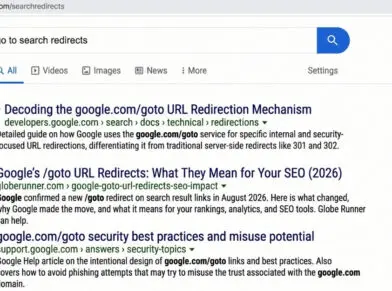



Google’s New /goto Search Redirects: What They Mean for Your SEO Strategy
Have you clicked a Google search result lately and noticed something different happening? Instead of a clean URL, you may have landed on an address containing google.com/goto?url= followed by a long string of encoded characters.
If you manage a website or a marketing budget, you may have some real questions. Is your organic traffic safe? Will this affect your analytics? Are your keyword rankings at risk?
The short answer: your website is not in danger. Google confirmed this update on August 26, 2026, and it changes how search clicks are routed, not how pages rank. Here is what’s actually happening and what it means for your strategy.
What Is a /goto URL Redirect?
In the past, clicking a Google search result took your browser straight to the destination page, or through a redirect that clearly showed where you were headed.
With the new /goto format, Google adds a routing step. When someone clicks an organic result, their browser is sent first to a Google-owned address like:
google.com/goto?url=[encoded string]
The destination site is no longer written out in plain text. It’s encoded, and Google’s server resolves it and issues a 302 redirect to the real page. For the person doing the searching, the click still works the same way. They land on the same page, just by way of one extra server-side hop.
Why Did Google Make This Change?
Google confirmed the rollout to Search Engine Land, calling it a technical measure against evolving forms of abuse. Google did not say who or what it’s targeting. AI companies and rank-tracking tools are the industry’s guess, not Google’s.
Here are the practical effects of the change:
- It raises the cost of scraping. SEO tools, competitor rank trackers, and AI models have long pulled ranking data by reading the links on a results page. With the destination hidden behind an encoded value, a tool now has to follow each redirect individually to find out where it leads. Across a page with hundreds of results, that adds up fast.
- It supports bot and abuse detection. Routing every click through a Google-owned checkpoint gives Google another point to evaluate whether traffic is coming from a real person or an automated script.
Taken together, this looks like an effort to protect proprietary search data from being harvested at scale by anyone, whether that’s a rank-tracking tool, a competitive intelligence platform, or an AI model pulling in search results to train on.
How This Affects Your Digital Marketing Strategy
Here is what matters for your day-to-day operations.
Rankings are not affected. Google is changing the container that delivers a click, not the algorithm that decides who ranks first. Strong content, sound technical health, and a legitimate backlink profile still drive results the same way they did before this update.
Search Console data is unaffected. Google’s own indexing and reporting systems still see your real page, and the redirect is a temporary (302) status, which signals it isn’t meant to replace your URL in any index.
Analytics attribution is worth watching, not worrying about. Because searchers still land on your actual page after the redirect, organic traffic should continue tracking normally in platforms like GA4 or HubSpot. Public reporting on this change hasn’t addressed referrer data or attribution edge cases directly, so we recommend clients watch organic traffic trends over the next few weeks rather than assume everything is unaffected by default. If you want a second set of eyes on your data and analytics tracking during this transition, that’s exactly the kind of thing we monitor for clients.
Your SEO tools may see some turbulence. Keyword tracking and SERP monitoring platforms now have to re-engineer how they collect ranking data. Expect temporary reporting glitches, and don’t be surprised if some providers raise prices to cover the added computing cost of following redirects at scale.
The Bigger Picture
This update is a reminder that the search landscape keeps shifting, and most of those shifts happen behind the scenes. This one is largely a backend measure aimed at automated data collection, not a signal that your SEO strategy needs an overhaul.
The best move right now is the same move that always works: keep your technical SEO foundation clean, keep publishing content that genuinely answers what your audience is searching for, and keep an eye on your reporting instead of reacting to every infrastructure change on day one.
As AI-generated search results and AI crawlers become a bigger part of how people find businesses online, moves like this one are also worth watching through the lens of AI Optimization, since visibility across both traditional and AI-driven search increasingly runs through the same technical groundwork.
If you want a strategy audit to confirm your site is holding steady through this update, schedule a call with our team. Globe Runner can help.
Your Website Is Losing Leads. Here Are 7 Signs It’s Time for a Redesign
Your website might look fine to you. But that doesn’t mean it’s working for your business. If leads have slowed down, or your phone isn’t ringing like it used to, your website could be the problem.
Many business owners don’t notice a struggling website until it shows up somewhere else, like a slow sales quarter or a marketing report full of low numbers. A website that used to work well can quietly stop working over time. Design trends change. Search engines update their rules. Visitor expectations shift. People are also turning to AI tools to research options and even shop, not just to search Google, and that’s changing how much traffic reaches your site and how it gets there. If you’re asking yourself, “Is my website hurting my business,” you’re asking the right question.
This guide covers seven clear signs you need a website redesign, plus what to do about it. Think of it as your website redesign checklist: the more of these red flags you recognize, the stronger the case for change.
1. Your Site Isn’t Mobile-Friendly
More than half of today’s web traffic comes from phones and tablets, not desktops. Your site doesn’t have to be broken to be losing leads on mobile. Outright broken layouts are rare these days. Most mobile problems are quieter than that: buttons placed too close together, text that’s technically readable but still strains the eye, forms that are a hassle to fill out on a small screen, or pages that shift around as they load. None of these send visitors running immediately, but they add friction, and friction adds up to lost leads before visitors ever get to know your business.
Google notices this friction too. Mobile-first indexing means Google looks at the mobile version of your site first when deciding how to rank you in search results, so a rough mobile experience can cost you rankings, not just visitors. Google’s mobile Core Web Vitals are a useful benchmark here, and your site should pass them. These metrics measure how quickly your page loads, how soon visitors can interact with it, and how stable the layout stays while it loads. A site that fails these checks tells Google what your visitors are already feeling: the mobile experience needs work.
A Quick Test
Pull up your website on your phone right now. Is the text easy to read without adjusting anything? Can you tap buttons and links accurately on the first try? Does the page load without jumping around as images and content settle into place? If any of that feels off, that’s a red flag your site needs attention.
2. Your Load Times Are Slow
Speed matters more than most people think. Search Engine Journal reports that visitors tend to abandon a page once it takes more than 2.5 seconds to load. Visitors don’t wait around. They leave, and they usually don’t come back.
Slow load times also hurt your search rankings. Google factors page speed into rankings, so a slow site can cost you visibility and leads at the same time.
If your homepage takes more than 2.5 seconds to load, it’s worth finding out why. Old code, oversized images, and outdated hosting are common culprits. So is a site built on an older platform that was never designed to handle today’s traffic or file sizes.
Speed problems tend to build up slowly. A site that loaded fine five years ago can slow to a crawl once you’ve added more pages, more images, and more plugins over time. A redesign gives you a clean starting point instead of layering more fixes onto an aging foundation.
3. Your Content Isn’t Structured for AI Search
Search has changed. AI-generated results are becoming a bigger part of how people find businesses online. Google has said that AI Optimization and generative engine optimization are extensions of SEO, not replacements for it. That means your website’s structure still matters, maybe more than before.
Structured data, also called schema markup, helps search engines and AI tools understand what your pages are about. Without it, your business might get skipped over in AI-generated summaries and answers, even when your content is solid.
A redesign is a good time to build this structure from the start, rather than patching it in later. Clear headings, organized content, and properly tagged pages all help both traditional search engines and newer AI tools understand your business and show it to the right people. Good page structure for generative AI search also makes it easier for these tools to pull accurate information about your business when they generate an answer.
4. Your Design Feels Outdated
First impressions happen fast. Visitors form an opinion about your business within seconds of landing on your site, often before they read a single word. An outdated design—think tiny fonts, cluttered layouts, or graphics that look like they belong on last year’s site—sends the wrong message before you get a chance to make your case.
An old design also makes people question if your business is still active or up to date. That’s a tough hole to dig out of, especially when you’re up against competitors with a fresher look and a faster site.
Design trends shift for real reasons, not just style. Newer layouts tend to load faster, work better on phones, and make it easier for visitors to find what they need. The way a site is designed also affects how well it performs in search results, so sticking with an old design usually means carrying old problems forward, not just an old look.
5. Your Navigation Confuses Visitors
If people can’t find what they need on your site, they leave. It’s that simple. Confusing menus, unclear labels, and pages buried three or four clicks deep all create friction for visitors who came ready to buy.
Good navigation should answer three questions right away:
- What does this business do?
- What do I do next?
- How do I get in touch?
If a first-time visitor can’t answer those questions within a few seconds, your navigation needs work.
6. Your Site Isn’t Built for Conversions
A website losing leads often has the same root problem: nothing on the page tells visitors what to do next. Maybe your calls to action sit buried at the bottom of a long page. Maybe your contact form asks for too much information. Maybe there’s no clear next step at all.
Every page on your site should point toward one path, whether that’s calling your business, filling out a form, or scheduling a consultation. If your site doesn’t guide visitors to a next step, it works against you instead of for you.
Think about the difference between a page that ends with plain text and one that ends with a clear button reading “Schedule a Free Consultation.” The second version tells visitors exactly what to do. The first one leaves them to figure it out, and most won’t bother.
7. You Don’t Know What’s Working
If you can’t say which pages bring in leads, or which ones visitors leave right away, you’re making decisions in the dark. Many outdated websites either lack working analytics entirely or have tracking set up years ago that was never updated.
A redesign is the natural point to fix this, since you’re already rebuilding pages and forms from the ground up. Setting up proper analytics tracking at the same time lets you see which pages bring in the most leads, where visitors drop off before converting, and which traffic sources actually turn into business, not just clicks. Without that visibility, you’re guessing. With it, every future decision about your site rests on real numbers, not hunches.
Is Your Website Hurting Your Business? Make a Change Now
Review the seven red flags above. Any of the first six indicators in our website redesign checklist can cost you leads on its own. And if your analytics aren’t up to date, you can’t tell which problems to fix or whether your changes are working. The more of these red flags your site shows, the faster those losses add up.
Knowing when to redesign your website comes down to one question: is your site helping people find and choose your business, or is it getting in the way? A slow, outdated, or confusing website doesn’t just look bad. It pushes potential customers toward competitors with a smoother experience.
A redesign doesn’t mean starting from zero. It means building a site that works for your visitors, your search rankings, and your bottom line, all at the same time. Seeing the signs you need a website redesign? Globe Runner’s website design experts can help you build a site made for both people and search engines, backed by data at every step.
How Small Businesses Can Compete with Big Brands in AI Search
AI search is changing who gets found first. Tools like Google AI Overviews, ChatGPT, and Claude now answer questions directly, often before users ever click a link. For years, that shift looked like bad news for small businesses. Big brands have bigger budgets, bigger content teams, and more backlinks.
But small-business AI search visibility doesn’t work the same way traditional rankings do. AI tools reward relevance, clarity, and trust over sheer size. That means a well-run small business can show up in an AI answer right next to a national brand, sometimes ahead of it. This guide covers what is actually changing and what you can do about it.
Why AI Search Levels the Playing Field
Traditional search rankings favor established domains with years of backlinks and content history. AI search works differently. AI Overviews and AI chat tools pull from a wider range of sources, including forums, review sites, niche publications, and pages that directly answer a specific question. Domain size matters less than how clearly a page answers what someone asked.
This is also why Globe Runner treats AI Optimization as an extension of SEO, not a replacement for it. Google has said as much in its own guidance. The fundamentals of good SEO, like clear content and strong technical signals, still determine what AI systems trust enough to cite.
What the data shows: When Google shows an AI Overview, pages cited inside it earn roughly a 2.1% click-through rate, compared to about 0.9% for pages on the same results page that are not cited, according to Search Engine Land’s coverage of a Seer Interactive study of over 5 million queries. Getting cited matters more than getting ranked.
Where Big Brands Fall Short in AI Search
Large companies are not automatically winning the AI search game. Several common big-brand habits work against them:
- Generic content. Broad, corporate-toned pages rarely give a direct enough answer to earn a citation.
- Slow adaptation. Bigger organizations often move slower to add structured data or restructure content for AI readability.
- Weak community presence. National brands are often absent from the forums, local groups, and Q&A platforms where AI tools pull real-world answers.
- Less detail. Big brands write for broad audiences. AI systems favor content that speaks directly to a narrow, real question.
This gives small businesses an opening. You already know the exact questions your customers ask. The work is making sure your content and your online presence reflect that knowledge in a way AI systems can find and trust.
How Small Businesses Can Build AI Visibility
AI optimization for small business owners comes down to a handful of concrete moves. If you want to know how to show up in AI answers, here is where to focus your effort.
Answer the Exact Questions Your Customers Ask
AI search rewards content built around real questions, not broad topics. Instead of a page titled “Plumbing Services,” write content that answers “How much does it cost to fix a running toilet in Dallas?” Direct answers to specific questions are far more likely to get pulled into an AI response.
Review your customer emails, calls, and reviews for the exact phrases people use. Those phrases often make the best headings and FAQ entries.
Strengthen Your Community SEO Presence
AI tools draw heavily on forums, niche communities, and Q&A platforms when they build an answer. This kind of visibility, often called Community SEO, is one of the clearest advantages a small business can build. Showing up in local Facebook groups, industry forums, Reddit threads, and review platforms builds the real-world signal AI systems treat as trustworthy.
Community SEO is not about posting everywhere. It is about being genuinely present and helpful in the specific communities where your customers already spend time.
Use Structured Data to Help AI Understand Your Content
Schema markup gives search engines and AI systems a clear, machine-readable summary of what your page is about. For a small business, this can be as simple as adding LocalBusiness, FAQPage, or Product schema to key pages. It does not require a large team, just accurate, consistent setup.
Prioritize E-E-A-T Signals
Experience, expertise, authority, and trust, the four pillars of E-E-A-T, matter even more for smaller sites that do not have decades of domain authority to lean on. Showing real experience, author bios, verifiable credentials, and honest customer proof gives AI systems a reason to trust your content over a page with no clear author or source.
Keep Content Specific and Locally Relevant
National brands cannot easily copy deep local or niche expertise. A small business that writes about a specific neighborhood, customer type, or problem builds relevance that a big brand’s broader content usually cannot match. Lean into that instead of trying to sound like a bigger company.
Measuring AI Visibility as a Small Business
Traditional rank tracking does not show whether your business shows up inside an AI answer. To measure real progress, track:
- How often your brand or content gets mentioned or cited across AI platforms, not just search engine results pages.
- Which questions or topics trigger a citation of your content.
- Referral traffic coming from AI tools, tracked separately from standard organic traffic in your analytics.
This is exactly what BrandVisibility.ai was built for. It shows small businesses (and large companies, as well) whether and how often they are showing up in AI-generated answers, so you can see what is working instead of guessing.
FAQs about AI Search for Small Businesses
What is AI search optimization?
AI search optimization is the practice of structuring content, data, and online presence so AI tools like Google AI Overviews, ChatGPT, and Perplexity can find, understand, and cite your business in generated answers.
Can small businesses really compete with big brands in AI search?
Yes. AI systems prioritize relevance, clarity, and trust over domain size. A small business with specific, well-structured content can be cited ahead of a larger competitor with generic content.
How is AI search different from traditional SEO?
AI search pulls from a wider range of sources, including forums and community platforms, and often answers a question directly instead of listing links. The core principles of good SEO, like clear content and trust signals, still apply and support AI visibility.
How do I know if my business shows up in AI answers?
Standard rank trackers do not show AI citations. Tools built specifically for AI visibility tracking, like BrandVisibility.ai, show whether and how often your business appears in AI-generated responses.
Building an AI Visibility Strategy That Grows With You
AI search is not a one-time fix. AI models retrain, update, and change how they source answers on an ongoing basis. An AI visibility strategy for small business success needs to be a living process, not a single project.
That means regularly updating content to reflect new customer questions, staying active in the communities where your audience already trusts you, and reviewing your AI citation data the same way you would review your search rankings.
Competing with big brands in AI search is not about matching their budget. It is about being more direct, more present, and more trustworthy in the exact places AI systems look for answers.
Ready to build an AI visibility strategy that fits your business? Talk with Globe Runner about AI Optimization and see where you stand today.
Why Internal Linking Is Your Most Underused SEO Asset
Most businesses spend their SEO budget chasing new backlinks and publishing more content. Meanwhile, one of the most useful tools for improving rankings sits inside their own website, untouched. That tool is internal linking SEO, and most sites are barely using it.
Internal links connect one page on your site to another. They sound simple, and they are. But when they’re organized with intent, they change how search engines understand your site and how visitors move through it. When they’re ignored, your best content ends up buried, and your rankings stall even as you keep adding new pages.
AEO gets most of the attention right now, but organic search still drives the overwhelming majority of website traffic. A 2026 industry benchmark found that AI referral traffic accounts for just over 1% of total web visits across major industries, while organic search continued to dominate site visits everywhere. Traditional search isn’t going anywhere, and internal linking still matters just as much for it as it does for AI visibility.
This post breaks down what internal linking SEO actually does, how to tell if yours needs work, and a practical framework for fixing it.
What Internal Linking Actually Does for Your SEO
Internal links for SEO do three specific jobs.
They help search engines find and understand your pages. Google discovers new and updated content by following links. A page with no internal links pointing to it, often called an orphan page, is harder for search engines to find and may never get indexed at all.
They spread authority across your site. When an established, high-ranking page links to a newer or weaker one, it passes along some of its credibility. This is often called link equity. Without internal links directing that equity, your strongest pages hoard their value instead of sharing it.
They guide visitors to what matters. A reader on your blog who clicks through to a related service page is a reader getting closer to a decision. Internal links create that path.
There’s a newer piece to this too. AI-powered search tools and chatbots pull information by moving across a site’s pages, much like a search engine crawler does. A site with a clear, logical link structure is easier for these tools to read, summarize, and cite. That means a strong internal linking strategy doesn’t just help you rank on Google. It helps you show up in AI-generated answers, too.
In May 2026, Google published official guidance on optimizing for its generative AI search features. According to Search Engine Journal’s coverage of the announcement, Google told site owners they could skip a number of tactics that had been heavily marketed as necessary for AI visibility. Internal linking wasn’t on that list. Google’s point was that AI-focused search is still built on the same SEO fundamentals that have mattered for years, and internal linking is one of them.
Signs Your Internal Linking Strategy Needs Work
Before fixing anything, it helps to know what’s actually broken. A few common warning signs:
- Orphan pages. Content with no other page on your site linking to it.
- Buried priority pages. Your most important pages sit four, five, or more clicks from the homepage.
- Repetitive or missing anchor text. Every link says “click here” or “read more,” or every link uses the exact same keyword phrase.
- Keyword cannibalization. Multiple pages compete for the same search term because internal links never established which one should rank.
- Old content nobody revisits. Blog posts from a year ago that have never been linked to newer, related pages.
If any of these sound familiar, your website internal link structure is working against you instead of for you.
How to Improve Internal Linking: A Practical Framework
Fixing internal linking doesn’t require a full site rebuild. It requires a plan and some consistency. Here’s where to start.
Build pillar pages and topic clusters
Group related content around one central, authoritative page, often called a pillar page. Supporting posts on narrower subtopics link back to that pillar, and the pillar links out to them. This structure tells search engines exactly how your content connects and which page should carry the most weight for a given topic. If you want a deeper look at how this works, we’ve covered how topic clusters build topical authority in more detail.
Keep priority pages close to the homepage
A widely followed rule of thumb in SEO is to keep your most important pages within three clicks of the homepage. The deeper a page sits, the less often it gets crawled and the less authority it receives. If a page matters to your business, it shouldn’t take a visitor five clicks to find it.
Use anchor text that actually describes the destination
Anchor text is the clickable phrase in a link. It should tell both the reader and the search engine what they’ll find on the other end. Skip generic phrases like “learn more,” and skip stuffing the exact keyword into every single link. Vary the phrasing naturally, the same way you’d vary word choice in normal writing.
Link with purpose, not just to hit a number
There’s no perfect count of links per page. What matters more is relevance. A long, detailed post might naturally support several internal links because it touches several related topics. A short page might only need one or two. Add a link because it genuinely helps the reader, not because you’re trying to reach a target.
Prioritize links inside your main content
A link buried in a footer or sidebar carries far less contextual weight than one placed naturally inside a paragraph. Search engines read body content as the strongest signal of what a page is actually about, so that’s where your most important internal links should live.
Audit your site on a regular schedule
Broken links, redirect chains, and outdated URLs build up over time. A recurring audit, even a simple one, catches these issues before they quietly drag down your rankings.
Building a Website Internal Link Structure That Scales
Picture your site as a pyramid. The homepage sits at the top. Below it are a handful of pillar pages representing your core topics or services. Below those are supporting pages that go deeper into specific subtopics, each one linking back up to its pillar and, where relevant, sideways to closely related supporting pages.
This shape does two things at once. It keeps your site organized in a way real visitors can follow, and it gives search engines a clean map of how your content relates. Every new piece of content you publish should have a home in that structure from day one, not get added and forgotten.
Common Internal Linking Mistakes to Avoid
- Linking without a reason. If a link doesn’t help the reader or clarify the site’s structure, it doesn’t belong.
- Overloading a single page. Cramming dozens of internal links onto one page dilutes the value each one carries.
- Ignoring old content. Older posts are often left out of the linking structure entirely, even when newer content could send them relevant traffic.
- Letting broken links pile up. A dead internal link wastes the value that link was supposed to pass along.
How Globe Runner Approaches Internal Linking
Internal linking isn’t a one-time task. It’s an ongoing part of how a site should be maintained, and it works best alongside the rest of your technical SEO. We treat link structure as part of a broader technical SEO audit, reviewing crawl depth, orphan pages, and site architecture together rather than in isolation.
Once the technical foundation is solid, the content itself needs to support that structure. Our content optimization work includes building the kind of topic clusters and pillar pages that make internal linking effective in the first place.
We also look at how a site’s structure affects visibility beyond traditional search. Our BrandVisibility.ai tool shows how a website’s content and structure are actually performing in AI-generated search results, which is increasingly shaped by how easily a site can be crawled and understood.
FAQs about Internal Linking for SEO
What is internal linking in SEO?
Internal linking is the practice of connecting pages within the same website using hyperlinks. It helps search engines discover and understand content, and it helps visitors navigate between related pages.
How many internal links should a page have?
There’s no fixed number that works for every page. The right amount depends on the page’s length and how many genuinely related topics it touches. Focus on relevance over hitting a specific count.
What’s the difference between internal linking and backlinks?
Internal links connect pages within your own website. Backlinks come from other websites linking to yours. Both pass authority, but they work differently and require different strategies to build.
Can internal linking help with AI search visibility?
Yes. AI-powered search tools and chatbots read a site’s structure to understand and summarize its content, similar to how traditional search crawlers work. A clear, well-organized internal link structure makes it easier for these tools to find and cite your pages.
Your Internal Linking Strategy Starts With What You Already Have
You don’t need a bigger content budget or a new batch of backlinks to see movement in your rankings. You likely already have the pages you need. What’s missing is the structure connecting them. A deliberate internal linking strategy costs nothing but time, and it’s one of the few SEO improvements you can start today with the content you already have.
If you’re too busy to handle this yourself and want a full SEO program behind it, schedule a time to talk with our team.
Structured Data in 2026: The Schema Markup That AI Actually Uses
Search has changed. When someone asks Google, ChatGPT, or Perplexity a question today, they often get a direct answer before they ever click a link. That answer has to come from somewhere. More often than not, it comes from a page that made it easy for AI to understand its content.
That’s what structured data does. It doesn’t just help search engines index your pages. It tells AI systems exactly what your content means, who you are, and why your answer is credible. In 2026, that distinction matters more than ever.
This post covers the schema types that are actually driving AI visibility right now, what most sites are getting wrong, and how to audit your structured data for the search landscape we’re operating in today.
What Structured Data Actually Does in 2026
Structured data is code added to a web page, typically in JSON-LD format, that gives machines a clear, labeled description of your content. Instead of forcing an AI to interpret your page through natural language alone, schema markup tells it directly: this is an article, this is an organization, this is a product, this is an author.
For years, structured data’s main benefit was visual. It could earn rich results in Google Search, such as star ratings, FAQ rich result dropdowns, and breadcrumb trails that make your listing stand out. FAQ rich results, introduced in 2019, were expandable Q&A panels that appeared directly beneath a specific website’s search listing.
They were never widespread, appearing more often in informational and health-related content than on commercial pages, and they became targets for manipulation as sites added keyword-stuffed FAQ sections purely to take up more space in search results. Google began restricting them to government and health sites in August 2023, and removed them entirely on May 7, 2026. That era is winding down more broadly. Google has also retired HowTo rich results (2023). Most of those visual search enhancements are gone.
What has replaced them is more significant. Both Google and Microsoft have confirmed that structured data helps their AI systems understand, verify, and cite content. Search Engine Land reported that Google’s Search team confirmed structured data gives an advantage in search results, and Microsoft Bing’s principal product manager confirmed schema helps their LLMs understand content for Copilot. For AI systems, schema is a trust signal, not a display trigger.
The goal of structured data in 2026 is machine clarity. When your schema accurately reflects your content, AI systems can confidently resolve who you are, what you offer, and whether your content is worth citing.
The Schema Types AI Engines Actually Use
The schema.org vocabulary includes more than 800 types. Only a fraction of them move the needle for AI visibility. Here are the ones worth prioritizing.
Organization
This is the foundation. Organization schema establishes your brand’s identity across the web. It provides AI systems with your name, official URL, logo, contact details, and how you connect to other entities. Think of it as your brand’s permanent record. Without it, AI systems have to guess who you are, and that ambiguity reduces citation confidence. Use sameAs properties to link to your social profiles and authoritative directories. This reinforces consistency across the web and helps AI engines verify your identity against multiple sources.
Article / NewsArticle
For blog posts and editorial content, Article schema tells AI systems what a piece of content is, who wrote it, when it was published, and when it was last updated. The dateModified property is often overlooked but important. AI Overviews and AI Mode favor recent, well-attributed content. Including a properly marked-up author with their own Person schema, tied to an author bio page, adds another layer of credibility.
BreadcrumbList
Breadcrumb schema communicates your site structure. It shows AI systems where a page sits within your broader content hierarchy. This is less about citation and more about entity context. A page on “technical SEO services” that’s clearly nested under a parent “SEO services” section is easier for AI to place accurately than a page that appears to exist in isolation.
Product and Offer
For e-commerce and service-based businesses, Product and Offer schema make your inventory machine-readable. AI shopping agents and Google AI Mode use this data to surface product recommendations and make purchase comparisons. Pages with complete Product schema, including pricing, availability, and ratings, see meaningfully higher visibility in AI-driven commerce queries.
Review and AggregateRating
Review schema gives AI systems quantified sentiment data. When combined with AggregateRating, it provides a score, a count, and a credibility signal that AI systems can use to compare options. This is especially valuable for local businesses and service providers, where trust signals influence AI answer selection.
LocalBusiness
For businesses with a physical location or a defined service area, LocalBusiness schema is essential. It feeds the data that AI systems use to answer queries like “best SEO agency near me.” The key is alignment: your LocalBusiness schema should match your Google Business Profile exactly. Inconsistencies between the two reduce AI citation confidence.
What Most Sites Get Wrong
Technically valid schema and strategically effective schema are two different things. A page can pass Google’s Rich Results Test with no errors and still contribute almost nothing to AI visibility. Here’s where most implementations fall short.
Schema that doesn’t match the page. This is the most common mistake, and the most consequential. AI systems check for consistency between what your markup claims and what your visible content says. Schema that describes content that isn’t actually present, or isn’t the primary focus of the page, reduces trust as a signal. Accurate markup that reflects real content is what gives AI systems the confidence to cite you.
Incomplete entity relationships. Schema works best when it tells a connected story. An Article linked to an Author, linked to an Organization, linked to a website is far more legible to AI than three disconnected schema blocks. Using @graph and @id in your JSON-LD builds an internal knowledge graph that AI systems can follow.
Misunderstanding what FAQPage schema is still good for. Google removed FAQ rich results from Search on May 7, 2026, and deprecated HowTo rich results on desktop in 2023. Neither change made these schema types useless. Both remain valid schema.org types. For non-Google platforms like Bing and Perplexity, FAQPage markup can help AI systems identify and parse Q&A content on your pages. For Google AI Overviews and AI Mode, Google has not confirmed a direct connection between FAQPage schema and AI citation, but the markup doesn’t hurt, and the underlying Q&A content still matters. The difference is where the value lives. FAQPage schema no longer earns you a FAQ rich result in search listings, but if your page has genuine Q&A content, keeping the markup is still a reasonable part of an AI optimization strategy. What’s no longer worth doing is adding FAQ sections specifically to grab more space in traditional search results. That use case is gone.
Boilerplate implementation. Copying a schema template and filling in the minimum fields produces minimum results. Optional properties, things like author, image, dateModified, sameAs, and description, are what give AI systems the context they need to cite your content confidently rather than skip it.
How to Audit Your Structured Data for AI Visibility
A structured data audit in 2026 differs from checking for rich results eligibility. The goal is to evaluate whether your schema accurately represents your content and provides clear entity signals for AI systems.
Start with Google Search Console. The Enhancements section shows schema errors and warnings across your site. Prioritize pages with high impressions and low AI Overview appearances. Those are the pages where better schema implementation has the most room to make a difference.
Use Google’s Rich Results Test to validate individual pages. Even though fewer schema types produce rich results today, the tool is still the most reliable way to confirm that your JSON-LD is syntactically correct and that your markup matches your visible content.
For a full picture of how your brand appears in AI-generated answers, that’s where a tool like BrandVisibility.ai comes in. It tracks how your brand is cited, described, and surfaced across AI platforms such as Google AI Overviews, ChatGPT, and Perplexity. Traditional rank tracking doesn’t capture AI citation frequency. BrandVisibility.ai does.
Once you’ve identified gaps, prioritize fixes by page value. Start with your highest-traffic pages and your core service or product pages. These are the pages where AI citation has the most direct impact on lead generation and conversions. If you’re not sure where to begin, our technical SEO services include a structured data audit as part of a broader site health review.
What to Prioritize in 2026
If you’re deciding where to focus your structured data efforts, here’s a practical order of operations:
- Get Organization schema right first. Brand identity is the foundation of trust in AI. If AI systems can’t reliably resolve who you are, everything else is harder.
- Add Article schema to every blog post and editorial page. Include author, publisher, datePublished, and dateModified. Link your author entities to real author bio pages.
- Implement BreadcrumbList site-wide. It costs little and communicates a lot about your content architecture.
- Add Product, Offer, and Review schema to any page where a transaction or decision is involved. This includes service pages, not just e-commerce listings.
- Use @graph to connect your entities. Don’t let schema blocks sit in isolation. Link your Article to its Author to your Organization. That connected structure is what makes schema work as a knowledge signal, not just a label.
Our AI Optimization service is built specifically around this kind of structured visibility work, from schema audits to entity optimization to ongoing monitoring across AI platforms.
Frequently Asked Questions
Does schema markup directly affect AI search rankings?
Not in the way traditional ranking factors do. Google has stated that no special schema is required for AI Overviews or AI Mode. What schema does is reduce ambiguity. When AI systems can clearly verify your content, your brand, and your authority, they’re more likely to cite you. It’s a trust and clarity signal, not a ranking switch.
What is the most important schema type for AI visibility?
Organization schema. Establishing clear, consistent brand identity is the first thing AI systems use to evaluate whether a source is reliable. Without it, every other schema type you implement has less to anchor to.
Is FAQPage schema still worth using?
It depends on the platform. Google removed FAQ rich results from Search on May 7, 2026, so the FAQ rich result benefit is gone. For Google AI Overviews and AI Mode, Google has not confirmed that FAQPage schema directly influences AI citation. For other platforms like Bing and Perplexity, the markup can help AI systems parse Q&A content more cleanly. It’s also worth noting that FAQPage schema does not directly influence People Also Ask appearances. PAA is driven by content quality and relevance, not markup. If your page has genuine questions and answers that help users, keeping the markup is reasonable and costs nothing. The tactic that’s no longer viable is adding FAQ sections purely to earn more real estate in traditional search results.
How do I know if my structured data is working?
Google Search Console shows schema errors and rich result performance. For AI-specific visibility, you need a tool that tracks how your brand appears in AI-generated answers. BrandVisibility.ai tracks citation frequency and brand presence across AI platforms, which standard analytics tools don’t capture.
The Bottom Line
Structured data isn’t a technical checkbox. It’s how you communicate with AI systems at scale. The brands getting cited in AI Overviews and AI Mode aren’t there by accident. They’ve built content that AI can read, verify, and trust.
That starts with accurate, complete schema markup tied to real content. It continues with entity relationships that connect your brand, your authors, and your content into a coherent picture. And it’s measured with tools that track AI visibility, not just traditional rankings.
If you want to understand how your site is performing in AI search today, Globe Runner’s SEO team can help you close the gap between where you are and where AI-driven search is going. Schedule a free intro call to get started.
Questions to Ask an SEO Agency Before You Hire
Most businesses don’t realize they’ve hired the wrong SEO agency until months of budget are gone and nothing has moved. Rankings are flat. Traffic is stagnant. The monthly report is full of charts that don’t connect to revenue.
SEO is a long-term investment, and switching agencies mid-stream costs time, money, and momentum. That’s why the evaluation process matters so much before you sign anything.
This guide gives you a practical framework for how to choose an SEO agency with confidence, covering what to look for, the right questions to ask, and the red flags that should stop you cold.
What to Look for in an SEO Agency
Not every agency that calls itself an SEO firm is actually equipped to move the needle for your business. Here’s what to look for in an SEO agency during your evaluation:
- Verifiable results, not just logo walls. Any agency can display brand logos on a website. Ask for specific results, the strategy behind them, and a timeline. If they can’t walk you through a real example, that’s a problem.
- Transparency in process and reporting. You should always know what’s being done, why it’s being done, and how it’s performing. Vague monthly reports are a warning sign.
- A fit for your business type. B2B SEO, B2C SEO, local SEO, and national SEO are different disciplines. Make sure the agency has experience with businesses that look like yours.
- Current expertise, not just traditional SEO. Search has changed. The agency you hire should have a clear strategy for both traditional rankings and visibility in AI-generated search results.
- A real team behind the pitch. Know who will actually work on your account. A polished sales team backed by junior offshore contractors isn’t the partnership you’re paying for.
A strong agency can speak to results they’ve driven in your industry. If they can’t point to anything relevant, that’s worth noting.
Does the Agency Understand AI Search?
Google isn’t the only place people find businesses anymore. ChatGPT, Perplexity, Gemini, and Google’s AI Overviews are reshaping the way buyers access information. When someone asks an AI tool about the best vendor in your category, your brand either shows up in that answer or it doesn’t.
An agency that only optimizes for traditional search results is already working with an incomplete picture. Generative Engine Optimization (GEO) is the practice of ensuring your brand is cited and referenced in AI-generated answers, not just ranked on a list of blue links.
When evaluating an agency, ask:
- Do they understand the difference between traditional SEO and AI Optimization?
- Can they explain how AI models decide which sources to cite?
- Do they have a strategy for earning brand mentions in AI-generated results?
- How are they measuring your AI search footprint alongside traditional rankings?
At Globe Runner, we built BrandVisibility.ai specifically to answer that last question. It’s a proprietary tool that measures how and where your brand appears in AI-generated search results, giving you real data instead of guesswork. Most agencies are still treating AI search as a future problem. We’re tracking it for our clients right now.
Traditional SEO tells you where you rank on Google. AI Optimization tells you whether your brand appears when AI tools answer the questions your customers ask.
What to Ask During the Evaluation Process
Use these questions to ask an SEO agency as a filter — the right partner will welcome every one of them. A weak one will dodge them or give you rehearsed non-answers.
- How do you approach keyword research, and what tools do you use?
- Who will be working on my account day-to-day?
- How do you report progress, and how often? Ask to see a sample report.
- What KPIs do you track beyond rankings? Traffic, conversions, and revenue impact should be part of the conversation.
- How do you stay current with algorithm updates and AI search changes?
- Can you show results you’ve achieved for a business like mine?
- What does success look like at 3 months, 6 months, and 12 months?
- Do you offer AI Optimization, and how do you measure it?
- What tools do you use to track visibility in AI-generated search results?
Pay attention to how they respond, not just what they say. Confident, specific answers signal experience. Vague language or deflection signals you may be getting sold a service they don’t fully understand.
SEO Agency Red Flags to Watch Out For
Knowing what to look for in an SEO agency also means knowing what to walk away from. These are the biggest SEO agency red flags:
- Guaranteed #1 rankings. No one can promise a specific ranking. Google doesn’t work that way, and any agency claiming otherwise is misleading you.
- Vague deliverables. “We’ll improve your SEO” is not a strategy. You should receive a clear scope of work with defined activities and timelines.
- No access to your own data. You should always own and have direct access to your Google Analytics, Google Search Console, and any reporting dashboards. An agency that controls your data controls your leverage.
- Tactics they won’t explain. Good SEO is not a black box. If an agency won’t walk you through their methodology, assume the reason isn’t flattering.
- Lock-in contracts with no performance accountability. Long contracts aren’t inherently bad, but there should be defined benchmarks and a clear path to exit if performance falls short.
- Pricing that seems too good. Unusually low rates often signal low-quality link schemes, outdated tactics, or work being outsourced to vendors who don’t understand your market.
- No mention of AI search. If you go through an entire pitch and the agency never brings up AI Overviews, GEO, or how they’re thinking about generative search, they’re behind. This isn’t a future consideration anymore.
What the Hiring Process Should Actually Look Like
A strong agency doesn’t just send you a proposal and wait. Here’s what a well-run process looks like when hiring an SEO company:
- Discovery call before the proposal. The agency should want to understand your business, goals, competitive landscape, and current performance before recommending anything.
- A site audit before you sign. Any credible agency should be willing to do at least a high-level audit of your current site. This shows they’ve done their homework and helps set realistic expectations.
- Strategic thinking, not just a task list. You want to see that they understand the “why” behind their recommendations, not just a checklist of deliverables.
- They bring up AI search without being prompted. A forward-thinking agency raises the topic on its own. If you have to ask about it, they’re probably playing catch-up.
The sales process is a preview of the working relationship. If communication is slow, vague, or hard to follow before the contract is signed, it won’t improve after.
Why the Right Agency Pays for Itself
A bad SEO hire doesn’t just waste money. It can take months to reverse the damage from poor practices, and the opportunity cost of flat organic growth compounds over time.
The right partner builds visibility that grows on its own. Organic traffic isn’t a one-time campaign. Done well, it becomes a compounding asset. A well-optimized page can generate leads for years without ongoing paid spend.
With AI search now influencing buying decisions before a user ever clicks a link, AI Optimization is part of that asset. Brands that appear in AI-generated answers are reaching buyers earlier in the research process, before they’ve started comparing options.
Globe Runner’s approach combines traditional SEO fundamentals with AI Optimization and BrandVisibility.ai-powered measurement. You get a clear picture of where you stand, what’s being done, and what it’s producing.
Ready to see where your brand stands in AI search? Request a free audit, and we’ll show you what you’re working with.
Frequently Asked Questions
How long does SEO take to show results?
Most businesses see meaningful movement within 3 to 6 months, with stronger results building over 12 months and beyond. SEO is cumulative. The longer you invest in it consistently, the more durable the results become.
What’s the difference between SEO and AI Optimization?
Traditional SEO focuses on ranking your website in search engine results pages (SERPs). AI Optimization, also called Generative Engine Optimization (GEO), focuses on ensuring your brand is cited and referenced in answers generated by AI tools such as ChatGPT, Perplexity, and Google’s AI Overviews. Both matter. Increasingly, buyers are starting their research in AI tools rather than search engines.
How much should I pay for SEO services?
Quality SEO for a mid-sized business typically ranges from $2,500 to $10,000 per month, depending on market competitiveness, the scope of services, and whether AI Optimization is included. Be cautious of pricing well below that range. Unusually low rates are a reliable signal that something important is being cut.
What makes Globe Runner different from other SEO agencies?
A few things set us apart. We built BrandVisibility.ai, a proprietary tool for measuring brand visibility in AI-generated search results, because we saw this shift coming before most agencies were paying attention. We combine that with deep technical SEO, content strategy, and a reporting structure that ties everything back to business outcomes rather than vanity metrics.
How do I know if my SEO agency is actually working?
You should see consistent movement in organic traffic, keyword rankings, and conversions tied to organic sessions. A good agency shows you the data behind those numbers, explains what’s driving changes, and connects SEO performance to pipeline and revenue. If your monthly report is just a rankings table with no context, ask for more.
What is Generative Engine Optimization (GEO)?
GEO is the practice of optimizing your content, brand authority, and digital footprint so that AI tools reference your brand when generating answers. Where traditional SEO earns you a spot on a results page, GEO earns you a mention inside the answer itself. As more buyers turn to AI tools for research, GEO is becoming a critical part of any complete SEO strategy.
Best Content Formats for SEO in 2026: What Actually Earns Rankings
You can publish content every week and still see flat organic traffic. Why? Because the format matters as much as the topic.
In 2026, Google’s ranking systems, AI-powered search summaries, and answer engines don’t treat all content the same. They reward content that matches search intent, earns engagement, and demonstrates authority, and certain formats do that far more consistently than others.
At Globe Runner, we’ve spent nearly two decades tracking what works across hundreds of client campaigns. This post breaks down the best content formats for SEO right now — the content types for organic traffic that consistently earn rankings, backlinks, and AI citations — and how to build a format strategy that compounds over time.
“ The question isn’t whether to create content, it’s whether you’re creating content in formats that search engines can reward and audiences actually consume. ”
— Linda White
President, Globe Runner
At a Glance
- Format determines performance. The wrong query format won’t earn a ranking, no matter how well written the content is.
- Long-form blog content anchors every strong SEO strategy. Posts between 2,000 and 4,000 words earn more backlinks, rank for more keywords, and generate more AI citations than shorter content.
- Blog and video are not competitors — they’re partners. Blogs earn rankings and backlinks; video drives dwell time and dual-platform visibility. Use both.
- AI citations are the new search real estate. Generative Engine Optimization (GEO) is the next evolution of SEO, and most brands haven’t started yet.
- Pillar pages and topic clusters compound over time. Topical authority grows with every backlink, internal link, and citation well-structured content architecture earns.
- Measure formats against the right metrics. Blog posts belong to rankings and backlinks. Video belongs to watch time. Tracking the wrong metric leads to poor strategic decisions.
Why Content Format Matters for Organic Traffic
Google doesn’t just index your words. It analyzes how users interact with your content, how it’s structured, whether it answers intent, and whether other credible sources reference it. The format you choose shapes all of those signals.
Here’s the core insight: different content types for organic traffic serve different stages of the funnel and different search intents. A keyword like “how does content marketing work” calls for an educational long-form guide. A keyword like “content marketing agency Dallas” calls for a persuasive service page. Using the wrong format for either query won’t earn a ranking, no matter how well written the content is.
In 2026, there’s an additional layer: AI Overviews, voice search, and LLM-based answer engines now draw on structured, authoritative, and clearly formatted content. If your AI optimization strategy isn’t built into every content format you publish, you’re leaving organic visibility on the table.
Key stats:
- 68% of online experiences begin with a search engine. (BrightEdge, via Ahrefs)
- Long-form content earns significantly more organic traffic than short posts. (DemandSage Content Marketing Statistics 2026)
- B2B buyers do a significant amount of their own research before contacting sales, and blogs are one of the primary sources of information. (Powered by Search)
High-Performing Content Formats in 2026
According to HubSpot, content marketing generates 3x more leads than outbound marketing at 62% lower cost, and the content marketing formats below are where that performance is concentrated. These are the high-performing content formats in 2026 that should be the foundation of any organic growth strategy. Each serves a specific role in a well-built content strategy.
Long-Form Blog Posts
2,000–4,000-word guides that cover a topic in depth. These are the top-funnel and mid-funnel authority builders of any SEO strategy. Long-form content gives Google more signals to work with, more keywords, more topical coverage, more internal linking opportunities, and consistently outranks thin content for competitive queries.
Video Content
YouTube SEO and embedded video increase dwell time and earn backlinks from social shares. Video content ranks in both YouTube search results and Google’s universal search results, giving brands a dual-traffic advantage that text alone can’t achieve.
Data and Research Posts
Original data and statistics pages earn editorial backlinks and citations at scale. A single well-promoted research post can generate dozens of referring domains and serve as a citation source in AI-generated answers for months after publication.
Interactive Tools
Calculators, quizzes, and assessments generate organic links and repeat visits. Interactive tools convert passive readers into engaged users, who then send strong behavioral signals to Google.
FAQ and Q&A Content
Structured question-and-answer content dominates featured snippets and AI summaries. FAQ sections belong on every service page and guide. They mirror how people phrase their searches and how AI engines retrieve answers.
Comparison Pages
“X vs. Y” and “best [category]” pages capture high-intent, purchase-ready search traffic. These pages often rank for multiple bottom-funnel keywords simultaneously and drive some of the highest conversion rates of any content format.
Blog vs. Video for SEO: Which Format Wins?
The blog vs. video for SEO debate is one of the most common questions we hear from clients. Here’s the honest answer: both formats win, but for different reasons. Understanding the blog vs. video SEO distinction is what separates brands that build a smart content mix from those that chase one format at the expense of the other.
What Blog Content Does Best
Text-based content is still the foundation of most organic search strategies. Google was built on text. Structured, keyword-rich blog posts get crawled efficiently, earn featured snippets, and convert AI Overview citations. A well-optimized long-form guide can rank for dozens of related queries simultaneously, something video rarely achieves.
- Indexable by all major search engines without a transcript
- Easier to target multiple keywords in a single piece
- Lower production cost at scale
- More effective for earning editorial backlinks from publications
- Easier to update as rankings shift
What Video Content Does Best
Video doesn’t replace blog content, it amplifies it. YouTube is the second-largest search engine in the world. Video content earns significantly higher engagement rates, keeps users on a page longer, and can rank in both YouTube results and Google’s universal search results simultaneously.
- Higher average dwell time, which signals content quality to Google
- Dual-ranking opportunity: YouTube + Google SERPs
- Stronger shareability and social amplification
- Builds brand trust at a level text rarely matches
- Transcripts can be repurposed as blog content
| Factor | Blog Content | Video Content |
| Google indexing speed | Fast | Requires transcript |
| Keyword targeting flexibility | High | Moderate |
| Dwell time impact | Moderate | High |
| Backlink earning potential | High | Lower (social links) |
| YouTube ranking opportunity | No | Yes |
| Production cost at scale | Low | Moderate–High |
| AI citation potential | High | Growing |
| Content repurposing options | Moderate | High |
“ The best-performing content programs use blog content as the SEO anchor and video to extend reach and deepen engagement. A long-form blog post paired with an embedded explainer video on the same topic consistently outperforms either format alone. ”
— Eric McGehearty
CEO, Globe Runner
Content Marketing Formats That Earn AI Citations
In 2026, a growing percentage of search traffic never clicks through to a website. AI Overviews, ChatGPT Search, and Perplexity pull directly from on-page content and summarize it for users. If your content isn’t structured to earn citations in those systems, you’re missing a significant channel for visibility.
This is where Generative Engine Optimization (GEO) comes in. GEO is the practice of structuring and formatting content specifically to earn visibility in AI-generated answers — the next evolution beyond traditional SEO. Brands that build GEO into their content process now are building AI search visibility that competitors are only now considering.
These content marketing formats are best positioned to earn AI citations:
1. Definitive Guides with Structured Headings
Long-form content organized with clear H2 and H3 headers maps well to how LLMs parse and attribute information. Use keyword-aligned subheadings that mirror how people phrase questions.
2. FAQ Sections
Structured Q&A content directly mirrors how AI answer engines retrieve and display information. Every service page and guide should include an FAQ section optimized for question-based queries.
3. Original Data and Research
AI systems and journalists cite original data because it’s a primary source. A single original data post, including survey results, proprietary analytics, or industry benchmarks, can earn citations for months or years after publication.
4. Community-Driven Content
This is where most brands miss an opportunity. Content published in Reddit threads, LinkedIn forums, Quora answers, and niche community platforms now surfaces in AI-generated responses. Engaging in Community SEO helps brands build presence across these high-citation surfaces.
How to Build a High-Performing Content Mix
Most brands make one of two mistakes: they publish only one content type (usually short blog posts), or they produce a wide variety of content without strategic prioritization. Neither approach builds momentum over time.
A strong SEO content strategy is built around format, funnel stage, and search intent working together. The most durable approach uses a pillar page and topic cluster model: a comprehensive cornerstone piece supported by a network of related, intent-specific content. This structure signals topical authority to Google and creates a compounding asset that grows in value over time. Distributing effort across format types based on funnel stage looks like this:
- Top of funnel (awareness): Long-form educational guides, video explainers, and data-driven posts targeting informational queries
- Middle of funnel (consideration): Comparison pages, case studies, webinars, and FAQ content targeting evaluation-stage queries
- Bottom of funnel (conversion): Service pages, landing pages, and customer testimonials targeting commercial intent queries
- Authority amplification: Original research, comprehensive resource guides, and community content that earns backlinks and AI citations across all stages
The 70/20/10 Rule for Content Formats
The 70/20/10 rule still applies in 2026: 70% of your content budget on proven formats (long-form blog, evergreen content), 20% on emerging formats (video, interactive tools), and 10% on experimental content. Evergreen content — guides, comparison pages, and FAQ resources that remain relevant for years — is the backbone of any lead-generation content strategy. It keeps working long after the publish date and compounds in authority with every backlink and citation it earns.
What to Measure: Content Performance Metrics by Format
Every content marketing format has a primary performance signal. Knowing which content marketing formats to measure, and against which metrics, keeps your strategy grounded in real data rather than vanity numbers.
| Content Format | Primary Metric | Secondary Metric |
| Long-form blog posts | Organic keyword rankings | Backlinks earned |
| Video content | Watch time/view duration | Embedded page dwell time |
| FAQ/Q&A pages | Featured snippet acquisition | Click-through rate |
| Original research | Referring domains | Brand mentions |
| Comparison pages | Conversion rate | Organic sessions |
| Interactive tools | Return visits | Social shares |
| Community content | Brand citation rate (AI) | Referral traffic |
FAQs on High-Performing Content Formats for 2026
What is the best content format for SEO in 2026?
Long-form blog posts remain the single highest-ROI content format for organic search. Posts between 2,000 and 4,000 words earn more backlinks, rank for more keywords, and generate more AI citations than shorter content. That said, the best-performing brands combine long-form blog content with video, FAQ sections, and original research to maximize visibility across all search surfaces.
Is video or blog content better for SEO?
Neither format wins outright, as they serve different functions. Blog content earns faster indexing, higher backlink counts, and more keyword rankings. Video content drives longer dwell time, dual-platform rankings (Google + YouTube), and stronger brand trust. The most effective SEO strategies use both: long-form blog posts as the SEO anchor and embedded video to deepen engagement.
What content formats earn citations in AI search results?
AI Overviews and LLM-based answer engines favor content that is well-structured, authoritative, and clearly attributed. The formats most likely to earn AI citations include: long-form guides with clear H2/H3 headers, FAQ sections, original data and research, and community-published content on platforms like Reddit, Quora, and LinkedIn. Globe Runner’s AI Optimization service is built specifically to earn visibility in these AI-generated results.
How many content formats should I use in my SEO strategy?
There’s no fixed number, but depth beats breadth. It’s better to execute three or four content formats well than to spread resources across eight formats poorly. Start with long-form blog content as your foundation. Add FAQ sections to every guide and service page. Layer in video and original research as your capacity allows. Use the 70/20/10 rule: 70% proven formats, 20% emerging formats, and 10% experimental formats.
How do I know how my brand is doing in AI?
Tracking your brand’s presence in AI-generated results requires a different toolset than traditional SEO rank tracking. AI platforms like ChatGPT, Gemini, and Perplexity don’t return the same results every time, so you need a tool that monitors your AI search visibility consistently across those surfaces. BrandVisibility.ai is built specifically for this. It tracks your brand’s visibility across AI platforms, measures how you’re mentioned relative to competitors, and provides actionable data to improve your AI search presence. If you’re investing in content marketing and want to know whether that content is earning citations in AI-generated answers, it’s a practical starting point.
How do I measure content marketing performance?
Measure each format against the metric it’s built to move. Blog posts should be tracked by organic keyword rankings and backlinks earned. Video content is tracked by watch time and dwell time on embedding pages. FAQ pages are tracked by featured snippet acquisition and click-through rate. Original research is tracked by referring domains. Work with a content marketing partner who reports on format-specific KPIs, not just overall traffic.
Best Content Formats for SEO: the Bottom Line
The brands winning organic traffic in 2026 aren’t just publishing more content. They’re publishing the right formats, for the right intent, optimized for both traditional search and AI-powered results.
A well-structured long-form blog post still anchors most content strategies. But the brands pulling ahead are layering in video, original research, interactive tools, and community SEO presence, and optimizing all of it for AI citation.
At Globe Runner, we build content strategies from data up. We analyze what formats are working in your category, map a content mix to your funnel, and build content that earns rankings, not just traffic.
Ready to build a content strategy that performs? Get your free content audit from Globe Runner.
Why Your Competitor Ranks Higher on Google (And What You Can Do About It)
You search for your own business on Google, and your competitor shows up first. Again.
It’s frustrating — especially when you know your product or service is better. But here’s the thing: Google doesn’t rank the best business. It ranks the best-optimized one.
So why does my competitor rank higher than me? Why is my competitor outranking me on terms I should own? These are questions we hear from nearly every new client. And the answer is rarely one thing. It’s a combination of ranking factors — some visible, others buried in a website’s technical foundations — that add up over time.
The good news? Rankings aren’t random. There are specific, measurable reasons your competitor ranks higher than you on Google. And once you know what they are, you can fix them.
Here are the most common reasons — and what to do about each one.
1. Their Content Is More Useful Than Yours
This is the most common reason, and the most fixable.
Google’s entire job is to give searchers the best possible answer to their question. If your competitor’s content does that better than yours, they rank higher. Simple.
“Better” doesn’t just mean longer. It means:
- More specific. They answer the exact question being searched, not a general version of it.
- More structured. Headers, bullet points, and clear sections make content easier to scan — for users and for Google.
- More current. Outdated content signals to Google that your site isn’t being maintained.
- More authoritative. They back up claims with data, examples, and expertise.
What to do: Pull up the page your competitor ranks with. Read it honestly. Ask yourself: Does this page answer the searcher’s question better than mine does? If yes, rewrite yours. Don’t copy — go deeper, be more specific, and add value they haven’t. Globe Runner’s content optimization service is built around exactly this process — analyzing what’s ranking, identifying the gaps, and producing content that outperforms it.
2. They’re Targeting Keywords You’re Missing
You might be creating solid content and still losing ground — simply because your competitor is targeting search terms you haven’t thought to cover.
This is the keyword gap problem. A keyword gap is the difference between the search terms your competitor ranks for and the ones you rank for. Those gaps represent real search traffic that’s going to them rather than to you. And in competitive markets, those gaps can be significant.
A proper keyword gap analysis reveals:
- Keywords your competitor ranks for that you don’t appear for at all. These are missed opportunities — topics your potential customers are actively searching for that you’ve left on the table.
- Keywords where your competitor ranks in positions 1–5, and you rank in positions 11–30. You’re in the game but losing. These are often the fastest wins to go after.
- Search intent mismatches. Your competitor may be targeting the same topic but with a page format that better matches what searchers actually want — a how-to guide instead of a product page, for example.
At Globe Runner, a keyword gap analysis is one of the first things we do with every new client. It gives us an immediate picture of where the competitive gap lives and forms the foundation of a content roadmap — a prioritized plan for the content that will close the gap and start capturing traffic your competitor currently owns.
What to do: Run a keyword gap analysis using a tool like Semrush or Ahrefs. Compare your domain against your top two or three competitors. Filter for keywords where they rank in the top 10, and you don’t. Prioritize by search volume and relevance to your business. Then build content that targets those terms.
3. They Have More — and Better — Backlinks
Backlinks are links from other websites pointing to yours. Google treats them like votes of confidence. More high-quality backlinks generally lead to higher domain authority, which in turn leads to higher rankings across the board.
If your competitor has spent years building relationships, earning press coverage, and getting listed on industry sites, they’ve accumulated an authority advantage that takes time to close.
What to do: Use a tool like Ahrefs or Semrush to see where their backlinks are coming from. Look for patterns — industry directories, publications, partner sites. Then build a plan to earn similar links. Guest posting, digital PR, and creating genuinely useful content that others want to reference are all proven approaches. Learn more about how Globe Runner approaches off-page SEO and link building.
4. Their Technical SEO Is Stronger
You can have great content and still lose to a competitor whose site is technically healthier.
Google closely monitors how your website performs. Key technical ranking factors include:
- Page speed. A competitor whose site loads in under two seconds has a real advantage over one that takes four or five. Even a one-second delay impacts both rankings and conversions.
- Mobile performance. Google indexes the mobile version of your site first. If your mobile experience is poor, your rankings will reflect it.
- Core Web Vitals. Google’s performance metrics measure loading speed, visual stability, and interactivity. Competitors who score well here gain a ranking edge.
- Site structure. Clean URLs, proper internal linking, and logical site architecture make it easier for Google to crawl and understand your content.
- Schema markup. Structured data helps Google — and AI search engines — interpret your content more accurately.
What to do: Run a technical SEO audit. Tools like Google Search Console, PageSpeed Insights, and Screaming Frog will surface the issues. Better yet, have an agency conduct a full audit — technical problems are often invisible until you know exactly what to look for. See how Globe Runner’s technical SEO services keep sites crawlable, fast, and competitive.
5. They’ve Built More Topical Authority
Google doesn’t just evaluate individual pages. It evaluates your entire site to determine whether you’re a trusted, authoritative source on a given topic.
If your competitor has published 40 in-depth articles on a subject and you have three, Google sees them as the authority. That authority lifts all their related content — including the pages you’re directly competing with.
This is why a consistent content strategy matters so much. It’s not just about individual blog posts. It’s about building a body of work that signals deep expertise across the topics that matter to your business.
What to do: Audit your content. Identify the core topics most important to your business, and map out the gaps. Build a content calendar that systematically covers those topics over time. Depth and consistency beat volume every time.
6. They’re Showing Up in AI Search — and You’re Not
This one is newer, but it’s becoming one of the most important competitive ranking factors of 2025 and beyond.
Search behavior is changing fast. Tools like ChatGPT, Claude, Google’s AI Overviews, and Microsoft Copilot now answer questions directly — and they pull from a relatively small pool of trusted sources. If your competitor is being cited in those AI-generated answers and you’re not, they’re capturing visibility you’re missing entirely.
AI search engines favor content that is:
- Clearly structured and factual
- Written by a credible, identifiable source
- Supported by consistent brand signals across the web
- Free of technical barriers to crawling and indexing
What to do: AI visibility doesn’t happen by accident. It requires a dedicated strategy. Globe Runner’s AI Optimization service is specifically designed to close this gap. We audit how AI platforms currently view your brand, identify why your competitor is being cited instead of you, optimize your content structure for machine-readability, and build the authority signals that make AI engines choose your content over a competitor’s. We also use BrandVisibility.ai, our own AI performance-tracking tool, to monitor how often your brand appears in AI-generated responses across ChatGPT, Perplexity, Copilot, and Google’s AI Overviews. This is still an emerging area, which means businesses that move now gain an advantage that will be much harder to close later.
7. They’ve Been at It Longer
Older domains with consistent SEO investment have a compounding advantage. Years of content, backlinks, and trust signals add up. A competitor who started optimizing in 2018 has a head start that won’t disappear overnight.
This doesn’t mean you can’t catch up. It means your strategy has to be smarter, not just work harder.
What to do: Don’t compete head-on for the most contested keywords right away. Use keyword gap analysis to identify topics and search terms your competitor hasn’t fully covered — and own those first. Build from a position of strength, then expand into more competitive territory as your authority grows.
How to Find Out Exactly Why You’re Being Outranked
The reasons above are the most common. But every competitive situation is different. The only way to know for certain why your competitor ranks higher than you is to dig into the data — not guess.
A thorough competitive SEO analysis looks at:
- The full keyword gap between your site and your competitors
- The quality and quantity of their backlinks vs. yours
- Their technical SEO health vs. yours
- Their content depth and topical authority vs. yours
- Their AI search visibility vs. yours
This analysis doesn’t just answer the question “why is my competitor outranking me?” It answers the more important question: how to outrank competitors on Google in a way that’s specific to your business, market, and current position — not a generic checklist.
At Globe Runner, we address every one of these factors. Our SEO program covers technical SEO, content optimization, off-page SEO and link building, and data analytics—and we layer in AI Optimization to ensure you’re visible in both traditional search and AI-generated results. We build a complete picture of where the gap is and close it systematically. Our new client onboarding includes a keyword gap analysis that produces a data-backed content roadmap from day one, but that’s just the starting point. Every recommendation we make is tied to measurable outcomes. No guesswork. No wasted budget.
Ready to find out why your competitor is winning in search — and get a clear plan to change it? Book a free consultation with Globe Runner today.
Globe Runner is a Dallas-based digital marketing agency specializing in SEO, AI Optimization, Paid Media, Web Design, and Content Marketing. Since 2008, we’ve helped B2B and B2C companies grow visibility, generate leads, and outrank the competition.
Content Marketing in a Zero-Click World: When Visibility Doesn’t Equal Traffic
Search has changed.
For years, the formula was simple: rank higher, earn clicks, drive traffic, generate leads. Today, that equation no longer holds. Google answers questions directly in search results. AI tools generate summaries without sending users to your site. Social platforms prioritize in-feed content over outbound links.
Welcome to the zero-click world — where visibility doesn’t always equal more traffic.
At Globe Runner, we help brands navigate this shift with data-driven content and AI optimization strategies built for measurable growth. Because in 2026, content marketing isn’t just about earning clicks. It’s about owning visibility wherever your audience searches, scrolls, or asks AI for answers.
Let’s break down what zero-click means — and how to win in it.
What Is Zero-Click Search and How Does It Impact Content Marketing?
A zero-click interaction happens when a user gets the information they need without clicking through to a website.
Zero-click results include featured snippets, AI-generated summaries, knowledge panels, “People Also Ask” boxes, Google Business Profile listings, social media posts that answer questions directly, and AI chatbot responses that summarize multiple sources.
The data is clear: a growing percentage of searches end without a click. Users often find what they need directly in search results or AI-generated answers.
For brands relying solely on organic traffic growth, this shift can feel alarming. But here’s the truth:
Traffic is no longer the only metric that matters.
Why Search Visibility Matters More Than Traffic in Zero-Click Search
In a zero-click environment, your brand may be seen more often — even if fewer users visit your site.
Your content may be quoted in AI-generated answers, appear in featured snippets, surface in Reddit threads or industry discussions, rank in image, video, or map results, or be referenced in voice search responses.
That visibility builds brand familiarity, strengthens authority, increases trust, and fuels future demand. But if you only measure performance by clicks, you’ll miss the full picture.
At Globe Runner, we call this shift Search Visibility vs. Traffic Dependency. Brands that adapt thrive. Brands that chase outdated KPIs fall behind.
Why Organic Traffic Is Declining in Zero-Click Search
Traffic is important. It drives conversions, enables retargeting, and informs analytics insights. But traffic alone doesn’t tell the whole story.
In a zero-click world, impressions may increase while traffic stays flat, brand searches may rise due to AI exposure, conversions may grow from direct traffic, and assisted conversions may increase.
If you focus only on sessions and pageviews, you could mistakenly believe your content isn’t working.
The smarter approach is to measure search impressions, share of voice, AI visibility, brand search growth, engagement across platforms, and lead quality, including assisted conversions.
Content now influences performance beyond direct clicks.
How AI-Generated Search Results Are Reshaping SEO
AI tools like ChatGPT, Gemini, and Perplexity summarize answers instantly. Users no longer need to read five blog posts to compare solutions.
This introduces a new question:
Is your brand included in AI-generated answers?
If not, your competitors may be.
AI search pulls from authoritative websites with structured content, clear headings and definitions, frequently cited insights, strong community discussion signals, and high-trust domains.
This is where AI optimization strategy becomes critical.
At Globe Runner, we implement a data-driven SEO strategy that goes beyond traditional rankings — optimizing content for AI extraction, summarization, and citation.
Because if AI is the new gatekeeper, your content needs to be structured for inclusion.
Zero-Click Content Marketing Strategy: How to Adapt and Win
Winning in zero-click doesn’t mean abandoning performance-driven content marketing. It means evolving it.
Here’s how forward-thinking brands adapt.
1. Optimize Content for AI Extraction and Featured Snippets
AI and search engines pull structured, clear answers.
Your content should include:
- Direct definitions
- Concise summaries
- Bullet points
- FAQ sections
- Clear H2 and H3 structure
- Schema markup
Make it easy for algorithms to extract and quote your content.
If your insights are buried in long, vague paragraphs, you won’t surface.
2. Build Brand Visibility to Win in AI Search
If users don’t click today, they may search for your brand tomorrow. Content should:
- Reinforce brand messaging
- Use consistent positioning
- Highlight proprietary frameworks
- Showcase expertise
For example, when we discuss community SEO or AI optimization, we attach those terms to Globe Runner’s brand identity.
The goal isn’t just visibility — it’s memorability.
3. Use Community SEO to Increase Zero-Click Visibility
Google increasingly surfaces content from platforms like Reddit, Quora, forums, and industry communities — and AI tools frequently reference these discussions when generating answers.
Community SEO focuses on actively participating in relevant forums, providing expert insights, encouraging authentic brand mentions, and monitoring conversations that influence buying decisions. Visibility now extends beyond your website.
Brands that ignore community conversations lose influence.
4. Create High-Value Content That Converts Beyond Zero-Click Results
If users get basic information directly from search, your website must offer deeper value. Move beyond “What is…” content. Create:
- Case studies with data
- Interactive tools
- Downloadable resources
- Industry benchmarks
- Proprietary research
- Strategic insights
Give users a reason to click.
Surface-level content fuels zero-click results. Deep content drives engagement and leads.
5. Align SEO Content With High-Intent Search Queries
Zero-click affects top-of-funnel searches the most. But high-intent searches still drive traffic.
Focus on:
- Comparison keywords
- Solution-based queries
- Local SEO
- Service-specific searches
- Branded keywords
At Globe Runner, we build content strategies that balance awareness visibility with bottom-funnel conversion content.
Because visibility without revenue is not success.
How to Measure Content Marketing Performance in a Zero-Click World
In a zero-click world, measurement must evolve. You should be measuring these data points:
1. Impression Growth
Are you appearing more often in search results?
2. Featured Snippet Ownership
How many priority queries do you control?
3. AI Inclusion Rate
Are AI tools citing your brand?
4. Brand Search Volume
Are more users searching for your company name?
5. Assisted Conversions
Is content supporting longer buying journeys?
6. Engagement Quality
Time on page, scroll depth, and conversion rate matter more than raw traffic. Content marketing has shifted from volume to influence.
The Psychology of Brand Visibility in Zero-Click Search
Even when users don’t click, exposure impacts behavior.
Repeated visibility builds trust, reinforces authority, creates familiarity bias, and influences future purchasing decisions. Think of zero-click visibility like digital billboards — but smarter. They’re contextual, targeted, and data-driven.
The brands that dominate visibility today often win conversions tomorrow.
When Zero-Click Visibility Fails to Drive Results
There is a real risk, though.
If your content gets summarized without brand attribution, appears generic, lacks differentiation, or fails to reinforce your brand name,
You may create awareness without ownership. That’s why brand-forward content matters.
Include unique frameworks, branded methodologies, distinct positioning, and a consistent voice to make your brand inseparable from your expertise.
Globe Runner’s AI-Driven Zero-Click Search Strategy
We don’t chase vanity metrics. We build visibility ecosystems.
Our full-service digital marketing strategy includes:
AI Optimization
We structure content for AI extraction, monitor and improve citation visibility, and strengthen entity recognition to ensure brands appear in AI-generated results.
Community SEO
We track brand mentions across communities, increase presence in high-impact discussions, and influence conversations where buying decisions begin.
Data-Driven SEO
We optimize technical SEO foundations, focus on high-intent keyword targeting, and improve search performance across evolving SERPs.
Performance Content
We tie content initiatives directly to revenue goals, analyze assisted conversions, and continuously refine strategy based on measurable outcomes.
We help brands shift from traffic dependency to visibility dominance.
The Future of SEO and Content Marketing in the AI Era
Zero-click isn’t temporary. It’s structural. Search engines want users to stay on their platforms. AI tools aim to simplify information access.
The brands that win will prioritize structured, extractable content, build strong brand identity, invest in AI optimization, measure influence beyond clicks, and focus relentlessly on revenue impact.
Content marketing is not dying. It’s evolving.
Final Takeaway: How to Win at Zero-Click Content Marketing
When visibility doesn’t equal traffic, many brands panic. But the smarter move is adaptation. If your brand is frequently cited, highly visible, trusted across platforms, and consistently associated with expertise, you are influencing the buyer journey — even without a click.
The question isn’t “How do we get more traffic?” It’s: How do we own more visibility and convert it into measurable growth?
At Globe Runner, we help brands answer that question with clarity, analytics, and AI-driven strategy. Because in a zero-click world, growth belongs to brands that understand one truth:
Traffic is a metric. Visibility is influence. Results are what matter.
Frequently Asked Questions About Zero-Click Content Marketing
What is zero-click search?
Zero-click search refers to search results where users get the information they need directly on the search engine results page without clicking through to a website. This includes featured snippets, AI-generated summaries, knowledge panels, and People Also Ask results
Why is zero-click search increasing?
Zero-click searches are increasing because search engines and AI platforms aim to provide instant answers. AI-generated search results summarize content from multiple sources, reducing the need for users to visit individual websites.
How do you optimize content for zero-click search?
To optimize for zero-click search, structure content with clear headings, concise definitions, FAQ sections, schema markup, and snippet-ready summaries. Content should be easy for AI systems and search engines to extract and cite.
Does zero-click search hurt SEO?
Zero-click search can reduce organic traffic for informational queries. However, it increases brand visibility. Brands that focus on AI optimization, featured snippets, and high-intent keywords can still drive measurable growth.
How should content marketing be measured in a zero-click world?
Content marketing should be measured using search impressions, AI visibility, brand search growth, assisted conversions, and revenue impact — not just website traffic.
How can brands appear in AI-generated answers?
Brands can appear in AI-generated answers by publishing authoritative, structured content, earning citations, building entity recognition, and increasing visibility across trusted websites and online communities.
Ready to Strengthen Your Zero-Click Search Strategy?
If your traffic is flattening but impressions are rising, the problem isn’t visibility — it’s strategy. Globe Runner helps brands measure AI visibility, improve citation presence, strengthen entity recognition, and turn zero-click exposure into measurable pipeline growth.
Want to know how visible your brand is in AI-generated search results? Let’s run a visibility analysis and build a strategy that converts influence into revenue.
- 1
- 2
- 3
- …
- 45
- Next Page »