















KEYWORD RESEARCH THAT WORKS: THE Q4 2019 EDITION
Mom used to say, “it’s not what you say, but how you say it.” When it comes to effective keyword strategy, it’s both.
Keywords have long been the building blocks of any solid SEO foundation, but the tactics that reliably drive organic traffic have changed considerably.
Today, if you’re looking to tap into the phrases your customers are actually searching for, you’ll not only have to optimize your site’s content with the right keywords, you’ll probably need to do so for hundreds of other relevant keywords.
First, you have to find them.
Whether you’re trying to get certain key pages to rank higher in SERPs, increase your web traffic, or both, this 2019 guide to keyword research can help.
The Basics of Keyword Research and Search Intent
We’re sure you’re anxious to start finding valuable keywords to add to your website, but let’s start at the beginning.
Keywords are individual words or short phrases that internet users plug into a search engine. Let’s take the most searched keyword on Google for example. Someone might type in the keyword “Facebook” or a phrase like “how do I get more followers on Facebook?” Regardless of what set of words are strung together, the most important aspect of finding the right ones comes down to one thing: search intent.
Search intent, the ultimate goal of the searcher, is different from search volume, which is typically expressed as the number of searches in a month. Keyword intent generally falls into one of four categories:
- Informational: The searcher might have a problem or query they’re looking to solve. Generally these are expressed as “what’s” or “how to’s.” For example, “how to rank higher in Google” would be an informational search intent.
- Navigational: As it sounds, navigational search intent helps the user get to a specific site. For instance, if you were attempting to log in to LinkedIn, you’d likely type that branded inquiry into the search engine to direct you there.
- Commercial investigation: If a user wants to compare two things (SEO vs Paid Advertising) or find the, “best keyword research strategies,” they’re making an investigation intent.
- Transactional: With a transactional intent, someone is ready to take action. Usually, this involves making a purchase or downloading a piece of marketing content.
Brainstorming Keywords
Guessing the best keywords for your site is never a good idea. At the same time, you definitely need a solid jumping-off point, and brainstorming some possible keywords could lead you to the relevant, traffic-increasing phrases you’re after.
As you begin to brainstorm, start with a few basic questions to get the ball rolling:
- What would someone typing this keyword expect to come up?
- What keywords are most relevant to your business, industry, etc.?
- What questions or problems is a user mostly likely to have that your brand can solve?
- What types of content would someone searching this keyword be most interested in?
- What other terms might a customer use to describe what you do? (ie: Digital marketing agency vs. online marketing firm)
Remember that even similar phrasing might have very different intents so start by coming up with as many variations, associated words, and related search topics as you can and test them individually later. Keep a spreadsheet of your ideas and different keyword iterations to help you keep track.
How to Find Long-tail Keywords
Once you have a general idea of the main keywords you’ll be targeting in your copy and content, you’ll want to build on them with long-tail topics.
Despite what the name suggests, long-tail keywords don’t improve your rank and direct web traffic to your site based on their length alone. Instead, these search queries are high in search demand despite their unimpressive search volume. This means less competition for these highly targeted phrases.
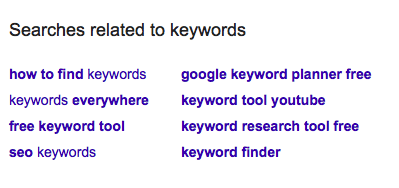
Perform some Google searches with the keywords you identified in the step above, then use them to discover additional long-tail keywords by looking critically at the “searches related to” field at the bottom of the page.
Tools to Help with Keyword Research
Not sure how to find keywords on your own? There are several reliable paid and free keyword tools that can help.
Three of our favorites include:
- Google Keyword Planner. The gold standard in keyword research.
- Keywordtool.io. To spy on what types of questions people are searching for.
- Keywords everywhere. Simply download the Chrome or Firefox extension to see how often a particular word has been searched for in a given month.
Dad used to say, “Say what you mean, and mean what you say.” Though they may not have known it at the time, your parents actually gave you some sage advice when it comes to executing an effective keyword strategy. Employ a little old wisdom and new-age advice, and you’re sure to have traffic streaming in from all angles.
Need some help keying in on keywords? We’ll give them something to talk about.
ONLINE REPUTATION MANAGEMENT ESSENTIALS FOR SEO AND SOCIAL MEDIA
What do your customers think of you? If you’re at all unclear or otherwise uncomfortable with the answer, your business could be suffering because of it.
Fortunately, there is a proactive way you can take part in the conversation: Online Reputation Management (ORM).
It’s a strategy that generally involves actively engaging with both the material in Google search engine results page (SERP) and online reviews/feedback about your brand. Just how important is your online reputation management strategy?
According to BrightLocal, “85% of consumers trust online reviews as much as personal recommendations.”
So, how do you shape your online reputation management through SEO and social? Get your crash course up ahead.
The Big 4
When it comes to ORM, there are four major players. A complete online reputation management strategy will, at a minimum, involve these four digital marketing channels.
· Media mentions
· Paid media
· Social media
· Your domains
Let’s start from the beginning.
Sometimes you get lucky and a big (or small) media outlet drops your brand’s name in an article. That’s great! In the biz, we call this earned media. Because of its ability to positively and immediately impact your rank, it is among the most highly coveted of all ORM efforts. Some companies find that working with a public relations or digital marketing firm can help them secure more of these valuable placements.
More and more, businesses are turning to paid media in the form of PPC campaigns and sponsored posts on social media and influencer accounts. It’s a great way to get your name out there, but then it’s up to you to continue growing and forging those new relationships.
Don’t neglect your social media accounts either. They’re a direct reflection of your brand and implore potential customers to interact with you online. As a general rule: the more actively you monitor them and engage with your audience, the more effective they’ll be.
Finally, whether you’re focused on your website(s) or blogging platform(s), realize that they’re pillars of building a strong online presence. You have control. Use it wisely.
Online Reputation Management Tools
Now that you know where to focus your efforts, let’s shift gears to how you can successfully gauge the effectiveness of those efforts.
Google Alerts is a great place to start.
If you do nothing else, at least set up an alert so you know when anyone publishes content that mentions your brand. You can use the same function to keep tabs on your competitors as well as relevant current events or news as it relates to your industry.
Quick pro tip: Make a note of any especially active journalists or bloggers who might be interested in receiving a pitch about your products or services!
Setting up the alert is easy.
Simply pick your keyword(s) and populate the frequency of email notifications you wish to receive. If you have a preference about which type of content you get sent (blogs, videos, news sites, etc) you can add those specifications, too. If you’re trying to improve your local SEO or reputation there’s also a field for you to specify your geographic location.
It’s a free solution that ensures you never miss an opportunity to re-post the nice things being said about you or respond when the feedback isn’t so great.
Other ORM tools we like include:
· Social mention – a social media monitoring tool.
· SentiOne – for insights about what people are saying about your brand.
· Reputology – a review management platform that lets you monitor reviews for each individual location of your business.
· Meltwater – a media monitoring tool that helps you do far more than organize your press clippings.
Ready to take your reputation into your own hands? You don’t have to go it alone. Let us help put your good name on everyone’s lips! Start chatting with an account specialist here.
TALKING TESTIMONIALS: WHY THEY’RE IMPORTANT AND HOW TO GET THEM
Testimonials are like a 24-hour online marketing team who’s always working, but you never have to pay. Still, many small businesses make the costly error of leaving them off their website, not realizing the power of peer praise.
How effective are they? According to Nielsen research, “92% of people will trust a recommendation from a peer, and 70% of people will trust a recommendation from someone they don’t even know.”
Could customer testimonials be the key to increasing your conversion rates or generating more leads? Test these testimonial and content marketing tips to see for yourself!
Show off your Social Proof
Even if you’ve been marketing under a rock and haven’t heard the term “social proof,” you’ve probably already leveraged it to promote your products and services at some point.
Tech Crunch describes the phenomenon as, “the positive influence created when someone finds out that others are doing something. It’s also known as informational social influence…In other words, people are wired to learn from the actions of others, and this can be a huge driver of consumer behavior.”
Put simply, it’s word-of-mouth marketing at its most basic level.
Testimonials are a compelling form of social proof. Here are some others you might recognize (or use):
- Celebrities and social media influencers. Celebs have long heralded trends and helped solidify brands. But, thanks to social media, how we define celebrity is changing. From YouTube sensations to Instagram stars, there’s a new social sway afoot. Read more about cultivating influencer marketing strategies for your business.
- Crowds and masses. It’s an “all these people can’t be wrong, join us” mentality that’s been used by big brands from McDonalds (1 Billion Served) to record companies (Platinum status records).
- Friends and acquaintances. You, just like your customers, probably trust the opinions of people you know more than anyone else. Size those personal recommendations up against pretty much any digital marketing tactic and it’s no contest which will win out.
- Experts and industry leaders. Though you may not know them individually, experts like doctors are great for giving your brand more credibility. The same goes for anyone who is well known in your industry like a CEO or thought leader.
- Users and past customers. Here’s where testimonials really take off. Getting a vote of confidence from someone you’ve already worked with speaks volumes. This goes double if the recs come from someone “just like you.”
But how do you go about getting them? That’s our next point of discussion.
Gathering Testimonials
Ask for testimonials and you’ll receive. That is if you request them from the right folks in the right way.
You see, a random selection of customers just won’t do. You’ll need to be more strategic in your ask.
Start with clients or customers you’ve done business with recently. Get them while you’re fresh on their mind and they’re more likely to take the time to give you feedback about their experience. You can use a site like Survey Monkey or simply make your own using Google Forms.
You might also consider creating an email drip campaign that will go out to anyone with whom you’ve completed a sale or project. You can set it up to send a few follow-up reminders, but don’t flood their inbox with requests lest the become tone deaf to your email marketing entirely.
It’s always best if you reach out to customers that you worked with directly, but getting a marketable testimonial may require some probing.
Giving them the following parameters about what they saved and what they gained could help you solicit a more compelling response:
- Did you save/time money? How much, specifically?
- Were you able to gain leads/increase your sales/etc? By what percentage?
- What was the biggest benefit of working with us?
- What did you enjoy most about our brand? (e.g. : Customer service, finished product, speed of delivery, etc.)
Make sure you also collect pertinent info like name, title, location, the date of service, and if at all possible, a photo of the person giving the recommendation. It’ll help personalize the testimonial.
Working with a business? Include their logo as part of the praise.
Marketing Customer Testimonials
Once you’ve gathered your endorsements, time to have your marketing department (or digital marketing agency) show them off.
There’s technically no wrong way to display your customer accolades, but here are some avenues that will give it the most exposure.
1. Case studies. Customer case studies can be as in-depth or condensed as you like. Whether you pull some compelling stats or give readers the play-by-play, they’re great ways to showcase customer successes.
2. Video testimonials. Audio and video testimonials from happy clients are much more intimate than the written word. Just make sure you have a prepared interviewer and good editor on staff to make sure it translates on film.
3. Social media. It’s a big part of your online presence. Whether you upload that vid rec you just wrapped or simply post a candid photo with your product and heartfelt quote, this is a surefire way for your testimonial to gain traction.
4. Site sidebars. You never want an endorsement to be distracting. However, the sidebars of your blog reel (or really anywhere with ample white space) are great reminders to your increasing unique monthly visitors.
5. Individual pages of your website. You might consider giving your testimonials and case studies their own individual pages on your site. You can also add them to your products and services page, strategically placed near CTAs that urge a potential customer to commit.
Though features like Google Reviews and sites like Yelp are a great way to get eyes on your brand, you don’t have to wait for customers to submit a review on their own. Armed with the right ask and good implementation, you can take testimonials into your own hands!
Need some help marketing your hard-earned testimonials? We can help.
GOOGLE ALGORITHM UPDATE
The average layperson probably doesn’t give much thought to Google’s search algorithm. As long as they can type their query into the search bar, hit a button, and get relevant results, then they’re happy! However, most business owners and professional bloggers have a vested interest in making sure that their site shows up on the first page of the Google’s search results. If you’re part of the aforementioned demographic, then it’s actually essential for you to know how Google finds and ranks pages.
In today’s video, we’ll discuss a couple quick, easy ways to make sure that your site is fitting Google’s criteria for “quality” webpages in light of their recent algorithm update. Having great content is crucial, of course, but it’s also a good idea to avoid duplicate content and NOINDEX/NOFOLLOW pages that could make your site seem a bit bloated in the eyes of a web crawler. Don’t forget about usability, page speed, and balance rate, either, as all three are now more important than ever.
Here’s the bottom line: a high ranking on a Google search can turn someone who’s never heard of your company into an interested, paying customer. So don’t let technical issues trip you up! Take the time to do things right, and your relationship with Google will be an advantageous one.
GOOGLE DUPLEX
A lot of people grumble when they call a business or customer service line and wind up talking to a recording instead of a real person. But how would you feel if you spent several minutes conversing with someone on the phone and then later learned that the “person” you spoke to was actually a computer? This may sound like something straight out of science fiction, but with the advent of Google’s new technology, this scenario may become more and more common in real life!
In this video, we’ll discuss Google Duplex, a program that acts as a “virtual concierge” for consumers. Here’s how it works: if you tell your phone to make you an appointment at a local business, the program won’t just reserve one using an online scheduling interface—it will actually call the business and “speak” to an employee. And it’s so skilled at parsing language and responding in a realistic way that the employee may not realize that they’re talking to a digital application. In fact, the AI was initially so convincing that, after its debut, Google later agreed to add a forewarning of sorts to the digital calls so that people wouldn’t be fooled.
As far we’re concerned, this technology is astonishing, thought-provoking, and maybe just a little bit spooky…
HARNESSING THE MAGIC OF META DESCRIPTIONS FOR INCREASED WEB TRAFFIC
By definition, ‘meta’ describes a thing that refers to itself. The word might also conjure something small. Both of these descriptors appropriately characterize the snippet that HTML tags use to summarize a page’s primary content and focus.
But these brief precursors are no small matter. They’re arguably the most significant determinant for whether or not your site gets visited or passed over by a potential customer.
And yet, in short supply these shorties are not – every second, search engines flash millions of metas in response to search queries. Here’s how to stay above the fray and increase your web traffic with compelling meta descriptions.
More about Metas
Meta descriptions are the short block of text that sits below a suggested website on the search engine results page (SERP) – see below. The space in which they appear is limited, and so are your characters.
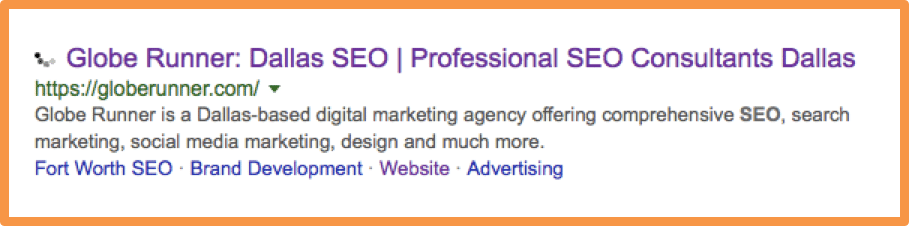
In late 2017 Google released an algorithm update that lengthened meta descriptions to 320 characters. Since then, there’s been some debate about length. Our recommendation? Pack in the most critical elements within about 160 characters. Otherwise, you risk all that compelling content being trunked (by the search engines that be).
How do Meta Descriptions Improve your Page Rank?
“Officially” you’ll reap no explicit ranking benefits from your meta descriptions. True, they aren’t directly built into the algorithm, but they still heavily impact your site’s click-through-rate (CTR). This, in turn, tells Google whether or not you’re a good match for specific search queries and subsequently where to order you on the SERP.
Writing Magical Meta Descriptions
Google Dallas SEO agency and you’ll get an onslaught of companies vying for your business. Before a customer ever has the chance to be swayed by your company’s prestigious awards, expert web design, or testimonials, the 2-3 sentences in your meta description will form the basis of their decision.
Meta descriptions are a fantastic way to your showcase services and collect clicks, so long as you:
- Write them like an elevator pitch. If you had just 15-seconds to make your sell, what would you say? Now’s the time to make sure your words are concentrated and direct, punchy and enticing. There’s no room for fluff. Every syllable counts.
- Create one for each page. Unique meta descriptions are a critical element of every page on your website. The more context and clarity you can provide up front, the more clicks you can solicit. Give each page the stage for a few brief seconds to capitalize on its full potential.
- Proofread then re-read. Give your meta copy the same level of care you would a billboard. Though the spacing may be small, the impact is substantial. Typos in your meta descriptions rob you of legitimacy and could very well cost you potential sales.
- Include a CTA. Whether you want them to learn more about your product, try it out risk-free, or redeem a discount code, the more action-oriented perks you give, the more clicks you’ll get.
- Make them keyword-focused. You aren’t turning up in searches by pure luck. Users are on the hunt for something specific. Make sure you target that special something with well-researched keywords. Not only does it make the search engines take notice, potential customers will, too.
Get meta with your meta descriptions and optimize them down to the smallest detail. Doing so could mean the difference between ranking on Google’s first page and being crowded out by a louder, more compelling online elevator pitch.
Want to increase your page ranking on Google SERPs? Let us give you a lift.
GOOGLE POSSUM UPDATE
The Possum update. Yet another animal update from Google. This one actually wasn’t named by Google. The search industry as a whole came up with the name.
What is the Possum update? It specifically addresses the map search portion of Google. It doesn’t address the rest of search. If you are affected by Possum, it would only be the maps or the locations part of your search. I have five points I want to cover about the Possum update.
The first one is separating the maps algorithm and the organic algorithm. Possum really pushes those algorithms apart and we find a stronger differentiator between what shows in maps versus what shows in organic. Back in the day, it was pretty muddled and a little more mixed. Now with Possum, there are very distinct algorithms.
Point two is the location of the searcher. The location of where I am physically standing when I do the search plays a massive part in results. That’s gone up tremendously since Possum. Google has gotten much more sophisticated about picking up the exact location of the searcher and serving the best result based on that location.
It completely makes sense. It’s actually a really good part of this update, I would say.
Another one is outside of city limits or surrounding areas are getting included more often. Before Possum, the name of the city that you were physically in made a big impact.
If I, for instance, looked for plumbing companies in Frisco, I would get plumbing companies that physically were in Frisco. It was less likely that I’d get a plumbing company in a neighboring city, even if that plumbing company was the best result for me.
Now, Google is much more likely to pull results from surrounding cities or adjacent cities into that result if they’re physically in good proximity and have good user reviews and things like that.
Another one is stricter filtering. Stricter filtering applies to a lot of businesses that maybe were trying to game the system a little bit by having locations that maybe weren’t their headquarters or weren’t their main location.
Maybe they had a Regus office or something like that, or maybe they were using their home address as their business address. Google has gotten much better with stricter filtering.
My last point is double location. Google has gotten much better at filtering out double locations. A lot of business owners had a building that they could split into two parts and have two different addresses and try to rank twice for the same search term.
Google has gotten much better identifying that. In fact, they’re going all the way up to the business ownership information to identify facts like these.
Let’s look at an example. Maybe somebody owns two buildings on the same street. There are two different addresses but they are really the same business, even if they have completely different names. Google can identify that through the business ownership information and will now only show one result.
Your likelihood of getting two listings by naming your business two different things has gone down dramatically. Local search has gotten a little more complicated, and just managing your citations is not enough anymore.
We’ve come up with a strategy specifically for Possum to help our clients get better results with these new algorithm updates. If you’d like to learn more about our strategy and have that implemented for you, give us a call. We’d love to talk to you and come up with a strategy that fits your business needs.
B2B VS B2C: LINK EARNING AND CONTENT MARKETING
We have customers that are B2B, and we also customers that are B2C. I think it’s interesting to dive into some of the differences in the way that we approach their marketing and some of the similarities between the two arts.
Today, I want to focus in on content marketing and link building for a B2B company versus a B2C company.
On the B2B side, some tactics that have been very successful are influencer outreach and guest posting in industry publications. We start the process of getting our clients involved in different industry organizations and getting links from those.
Other tactics include infographs. An infograph can be very successful in B2B marketing. Partners and vendors will commonly share or repost infographs on social media. They also can be successful in B2C, but it’s a little more targeted on the B2B side.
Now, B2C marketing is different. We’ve got to capture everybody’s attention. The content that we produce has to be very creative. Usually, it’s more fun and less serious, but that’s not always the case. It’s content that grabs people’s attention and people want to share it because they enjoy interacting with your brand.
What I’ve noticed is brands that link build using content are generally the brands that people like. People love that brand and they want to share their posts. They want to post about them on their Tumblr account. They want to show brand affiliation. On the B2C side, brand affiliation is a huge part of successful link building.
One of the most common strategies we do to get people excited about a brand is product reviews. Everyone values external validation. Reviews are great even for small brands or brands that no one’s ever heard of. A product review can validate the product and also can get links for that product and elevate your presence in search.
When you think about the two, you really have to separate your mind and go, “Who are we selling to and why are they buying?” It’s really the same question on link building. It’s “Who would link to us and why would they link to us?” Usually, it’s not always your customers.
A lot of the time on B2B, it’s your vendors or people you have business relationships with and B2C is your brand advocates. Think about that when you’re coming up with link strategies and separate in your mind what you do for B2B and B2C.
Thanks so much for reading. If you have any questions that you’d like answered in a future video, leave them in the comments. I look forward to reading them and hopefully answering those questions in a future video.
HOW TO IMPLEMENT SCHEMA INTO YOUR CONTENT
If you’re looking for a new technique to enhance your SEO, Schema is a powerful tool to boost your search engine result pages, also referred to as (SERPs). Not too many people use Schema, but it’s something that most people see and interact with on a daily basis.
Why Is It Important?
Not only does Schema enhance your general search engine results, and the way that they are displayed to users, but they can improve your click through rates on your website. Schema allows Google to show your website to a larger variety of searches, further gaining the attention of a wider audience.
Where & How To Use Schema
There are a variety of ways you can implement Schema into your own content in order to enhance your rich snippets, and expand your audience.
When you use Schema markup on your own company reviews, you can cherry pick which ones you like the most, and have those displayed to users. Keep in mind you might consider throwing in at least a 4.0 star review, over 5 star reviews to make it seem more realistic. A 4.8 star review will make your company stand above the rest, without looking too good to be true.
Health plays an important role in our lifestyles today, and with everyone monitoring their calories (especially with the New Year just starting), restaurants will want to inform their customers of the nutrition facts for their food. If you’re a restaurant owner, or any type of food related industry, an easy way to add Schema to your business page is to use the markup to create nutritional facts for your users to read.


Other Examples
Celebrities/Public Figures
This example of Oprah Winfrey shows specific information about her life, including her birth date, zodiac sign, and educational background. This information was embedded in the code in order to produce the rich snippet and improve SERPs.

Events
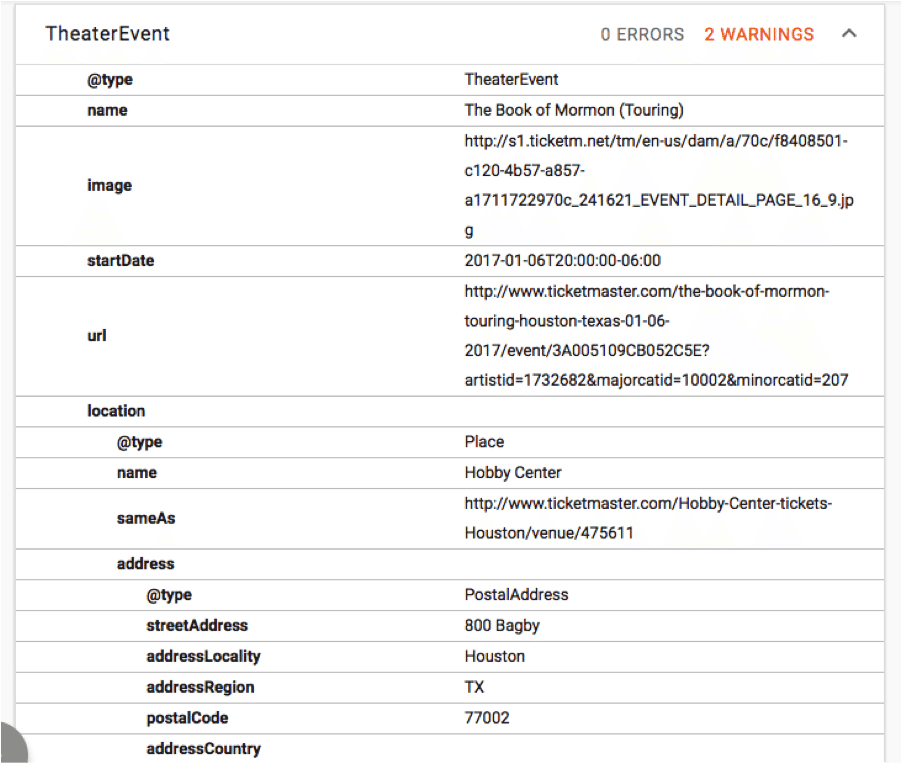
When you use a site, such as Ticketmaster, it’s easy to see the Schema implemented in the search results. By incorporating Schema, they’re getting free additional links, as you can see in the sample, by providing specific dates and show times that link directly to that performance to purchase a ticket.

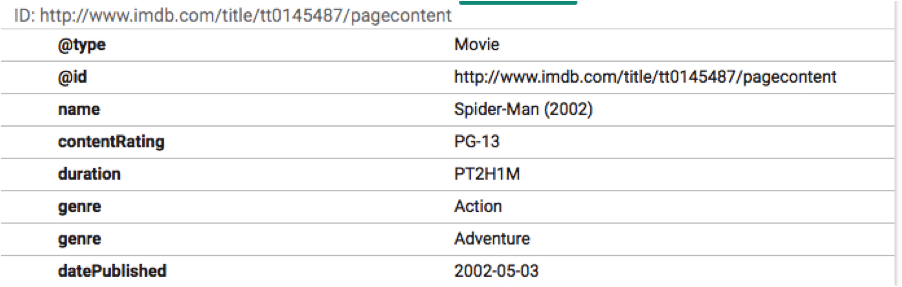
Movies
The next time you search for a movie, or a website, such as IMBD, you’ll find that Schema comes in handy when trying to find specific information, like ratings and genre.


- « Previous Page
- 1
- 2
- 3
- 4
- 5
- 6
- …
- 12
- Next Page »