














GOOGLE TRENDS REDESIGN + INSIGHTS FOR A PROFITABLE Q3
Marketers spend a significant portion of their working lives attempting to get inside the heads of consumers. What better way to peer into the minds of internet users than to review their search histories?
Whether we realize it or not, every query we plug into a search engine is like a digital diary of our thoughts, our wants, our curiosities. Businesses looking to harness this information need look no further than the Google Trends tool.
Its recent redesign focuses on ‘editorial data-based stories’ helping content concerned marketers tailor their blog topics, key in on keywords, and solidify their social media strategies by utilizing trending data from trillions of online searches.
The data explorer lets you see what users around the world are querying in real-time and overtime – for free. It’s like looking at key topics in Google’s search engine with a magnifying glass. Newer features also let you drill down and get granular, as though you were analyzing searches with a microscope.
What else should you know about the Google Trends update and how can you use it to improve your digital marketing strategy? That’s what we aim to unpack.
Redesign Features
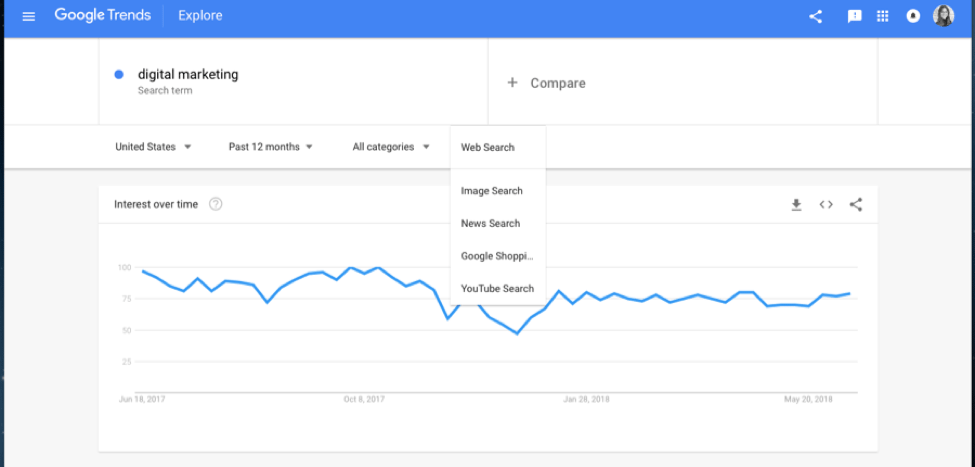
It all starts with a search term. Type your topic of choice into the search bar at the top, and you’ll see four subcategories below. These drop-downs let you contextualize trends based on geographic location, timeframe, different industries, and, most notably, types of search.
Since Google’s algorithms, and search results, are so multi-faceted it makes sense to broaden yours beyond web links alone. The update allows you to also refine your exploration across verticals like videos, news, and images.
In addition to these, other standout feature updates include:
- Real-time trending search data denoted by the word ‘breakout’.
- Curated data stories courtesy of the Google News Lab team. (Plus real-world visualizations created by international newsroom designers.)
- Aggregated official Year in Search information for the last 17 years, showing how various topics have performed over time.
- Intensity mapping and info graphs for meaningful topic comparison.
Once you have the data, it’s time to put it to good use!
Best Ways to use Google Insights
Internet users have done the work of popularizing certain terms. Now, it’s your job to put them to use. Next time you sit down with your team to create or present a content strategy, make sure you leverage Google Insights and Trends to help you pique the interest of your target audience.
Some of the best ways we’ve found to make use of Google trends are:
- Optimizing your keywords for your PPC and online advertising campaigns.
- Creating content calendars and press releases that resonate.
- Marketing to potential customers based on what they’re searching for in their location.
- Researching which keywords have grown in popularity from year to year.
- Seeking out new audiences that resonate with your products and services.
- Visualizing your product with new photos that correspond to different markets.
- Utilizing the related topics section to create compelling video content based on searches.
Simply put, anyone with a Google account has access to this wealth of info, and businesses looking to increase their web traffic and conversions have found it to be an invaluable part of their marketing plans. The way we see it, as far as free tools go, this one is more than a passing trend.
Want some help analyzing Google Trends? We’ll help you strategize into the stratosphere!
BUILDING BUYER PERSONAS: IT’S PERSONAL
Did you have an imaginary friend as a kid? If so, you probably remember them feeling a lot more real than a pretend person. In fact, if asked, you could have probably listed off everything about them from where they lived to what they ate for breakfast.
Buyer personas are the grown-up versions of this childhood pastime. They’re no less detailed (or fun!) and can help you actually make contact with the types of audiences that match your creative vision.
Thinking of creating buyer personas for your business? Here’s how to do them well.
Why are Buyer Personas Important?
We live in a world where content is king and paid advertising campaigns are the best way to speak directly to your target audience. But spending marketing monies to get in front of a random collection of consumers without first understanding who is most likely to buy your products and services is bad business. It’s like calling a wrong number and expecting them to contribute to your best friend’s birthday present.
Buyer personas help you do a deep and necessary dive into your core customer groups – the ones most likely to care about your brand. Though they’re mostly fictitious, these characterized generalizations are a great way to hone your marketing messages and zero in on your ideal market segments.
When you fully comprehend who your potential buyers are and what motivates them to purchase, you can hyper-target your PPC and social media campaigns, maximize your advertising ROI, and create compulsively compelling content.
The Buyer Basics
At Globe Runner, we make our buyer personas as thorough as possible. We start by fleshing out general demographics like the personas age, where they live, and how much they earn per year. At a minimum, you should have the following for each of your buyers (most companies have more than one profile).
- Age: We like to do a range of 10-15 years.
- Gender: Segmenting between males and females is one of the biggest distinctions when understanding your target market.
- Education: Are they high school graduates, do they have some college, or is your target audience all masters level or higher?
- Title/Income: Research sites like Glassdoor.com to get an idea of potential titles and annual earnings.
- Location: Dallas, Texas might be sufficient, but really think about whether they’re a family more likely to live in a suburb, or a young professional who prefers 75201 proper.
You might think e-commerce and the internet lessen the importance of location, but you’re wrong. In fact, it might be a good idea to add in an excluding location. This is especially true if you’re running a pay-per-click campaign. For instance, if you’re selling to farmers in Muenster, you might actually want to omit urban areas or cities like Dallas with larger population sizes.
Making Personas Personal
Where we really start to drill down is in the psychographic (psychological demographic) details. This is when your persona will really come to life. In our opinion, it’s also the most fun part. It allows you to occupy the headspace of another person and think as someone other than yourself in order to build the relationship with your customers IRL.
- Persona: These are the overarching angles like: teen girl end user or older farmer wholesaler.
- Interests: What would they spend their disposable time and income on? Travel? Fashion? Technology? Sports? Politics? Literature? DIY crafts?
- Personality: Are they open-minded or traditional? Informed or influential? Cautious or risk-taking? Describe them with a handful of adjectives.
- Profile: Here’s where you really create the “character.” What are they all about? Give us the highlight reel of what’s most important to him or her.
- Day-to-day: Then, describe a day in the life. From sunup to sundown, how is it they conduct the hours of their day. Are they just starting their career or bringing it to a close? Do they pour their energies into their families or are they devoted to getting back in shape?
- Goals: Think about how your product could specifically help them meet some of these goals. Do you provide a service that can give them more time with family? Do you sell a product that can help them elevate their social status?
- Challenges: What would prevent them from buying with you? Do they have limited internet access? Are they on a tight budget? Is their taste very specific or brand loyal?
- Objections/their questions: Try to pretend you were creating a FAQ for your website. Take the challenges listed above and create questions out of them.
Once you have given life to your persona, make sure to give them a name and add a photo. You’ll be surprised at how much you can connect with this fabricated person staring back at you.
Connecting to the Consumer
Your final step is to think through how you’ll make the rainbow connection.
- Why your product is right for them: Which needs or goals does it meet? How does it solve problems they didn’t realize they had?
- Elevator Pitch: You have just a few seconds to catch their ear. All the better if you can work in a little curiosity mixed with a call-to-action (CTA).
- How we reach them and convert to a sale: Here’s when you get to discover where your consumer congregates. Are they obsessed with Instagram contests or more likely to respond to an email campaign advertising a sale or discount?
In this last section, you’ll start to see some of your traditional and digital marketing strategies emerge. Just know that it may change over time as you review more sales data. That’s not only normal, it’s encouraged!
Point is, if you’ve ever written fiction, acted in a play, or had an imaginary friend you already know a bit about building buyer personas. Done right, they’ll help you be more responsive to your customers and get your brand in front of your ideal audience. Don’t forget to be creative, get personal, and have fun with them!
Need some help identifying your core consumers? Let us package your personas instead!
CREATING AN EFFECTIVE CONTENT CALENDAR
The content calendar. I cannot emphasize the importance of this enough. The content calendar really is your guiding ship. It’s your light post that you are heading towards from a content strategy point of view.
How to make it effective is key, so there are some things I’ll point out.
First off, think about the year in advance. Come up with all the major holidays and all the different things that you want to mention about those days in your content calendar.
That way, you’ll have everything planned out and ready to post. You could potentially have something that you would do that’s specific for Thanksgiving or Christmas. Once you have that in mind, you want to integrate and lead up to these holiday-specific events.
Another thing to think about this is who your buyer is. At Globe Runner, we look at two things: the buyer and the keyword strategy.
We develop the keyword strategy first, and then we look at keywords that stem from common questions that are being asked about the topic. We also look at common search words that are coming up, and we use those to inform the content calendar.
Then, we match those queries with the buyer persona that we’ve written that would most likely ask that question. That way, we can write the content towards that buyer persona.
For instance, in a B2B space, we might have a client who could sell to a CEO, CFO, or CIO. This depends on which angle they’re coming in from and the software they are selling, like an ERP system.
We write different pieces of content that are angled towards the owner/decision‑maker, towards the financial decision‑maker, and towards the technical decision‑maker, and different keywords will inform different pieces of content.
The effectiveness of a content calendar is not just having one so you know what you’re going write in advance. Rather, having a calendar with some thought behind it is part of your SEO strategy, part of your engagement strategy, and an overall part of your inbound lead generation strategy.
We would love to talk with you about content marketing and help you write your content calendar. Call us anytime. If you want to post any questions or any suggestions for future topics in the comments, I would love to address them in the next video.
FREE 2017 CONTENT CALENDAR TEMPLATE (DOWNLOADABLE)
Last year, one of our most popular blog posts was our free 2016 content calendar via Google Sheets, complete with sections for your social media posts so that you could plan out your whole year of content marketing. In that spirit, we’ve updated the calendar and once again it’s free to download and use at your discretion.
How to use this content calendar template:
- If you can open it, then it’s saved onto your Google drive. To save your own copy that you can edit, simply go to File –> Make a copy to have your own. There is no need to request us for access to use the sheet. Repeat: There is no need to request us for access to use the sheet!
- Navigate the months using the tabs at the bottom of the screen.
- US Federal holidays are highlighted in blue. Weekends are highlighted in pink. Just so you don’t mistakenly schedule a blog post for the weekend.
- Key dates for the months are listed in Column C-D. We deliberately added a generous helping of silly days (hello, Barbie Day on March 9), famous birthdays and today-in-history entries for the occasional moment when we run out of clever things to say on social media. You can change these of course to the type of content that makes sense for you.
- This calendar was completed within the last few days. Obviously a lot of things can happen between now and 2017. We encourage you to check other sources in case you’re building campaigns around sports and other special event dates.
Ready to plan out your year?
Download our exclusive 2017 Content Calendar Template
Plan out your entire year in one place.
I’m interested in SEO/PPC services
GLOBE RUNNER CEO ERIC MCGEHEARTY APPEARS ON PLAYMAKERS TALK SHOW
PlayMakers Talk Show
We are thrilled to announce our very own CEO of Globe Runner Eric McGehearty will be joining PlayMakers Talk Show on 770 KAAM this Friday, September 30 at 3 pm.
Be sure to tune in! If you miss the Friday show, don’t worry because there will be an Encore Presentation on Saturday at 2 pm.
For those who don’t know, Eric is an entrepreneur and thought leader. His writings on business and entrepreneurship have been published in Forbes, Octane Magazine, and Yahoo Small Business Advisor.
In is not so “free time” he is a nationally recognized artist showing in galleries, museums, and public spaces. His sculpture in Fort Worth was recognized by America for the Arts as one of the top 40 pieces in 2007.
Eric is also the co-founder of the non-profit Stand UP LD a support network for parents and educators seeking resources to support and inspire children with learning differences.
Play below to listen to a promo for the show!
MICRO-MOMENTS: BREAKING DOWN ‘I-WANT-TO-BUY’ MOMENTS
Micro-moments are the small instances each day when someone uses a mobile device to quickly search for a bit of desired information. One type of moment, called an “I-want-to-buy” moment, centers around using internet searches to help with purchasing decisions. These moments present a massive opportunity for companies looking to attract buyers.
‘I-Want-To-Buy’ Moments Defined
An “I-want-to-buy” moment is any instance when you search for information to help with a purchase. This can include both on-the-spot purchases (like which brand of cologne to buy during a shopping trip) and large investments (such as buying a house).
These moments are often spread throughout the day, made either before a shopping excursion, while in the store, or over the course of days, weeks, or months prior to a large purchase. The one thing all these instances have in common, however, is the fact that they usually result in a purchase.
The following scenario breaks down what actually happens in these moments.
Scenario
Let’s suppose Doug is out on a grocery trip during which he intends to buy something to help with his athlete’s foot. He finds the foot cream section in the store and notices a wide variety of different brands, the prices of which range from around $6 (for a 10oz generic brand) to $60 (for a 4oz name brand).
How does Doug decide? He certainly doesn’t want to spend $60 on a small tube of foot cream, but what if the cheaper brands don’t work at all? He does a quick search for reviews on his phone to help him choose a brand.
Making the Most of the Moment
Doug’s not going to sit there forever sifting through content, so if you’re in the foot cream business, you need to provide content he can find and digest quickly. Creating this kind of content involves planning and online marketing savvy. During the process, consider what your audience needs to know prior to making purchasing decisions. Well-executed content will draw customers during these moments.
For additional help with “I-want-to-buy” moments, contact us at Accelerate Online Marketing today.
MICRO-MOMENTS: BREAKING DOWN ‘I-WANT-TO-DO’ MOMENTS
Mobile devices, and especially smartphones, have revolutionized the way we use the internet. Online searches are now faster and more focused than ever before, often taking only a minute or two. Being able to provide what users are looking for in a quick, digestible manner is the core of online marketing today.
The brief moments people spend online are referred to as “micro-moments.” Google has divided these into four categories, one of which is “I-want-to-do” moments.
‘I-Want-To-Do’ Moments Defined
One of the reasons why people go online is to learn how to do something. The time they spend online researching how to perform various tasks is concentrated and brief, so to fulfill their needs (and increase the odds that they’ll come to your brand), you need to make sure the content you publish online is designed to quickly provide what people are looking for.
Scenario
To break down “I-want-to-do” moments, let’s look at a common scenario. Suppose Penelope has spotted a bit of mold in the sink that grew over the past week while her roommate’s dishes were sitting there unwashed. She knows that mold is difficult to remove, but she’s not sure what to do about it.
So she pulls out her smartphone and does a quick search for “how to remove mold.” She doesn’t have much time to spend researching this, so she’s likely to go with the first promising-looking result that comes up.
Making the Most of the Moment
Most of us know that mold is pretty difficult to remove, generally requiring certain chemicals. But who’s going to let Penelope know what she needs? If your content is well designed, it will be you. To satisfy her need in this moment, your content should:
1. Be optimized for search engines so it comes up high on the list.
2. Provide answers quickly in a digestible, easy to navigate format.
3. Give complete, reliable information.
The challenge is doing all this in one piece. Our skilled digital marketing experts in Dallas can help you there. Contact Accelerate Online Marketing for help working with “I-want-to-do” moments today.
Managing Your Online Reputation
Online reputation is an important aspect for not only large enterprises, but small businesses as well, and it’s an area that’s often neglected. So the question is, how can you improve your online reputation, or even establish one if you don’t already have it?
Some of the basics that can help you get your name out there are your Facebook page, your website, and Google Plus page, to name a few. But how can we get positive reviews and customers raving about our business?
That’s what digital reputation is about: getting customers to give you five-star reviews. Of course, it’s essential to have a good service/product, but that doesn’t seem to be enough these days. We have to ask our customers appropriately to give us feedback and reviews.
There’s a lot of different ways you can go about doing this, but we have come up with a system that really works and is effective: We don’t ask our customers to give us reviews. Now, that may be counter-intuitive, but that’s not what I’m going to lead with. As soon as a customer comes to my store or I go to their location to provide a service, I don’t automatically ask them to review my performance. Frankly, a lot of customers are turned off by that and they don’t think they would benefit from it.
So instead, I ask them for their feedback. Feedback doesn’t have a positive spin to it. It could be negative or positive, and it urges the customer to give their honest opinion. That’s the differentiator. Asking for feedback rather than reviews. I don’t want that feedback to go on the web because I don’t know if what my customer will say will be positive or negative. So we take that feedback internally and we have a system that allows us to decide whether or not that feedback was positive, negative, or neutral.
If the feedback was negative, we need to put that into a customer service group where they get an apology e-mail, and once that has been sent out, an actual customer service rep will call them asking them how we can best resolve the situation. That way, we catch them before they have time to get angry, go on yelp or any other review site, and write something negative about our establishment.
Once we resolve all of the issues with the negative feedbacks, we look at the positive and neutral ones. For the neutral ones, you can decide if you want to reach out to them or not. The ones that have great, positive things to say are the ones that get a follow-up e-mail thanking them and requesting them to share their positive feedback on their social media accounts, our Google Plus, or Yelp pages.
Depending on the industry, you can pick which social media and review platform works best. This way, I’m controlling my digital reputation. I’m not artificially inflating who I am. I’m handling customer feedback by asking the ones who have great things to say about my business to promote those things publicly.
MICRO-MOMENTS: BREAKING DOWN ‘I-WANT-TO-GO’ MOMENTS
When you want to go somewhere, such as to eat or to find something you need for a project, that’s what Google defines as ‘I-want-to-go’ moments. Finding places to go has become a massive function of online searches, so being able to take advantage of those moments is vital to attracting customers.
‘I-Want-To-Go’ Moments Defined
In many instances, ‘I-want-to-go’ moments involve “near me” searches. In other words, someone might search for “restaurants near me” or “hardware stores near me.” By and large, these searches are more generic than specific, so very few people are going to be looking for your brand. Instead, they’ll be interested in whoever is closest who can satisfy their needs.
A Scenario
Let’s take an example. Suppose Mr. Jim has a hankering for some waffles one Saturday morning. He also kind of wants to eat out rather than fix them himself. He pulls out his phone, and he asks Siri to search for “waffles near me.”
If you serve waffles, you want to make absolutely sure your restaurant comes up on that list. If it doesn’t, Mr. Jim is not paying you a visit. If it does come up, and if your site presents the quick message that your waffles are more amazing than anything ever (or if they at least look appetizing enough that Mr. Jim’s stomach screams “WANT!” to his brain), he’s likely going to visit you ASAP.
Making the Most of the Moment
To make the most of these ‘I-want-to-go’ moments, you need to remember a few things. These are:
- As stated, most “near me” searches are for generic keywords, not specific brands.
- Customer loyalty is nowhere near as important in these searches as convenience and instant satisfaction.
- Half of those who conduct these searches will visit the store within 24 hours.
- Roughly one out of five “near me” searches results in a purchase.
So the question now is whether your brand has the online presence needed to come up on “near me” searches. If you want help establishing that presence, contact our team of Digital Marketing Rockstars at Accelerate Online Marketing.
- « Previous Page
- 1
- 2
- 3
- 4
- …
- 7
- Next Page »