











GLOBE RUNNER JOINS SMC DALLAS BOARD OF DIRECTORS
2014-2015 SOCIAL MEDIA CLUB OF DALLAS BOARD OF DIRECTORS WITH GLOBE RUNNER’S JEFF NUNN IN THE CENTER
On May 22, Globe Runner’s head of Business Development Jeff Nunn was welcomed to the Social Media Club of Dallas‘ 2014-2015 Board of Directors. Jeff will be responsible for Treasury.
Jeff is a seasoned sales and marketing professional with extensive experience in segments ranging from interactive marketing to retail. He joined Globe Runner in September 2013.
With Jeff’s new appointment, Globe Runner now sits on the boards of two prestigious organizations in Dallas Fort Worth: the DFW Search Engine Marketing Association and the Social Media Club of Dallas.
5 ASPECTS OF SUCCESSFUL WEB DEVELOPMENT PROJECTS
Building a new website can be a complicated process, requiring a lot of decisions based on a technical and creative process that many know very little about. While getting the web to shine light to billions of people across the planet in exactly the way that promotes your brand, platform, and business sounds daunting and overwhelming… it isn’t if you are doing it right. There is a certain energy to the teams that build successful web sites and applications, and if you are able to recognize it and harness it – you will create a quality result every time.
Aspect 1 – A Team
While no doubt, great websites have been built by one guy in his basement doing everything in a weekend with an IV of Red Bull and loud music, they typically don’t have long term success. The first aspect of building a great website is the recognition that it is the creation of a team and not of a single individual. The process is simply too large to be done well by a single individual in a reasonable time frame.
There are typically three to four groups involved in a building out a great website.
- The Customer – this is the person who has the most information about the website to be built because it is ultimately their creation. The website the customer wants is largely only obtained by communication with the customer. The customer often knows what the website should “feel” like before a single bit of design or work has been done. While this is the single most important piece of the process of building a website, very little attention is given to it and it is often overlooked. The best teams work to get the customers feeling in line with the technical, creative, and business aspects of the process.
- Design Team – this group is responsible for building the non-functional, initial diagrams of what the website will specifically look like. The best visual designers are those that can also do some of the technical work required, but are more idea driven than implementation driven. These guys spend a lot of time on the web and know what is going to be visually appealing and functional to the user of today.
- Technical Team – this is the group that typically exists in the dark catacombs of some cave with nothing but wires coming out, just kidding. The technical team is responsible for taking the feeling and vision of the customer and designer, and parsing it out into great technical detail so that it can be delivered to millions of people world wide. The technical team is concerned with ensuring the vision and design of the team is honed with what the real world can actually provide.
- Business Team (for eCommerce Sites) – while not always a separate group, the business team is concerned with aspects of how a site integrates, enhances, and encourages revenue-generation. This team is focused on the specifics of the eCommerce experience, such as order processing and fulfillment, analytics and marketing of the site to generate users, and how the site functions as the first-line customer service tool for the business.
Aspect 2 – A Goal
The customer doesn’t typically build a new website on a whim. Time must be taken by the customer to reason and analyze what their goals ultimately are. Do you want a better user experience? Are you looking to drive more traffic to your site? Are you simply tired of dealing with your current website? Do you want to enhance your eCommerce conversion? All great websites start with clear goals.
When I meet with a potential client that cannot communicate this in a very specific and well thought out plan, I will not take the job. The customer has to play the role of knowing what the customer wants. If the customer doesn’t know, than a professional engagement where they pay me to persuade them to believe that what I tell them is what they want… well its always been a bit strange to encounter this kind of proposal. But it does happen and it’s kind of scary when it does.
It is the customer’s job to the team to ensure every single member is informed of the goal at the very beginning. The customer needs to meet every person in the project and communicate this goal to them and simply ask, “How are you going to help me meet this goal?” If the designer can’t answer that question – its time for a new designer. If the technical team didn’t respond with questions about specific numbers or server technology to be used– time for a new technical team. If the business team didn’t respond with a question about conversion %, bounce rates, and what marketing outlets have and have not been explored…. Time for new business team.
Each member of the team needs to feel like they are playing their part in the successful team. Some guidelines for gaguing how your team is meeting this aspect
- Are they asking questions and proposing ideas? Are they actively engaging in the creative and technical process?
- Are they prompt in their communication with you? Are they proactive in their communication?
- Do they perform? Do they do what they say they are going to do? Are they proactive about keeping the whole team informed of anything that affects the process?
- What is their tone in the interaction with you? The tone is, in my experience, most indicative of the eventual result of the team.
Aspect 3 –Visual Design and a Functional Design
When the site is built, the designer should include a writeup on the various ways their drawing should function as a user interacts with it. Anything that moves on the site should be specified. Anything that needs to be computed, such as how a form should perform once it is submitted, should be specified. How should your blog look when its paged? If you want a sliding banner you have to say that. If you want a menu to fade in slowly, you got to say that.
Successful web design teams design what a site looks like and what it acts like.
Particular focus must be on providing the design to the variety of different web browsers that can be used. If you have analytics on the browser distribution of your current site, you need to make sure your team knows this so they can build the site to maximize effect on your specific traffic distribution. But this leads us to an even more important aspect of successful web sites…
Aspect 3.5 – Mobile Focused Team, Responsive Design
Almost every website I’ve seen analytics for in the last 2 years has undergone a very drastic and dramatic shift in the demographics of the browser used to view the site. Mobile devices are the primary way people are going to view your site in the period you have developed it to exist for. A successful team is going to be aware of this and will be bringing every single component of the design back to what it looks like. Many teams have started doing mobile first designs, largely amplified by the semantics of some of the more popular CSS frameworks like Bootstrap 3 and Framework. Some teams split it out into two endeavors or two sites… but all successful web sites are focusing on and enhancing how the site is being displayed on phones.
Sadly, I have not seen this in the eCommerce sector to the degree I think it needs to be done. Many people are still providing large hard to click tables of products to mobile devices – often to mask the fact their search and taxonomy are not relevant to interested customers. This is one of the clearest paths to eCommerce growth to me is maximizing the conversion of 50% of the traffic through simplification and optimization of the mobile experience.
A mobile user is going to spend less time on your site as well. That needs to be acknowledged, and the design needs to recognize the limitation so that it can capitalize on what the user sees. If a user has to hunt to figure out how to contact you, or has to zoom in to hit the next button on your product page and zoom in again to see the photos on it or read the text of the product names, your website will fail to capitalize on the opportunity with a majority of its traffic in the next 5 years.
Maximize the limited time you have with mobile users by greatly limiting the content that is presented to them– while at the same time not prohibiting their access to more detailed inquires. A regular user should be able to have a regular experience – which we can achieve through the use of site cookies – but a first timer needs to enticed into learning about your company or making a purchase by not overwhelming them with finger actions or text.
Aspect 4 – An Issue (Bug) Tracking System (preferably with integrated source control)
This is, in my opinion, the fatal pitfall many teams make… once development begins, the silence gap happens… and grows until the Customer appears disinterested to the developer and the developer unskilled to the Customer. A silence gap in the development process lends itself to many sub-optimal products. The way this is mitigated is through the DILIGENT use of an issue tracking system. All team members should be recording their plan for the next two weeks of work out to the issue tracking system, and regularly commenting on their progress. This allows every member to survey what’s going on… This reminds every team member that they are part of team that relies on them, so that gaps in communication are not possible.
While no web site is ever finished as they are living breathing things that are displayed on technologies that rapidly change….. for the initial build it is important that every member of the team is monitoring and engaging with the issue tracking system. If the visual designer has a quick question for the Customer, they can use the issue tracking system to record that. If it takes more than an hour or two to get a response, they can follow up with a quick phone call – and record the answer to their question in the task so the whole team is aware of the evolution of the creative process.
If you bundle your issue tracking system with your source control you really unlock the key of building a great web site. Great teams use a source control system they are actively committing to. Great teams watch the progress of every other team member’s commits to the source control and actively engage with them based on that. The source control is the component of the development process that allows the team to congeal into a unit that builds the great website. But it has to be wielded properly to do that.
I encourage developers to use the microcommit – commiting small amounts of work on a regular basis. This gives insight into what the developer is doing without interrupting their creative process. It also keeps the developer honest with themselves with what they have accomplished and what they are working towards. In short, it makes them better developers. Every development process has a narrative, and the developer tells that narrative through the commits of the source control.
Add to that the ability to track deployments and version releases and even drive the deployment of the site to a cluster of severs directly from your command line – with little effort – and the technical advantages of diligent source control use becomes crystal clear. This is an aspect of all great technical teams.
Aspect 5 – Testing, Sign Off, and Testing Some More
When a developer gives you a URL to visit to look at the site, that’s telling the team they should begin testing it and tracking issues in the issue tracking system. Remember the developer is in an intensely detailed creative process, so you don’t want to overwhelm them with the obvious or with egocentric urgency. But if you do see something wrong with the site that maybe you want to changed or added, or maybe you’re seeing that it doesn’t look good at all on your browser, log a ticket so they are aware.
All team members should be testing as soon as they can. Even if that’s just one page, the developer needs to hand that off to them as soon as they can. The sooner the developer engages testing in the development process, the less time they have to build something that is fundamentally flawed because it was built on something that was discovered in testing.
When all team members are actively engaged in honing the site, through this stage of the process is when the real magic of successful web sites begins to shine. This can be an immensely fun process where each team member gets to play the role of both painter and art critic simultaneously. When great teams work together closely to build a great product…. That energy has a lasting effect. I’ve seen people come back to companies after many years citing the experience of the time they built the website as one of the “coolest” things they did.
Even after its tested and tested (in IE 8,9,10,11 FF, Chrome, Safari my iPhone, iPad, Android, and a some guys archane Blackberry for some reason, and one guys Wii) and all tickets are resolved and the site is live and generating thousands of dollars of revenue a day…. TESTING IS NEVER OVER. Every member of the team should test the site from time to time and, if they see an issue, log a ticket. Web sites shine their light 24 hours a day, and only those who are diligently verifying the quality and accuracy of the light they shine…. Shine bright.
If you combine these 5 aspects into your web development process, it will create something great for your company for the next several years, serving as a platform for both revenue generation and brand recognition, and acting as a reminder to your team of what they can accomplish when they work together on a creative task.
Now speaking of testing, I have some bugs to fix on this web site. Take care.
WORLD CUP 2014 MARKETING: USMNT SOCIAL MEDIA MENTIONS QUADRUPLE IN 7 DAYS
What sport will people be talking about a month from now?
From the past week’s social media mentions, it’s going to be soccer, specifically the 2014 World Cup, and most particularly the US Men’s National Team’s upcoming match against Ghana in the Group of Death.
Social mentions of the US Men’s National Team (USMNT) leapt to 15,426 the week of May 10, a gobsmacking 476% increase over the previous week’s mentions of 2,675. Majority of these mentions were on Twitter — something to note for anyone conducting World Cup 2014 marketing campaigns for their brand.
The figures were derived from SociaLitmus, an omnibus social media command center that will run only throughout the 2014 World Cup. The social media command center will be keeping tabs on World Cup 2014 marketing promotions and activity online for the US, popular athletes and teams, trends and key developments.
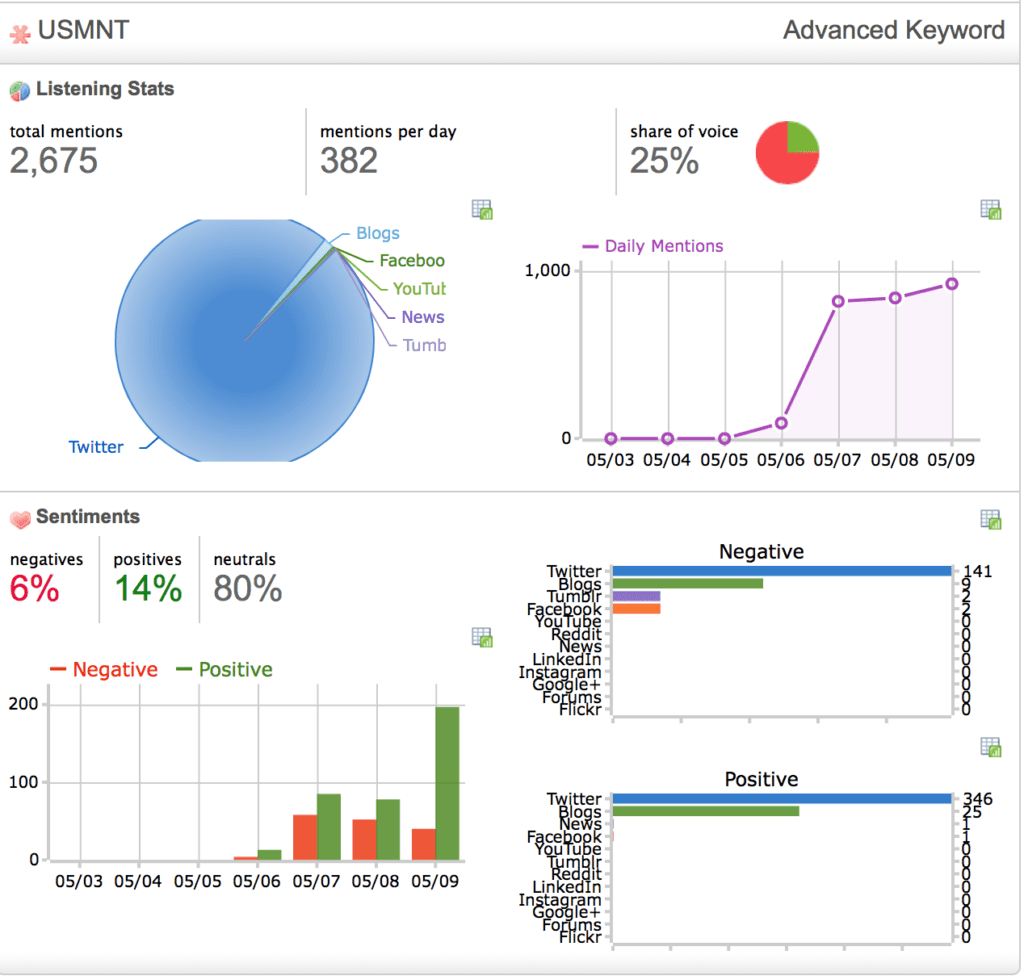

USMNT SOCIAL MEDIA MENTIONS FOR THE WEEK OF MAY 3-9, 2014: SOCIALITMUS<
USMNT SOCIAL MEDIA MENTIONS MAY 10-16, 2014: SOCIALITMUS
The most dramatic spike in mentions was on May 12, when team coach Jurgen Klinsmann announced his 30-man roster for the World Cup.
Sentiment about Klinsmann’s picks was largely positive, as social media data from May 12 show:

USMNT SOCIAL MEDIA SENTIMENT 12 MAY 2014: SOCIALITMUS
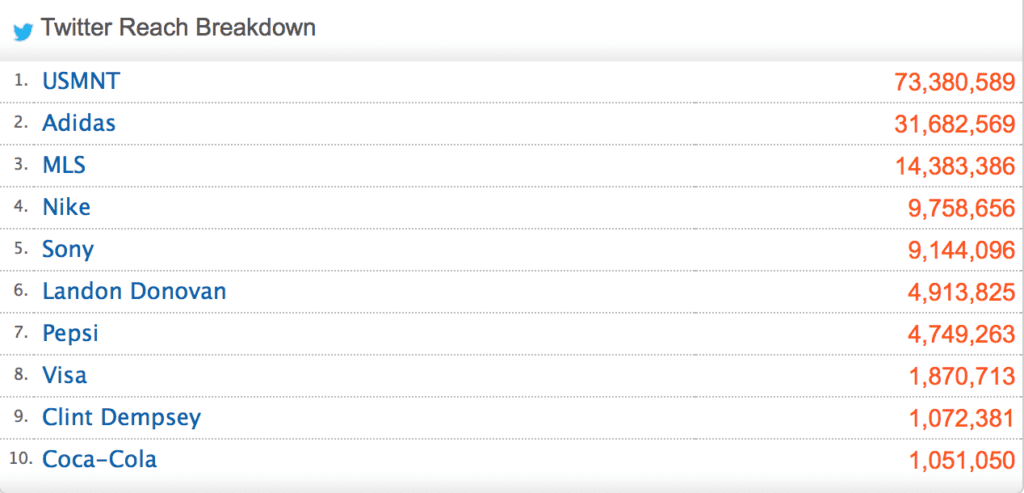
The numbers may seem negligible, but multiplied into impressions, the reach is not shabby. On Twitter, the USMNT earned over 73 million mentions in one week. Any brands looking for endorsers?
Sports network ESPN predicted last month in an AdAge interview that social buzz over the 2014 World Cup will outperform those of the 2010 World Cup and even the 2012 London Olympics.
The World Cup is fertile ground for marketers targeting fans of the Beautiful Game. Categories that will be out in full force are the usual suspects: Beer, fastfood, men’s personal care, sports brands (the Adidas vs Nike rivalry is a sport unto itself) and technology.
It will be interesting to see whether new categories, such as e-cigarettes, will see the same opportunities and make a play on social media.
WORLD CUP 2014 MARKETING: FIFA PARTNER ADIDAS CRANKS UP SOCIAL MEDIA; NIKE WARMING UP FOR AMBUSH CAMPAIGN?
With only 30 days to go to kickoff, Adidas and Nike’s World Cup 2014 marketing strategies are ratcheting up.
Online buzz in the US for the week of May 3 to May 9, 2014 shows Adidas winning by a handy length as the SociaLitmus chart above shows. Nike’s share of voice World Cup-wise across all major social media platforms registered only 5% compared to Adidas which captured 95% of mentions.
This online state of affairs should satisfy soccer’s governing body FIFA which brooks no nonsense from brands flouting World Cup marketing rules. In March the organizer issued a warning to non-sponsor brands about free riding on official sponsors’ coattails. At the last World Cup in 2010, FIFA famously sued a Dutch brewer for allegedly trying to hijack attention by dressing two fans in orange, the brand’s colors. The case was settled out of court.
Adidas averaged 134 social media mentions a day in the past week, with a total of 938. Majority of these were on Twitter, where an EA-branded soccer ball and Panini sticker book were being raffled off to retweeters of the promotion. Mentions of Adidas made up roughly 10% share of voice overall for all the keywords being monitored, which generated over 10,000 mentions. Keywords being tracked on SociaLitmus include the US Men’s National Team (USMNT), US team captain Clint Dempsey and player Landon Donovan, and official FIFA partners and sponsors.

Nike may be relatively quiet, but it would be foolhardy to think that the sports brand would not try to pull off another Johannesburg. Nielsen research figures for the 2010 World Cup show that online buzz about Nike was twice as high as that of official sponsor Adidas. In fact Nike was the number one brand associated with the World Cup, followed by Adidas.
Repeating its playbook in 2010, Nike on May 9 released a slick World Cup-themed ad, Take It To The Next Level, which was directed by Guy Ritchie. Their 2010 ad, Write The Future, received over 14 million views during the event. It will be interesting to see what else Nike has up its sleeve for 2014.
LINK BUILDING IS DEAD
Yes, there, I said it. Link building is dead. Link building for SEO purposes started getting really sick when Danny Sullivan went on his rant about link building back in June 2012. Well, here we are now, almost two years later, and we now have official confirmation that link building is dead, from Duane Forrester of Bing:
You should never know in advance a link is coming, or where it’s coming from. If you do, that’s the wrong path.
If you are building links, doing link building in the “traditional”, old-style ala 2003 link building, then you’re doing it wrong. What Duane is saying is that if you ask for a link, and you know ahead of time that you are going to get a link on X site, then guess what? You’re not doing it the right way or in any that’s acceptable, according to Bing and, (I’m going out on a limb here) Google.
You should be earning your links, and not building links. Link Building is Dead.
It’s now link earning, not link building.
So how do you earn your links? One way would be to start focusing on being a content marketer. A content creator. Someone who is not doing old-style SEO, but doing Public Relations. Reach out to the media. Reach out to bloggers. Don’t worry about where your links will be placed, and don’t worry about whether or not those links are going to be “nofollow” links or not.
One reason I mentioned HARO last week and the low quality, inorganic, unnatural links that Google flagged during a reconsideration request last night, is that typically Help a Reporter Out is not a source of low quality, spammy links. It’s a source that allows you to connect with real reporters/journalists/media outlets who will mention you, your company, or even your client if there is a fit. They’re after information or quotes that they can use in real content. And that real content is where you want to be mentioned, not some fake, low quality article or blog post that no one will read.
So how could the search engine determine whether or not a link is natural, and organic? There certainly are several ways, and obviously Bing and Google have algorithms to deal with these sorts of things. When I say that they can tell, they can tell. But let’s speculate on one simple way:
If a link is added after-the-fact, meaning that the URL was crawled by the search engine and a link was not there, and suddenly appears in content at a later date and time (after the initial crawl from an initial discovery of the URL), then there is a chance that it’s an inorganic link. To be honest with you, as a blogger I typically don’t go back to older articles and place links. I may add internal links to other pages on the same site, but that’s different. If a link appears several months later in an older blog post, then why was it added? Most likely it’s an inorganic link.
The search engines could be counting URL mentions and brand mentions as “links”. I’m speculating, but what if the search engines are now counting brand mentions just as if they were a link and passing on some sort of value (not PageRank) but something else, let’s call it “BrandRank”. What if a brand mention in Forbes or on CNN.com was just as good as getting a link from one of those sites? It’s possible, and probable in the future if Google is going to put less value on links in the future.
So, now we have “official” confirmation that traditional link building is dead. Great. That only means that what I am doing to build brand awareness for clients, and what Globe Runner as an agency is doing, is right on track: we’re brand builders, content marketers, and that’s how we do SEO now.
Yep, link building is dead. RIP link building. I sure won’t miss it.
Bill Hartzer is Globe Runner’s Senior SEO Strategist. Connect with him on Google+ or on Twitter as Bhartzer.
GOOGLE FLAGS HELP A REPORTER OUT, PRESS RELEASE LINKS AS BAD LINKS
As you probably know by now, Google has been on the prowl lately, flagging and penalizing links from directories, paid and sponsored links, links in guest blog posts, and, now you can add Help a Reporter Out links to this list that you should be cautious about.
In the response to a recent Google Reconsideration Request (I’m in the process of cleaning up a client’s links and getting rid of their Google manual penalty), Google gave three example links that “violate their guidelines”. Their response was something like this:

Now, I realize that this particular website does have inorganic links pointing to the website. And I’ve been working hard to clean up the organic links pointing to the website, mainly done by a previous SEO working on this particular website. However, the links that Google points out as examples in their response to our reconsideration request are like this:
– two links from Help A Reporter Out.
– one link from a media outlet who picked up a press release we distributed via a newswire.
The first two links provided as “inorganic” links by Google are, in fact, where the owner of this particular business was quoted in an article. In BOTH cases of the first two URLs, we had used the Help A Report Out service to respond to a request for a quote from a business (which was in a particular industry). As far as we knew, the reporter or journalist was writing an article and needed a legitimate quote from a business owner. Not only was the business owner quoted properly, we’ve seen traffic from these articles to the website. And, oh yeah, for those who care, the “anchor text” of the links are “branded” (i.e., the anchor text is the company’s name) and NOT a keyword-rich anchor text links.
The second link that Google flagged as being inorganic was, in fact, where a site picked up a press release that was put out on a popular press release distribution service. The news that was being reported in the press release was that this particular business was an official Toys for Tots drop-off location. Even the Toys for Tots website lists this business as an official drop-off location.
So, at this point, it is my impression that Google now doesn’t like links obtained from using Help A Reporter Out, and they don’t like links that are from websites who pick up stories from popular press release distribution services. Why?
Well, a Google manual review from a reconsideration request flagged those links as being inorganic links. In other words, the website is still manually penalized because of links obtained from Help a Reporter Out and a popular press release distribution service. If Google isn’t targeting Help A Reporter Out specifically, then perhaps HARO needs to do some more “policing” of the reporters who are using their services, as the last thing we need is for things like this to happen. There’s not much we can do about popular press release distribution services, though, as the popular press release distribution services really can’t do much about low quality websites picking up your press release. They are, though, being a lot “pickier” when it comes to the press releases that you submit to them, as they really do, in fact, need to be news.
Bill Hartzer is Globe Runner’s Senior SEO Strategist. Connect with him on Google+ or on Twitter as Bhartzer.
UPDATE: I want to clarify a few things that have come up regarding this. First off, I can tell you that in the case of the HARO articles, these were from legitimate HARO requests. In fact, we responded to requests for quotes from HARO. Just like we have done in the past with great success. The sites where the articles appear seem to be legitimate news sites or media sites. However, upon further investigation, it appears that the sites in particular where our links appear are “doing fishy or spammy things” in regards to inter-linking and duplicating of the content/articles. So, I believe that our client is “caught up” in this, and being innocently penalized because we innocently responded to a HARO request for a quote.
In no way are we, nor our client, involved in the “fishy or spammy” things that these websites/media outlets are doing. So, I still am recommending that you be very cautious in what you respond to when HARO is involved.
Update 2 I’ve updated the title of this post so that it is clear that Google has only flagged links that were a result of responses to HARO requests as being inorganic, unnatural links. I do not want anyone to get the impression that Google is targeting HARO in any way other than flagging inorganic links.
GLOBE RUNNER’S SOCIALITMUS: FIRST OMNIBUS SOCIAL MEDIA COMMAND CENTER FOCUSES ON 2014 WORLD CUP
Globe Runner is proud to announce the launch of SociaLitmus, an event-specific omnibus social media command center for the 2014 World Cup organized by FIFA. The command center technology will be provided by MutualMind.
The 2014 World Cup runs from June 12 to July 12, 2014 in Brazil and will be attracting a potential audience of 3.2 billion soccer fans across the world. In a recent Reuters/Ipsos poll, survey findings showed that over 100 million Americans plan to follow the World Cup.
What is an omnibus?
Most people think of omnibus as the historical term for the passenger vehicle, but it can mean anything from an anthology of written works to a group of objects.
The common thread is collective benefit, where groups work more efficiently than an individual.
SociaLitmus adopts the same philosophy with its social media command center powered by Mutual Mind.
Like a bus where all passengers pay fares to share a ride, SociaLitmus allows multiple brands to share a social media command center by paying an access fee. The cost is significantly lower than the investment required in building one from the ground up.
And like a bus with a fixed route, SociaLitmus will only run during a specific period: The 2014 World Cup in Brazil from June 12 to July 12.
It will be designed specifically for this event, preloaded with hashtags, event sponsor and partner brands, popular teams, etc. that are relevant to the 2014 World Cup alone.
The benefit for brands: Real-time social media research that is cost-efficient, focused and actionable.
Event- and location-specific = More signal, less noise
SociaLitmus’ 2014 World Cup social media command center will cover only the USA so brands targeting the growing US soccer market will get meaningful, focused results and analysis.
And as it will be preloaded with relevant terms, the hours needed to research and populate a traditional social media command center are effectively eliminated.
For an additional fee, participating SociaLitmus brands can create customized dashboards with their own keywords and hashtags. This ensures privacy for the brand in designing and tracking their social media campaigns.
Beautiful, insightful graphics + downloadable reports
Get real-time visibility on 2014 World Cup social trends, developments and chatter with SociaLitmus’ elegant dashboard. Zero in on and analyze the campaigns and promotions that are getting traction. See what people are talking about online when and where.
For campaign planning, all data can be exported into CSV or Excel.
Cost-effective research = Better ROI
Do any of the below describe your brand?
- Serious about social and invest in it, maybe even more than or in lieu of traditional
- Have a distinct social media voice, with a solid following on different platforms
- Experienced in organizing social media campaigns
- Looking to build brand and grow sales among US soccer fans
- Fanatical about ROI
- Punches above its weight; a challenger brand
Then Globe Runner’s SociaLitmus is for you. For details, costs and other information, get in touch.
TOP 100 TECH INFLUENCERS ON TWITTER FOR 2014
Business Insider has released their list of the top 100 most influential tech people who are on Twitter. This is the updated list for 2014. There are some surprises, as it’s interesting to see several people from the search industry make the list this year.
For example, Rand Fishkin @randfish comes in #73, while Matt Cutts @mattcutts came in 32nd in the list. Danny Sullivan @dannysullivan beat out @mattcutts and Danny is 22nd on the list.
100. Rupert Murdoch Handle: @rupertmurdoch
99. Zeynep Tufekci Handle: @zeynep
98. Hilary Mason Handle: @hmason
97. Jim Dalrymple Handle: @jdalrymple
96. Keith Rabois Handle: @rabois
95. Bill Gurley Handle: @bgurley
94. Kontra Handle: @counternotions
93. Evelyn Rusli Handle: @EvelynRusli
92. Jeff Weiner Handle: @jeffweiner
91. Emily Chang Handle: @emilychangtv
90. Tristan Walker Handle: @tristanwalker
89. Kathy Sierra Handle: @seriouspony
88. Brooke Hammerling Handle: @brooke
87. Rafat Ali Handle: @rafat
86. Gabe Rivera Handle: @gaberivera
85. Baratunde Thurston Handle: @baratunde
84. Ben Bajarin Handle: @benbajarin
83. Rory Cellan-Jones Handle: @BBCRoryCJ
82. Mat Honan Handle: @mat
81. Alexia Tsotsis Handle: @alexia
80. Sarah Lacy Handle: @sarahcuda
79. Dennis Crowley Handle: @dens
78. Dan Primack Handle: @danprimack
77. Joanna Stern @joannastern Handle: @joannastern
76. Steve Silberman Handle: @stevesilberman
75. Peter Kafka Handle: @pkafka
74. Andy Ihnatko Handle: @Ihnatko
73. Rand Fishkin Handle: @randfish
72. Geoff DeWeaver Handle: @geoff_deweaver
71. Marissa Mayer Handle: @marissamayer
70. Ryan Hoover Handle: @rrhoover
69. Martin Bryant Handle: @MartinSFP
68. Joel Gascoigne Handle: @joelgascoigne
67. Christopher Mims Handle: @mims
66. Nilay Patel Handle: @reckless
65. Christopher Soghoian Handle: @csoghoian
64. Lance Ulanoff Handle: @LanceUlanoff
63. Bill Gross Handle: @Bill_Gross
62. Chris Dixon Handle: @cdixon
61. Ruhani Rabin Handle: @ruhanirabin
60. Bryan Kramer Handle: @bryankramer
59. Joshua Topolsky Handle: @joshuatopolsky
58. Charles Arthur Handle: @charlesarthur
57. Marco Arment Handle: @marcoarment
56. David Pogue Handle: @Pogue
55. Kevin Rose Handle: @kevinrose
54. Steve Case Handle: @SteveCase
53. Chris Sacca Handle: @sacca
52. Jon Russel Handle: @jonrussell
51. Chris Ziegler Handle: @zpower
50. Mike Isaac Handle: @mikeisaac
49. Paul Haddad Handle: @tapbot_paul
48. Mark Gurman Handle: @markgurman
47. Ed Bott Handle: @edbott
46. Horace Dediu Handle: @asymco
45. Mary Jo Foley Handle: @maryjofoley
44. Mike Butcher Handle: @mikebutcher
43. Rene Ritchie Handle: @reneritchie
42. Hiten Shah Handle: @hnshah
41. Marc Benioff Handle: @Benioff
40. Tom Merritt Handle: @acedtect
39. Kim Dotcom Handle: @KimDotcom
38. Brad Feld Handle: @bfeld
37. Loic Le Meur Handle: @loic
36. David Heinemeier Hansson Handle: @DHH
35. Mark Suster Handle: @msuster
34. Chris Pirillo Handle: @ChrisPirillo
33. Fred Wilson Handle: @fredwilson
32. Matt Cutts Handle: @mattcutts
31. Arianna Huffington Handle: @ariannahuff
30. Tom Warren Handle: @tomwarren
29. Alex Wilhelm Handle: @alex
28. Paul Thurrott Handle: @thurrott
27. Farhad Manjoo Handle: @fmanjoo
26. Scott Hanselman Handle: @shanselman
25. Tim Cook Handle: @tim_cook
24. MG Siegler Handle: @parislemon
23. Dave McClure Handle: @davemcclure
22. Danny Sullivan Handle: @dannysullivan
21. Chris Hadfield Handle: @Cmdr_Hadfield
20. Kara Swisher Handle: @karaswisher
19. Tim O’Reily Handle: @timoreilly
18. Hunter Walk Handle: @hunterwalk
17. Paul Graham Handle: @paulg
16. Dave Winer Handle: @davewiner
15. Nick Bilton Handle: @nickbilton
14. Jim Roberts Handle: @nycjim
13. Marc Andreesen Handle: @pmarca
12. Walt Mossberg Handle: @waltmossberg
11. Ezra Klein Handle: @ezraklein
10. Anil Dash Handle: @anildash
9. Bill Gates Handle: @BillGates
8. Benedict Evans Handle: @BenedictEvans
7. Mathew Ingram Handle: @mathewi
6. Elon Musk Handle: @elonmusk
5. Robert Scoble Handle: @Scobleizer
4. Om Malik Handle: @om
3. Aaron Levie Handle: @levie
2. Jeremiah Owyang Handle: @jowyang
1. Jack Dorsey Handle: @jack
For the full list along with commentary about why each person was picked, you can see the list on the Business Insider site: https://www.businessinsider.com/100-influential-tech-people-on-twitter-2014-4?op=1.
Bill Hartzer is Globe Runner’s Senior SEO Strategist. Follow him on Google Plus.
LOCAL BUSINESS REVIEWS FOR TRICKY BUSINESSES
What’s a tricky business? It’s a special category of companies that tend to create negative reactions through advertising. How is a funeral home supposed to gain online reviews? Can criminal defense attorneys advertise to criminals? When a B2B company’s customers are spending $20+ million on construction projects, can customers be expected to react the same as those from an ice cream shop? The short answer is no. Tricky businesses require a unique approach. For today, my goal is to only tackle Local business reviews.
Many businesses are simply review magnets and can easily receive hundreds of online reviews in a month. It’s nice to have a product and a service that consumers love, but when a business provides a service that is a necessity, it can be much harder. Google has already taken some steps against tricky businesses. For many, the local carousel isn’t even an option. For others like consulting companies and agencies, the local pack doesn’t even appear in results. Here are several other reasons why it will be difficult, if not impossible to receive reviews for your local business.
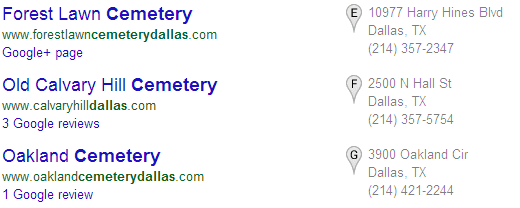
Why Your Customers Won’t Leave a Review Online
- Your customer’s aren’t excited for your product or service, often due to need vs. want (ex: morgue, funeral home, cemetery)
- Your customers are too busy and don’t see the value (B2B businesses that target C suite executives)
- Your customers aren’t internet savvy (ex: nursing homes)
- Your customers want to remain anonymous (ex: criminal defense attorney’s, strip clubs)
- Your customers don’t know you (ex: B2B company working for clients with multiple contractors)
Ice Cream Shops Aren’t Competing with Funeral Homes
Luckily your competition is other local businesses that are just as tricky. Your quantity and length of reviews can be much less than other industries. Receive only a couple of reviews and you should see a direct increase in local rankings. If you do have a competitor in your industry with many reviews, it’s probably a sign of foul play. Read the reviews and look for these signs:
- Were the reviews written all in the same month or in chunks of time?
- Are the reviews overly promotional, too well written or all positive?
- Are the reviews from employees or vendors? In Google, you can click on the name and arrive at someone’s Google + profile.
If you believe a competitor is creating false reviews, you can report it. Most review sites include guidelines on what is a false review. Here are Google’s. A word of caution, report the review at home and use a non-work or non-identifiable email address.
If the reviews are valid, it should give you insight into who is leaving the review, information you can use to increase reviews for your own business.
Step 1: Identify Your Customer Lifecycle
A recent Moz blog on local reviews is worth reading, especially for the customer lifecycle section, which can’t be overlooked. It is critical to analyze when and how you interact with customers, the stages of the relationship, and especially when the customer is happiest.
Take those insights and define when the customer should be encouraged to review. Keep in mind the guidelines for review sites which include: no incentives for leaving a review, no negative reviews for a competitor, no reviews on business premises and a few more.
The idea isn’t to ignore reviews and wait for them to happen, you’re probably doing that now and it isn’t working. The idea is to meet the guidelines of review sites, yet encourage reviews through proactive planning and education within the customer lifecycle.
Step 2: Identify Customer Loyalty
Next, it’s important to call out and define which customers are most loyal. Whether it’s repeat business or a customer who has turned into a loyal friend, chances are you have a small list of customers who would be more than happy to write a honest review if you simply asked them.
Take advantage of these friendly customers first, before putting in place a process for the future. Make sure to space out the reviews, you don’t want a lot to hit your profile all at once, it’s a sign of spam and they could be removed.
Step 3: Identify Which Sites Are a Priority
It’s confusing to ask customers for a review on any site so point them to those that matter most and only recommend 3. Look at the top citations by industry or research your competition. If a restaurant, Urbanspoon should be on your list or for a law firm, Avvo is a good bet. Google and Yelp tend to impact rankings more heavily for every industry, so don’t overlook the big players over those in your niche.
Also, take into careful consideration the experience of the review sites you are asking customers to write a review on. If your customers tend to wish anonymity, don’t encourage reviews on Google +. Or at least explain how customers can create an alias name for a new Google + profile. Google + can be one of the most valuable citations, but often requires the confusing and tedious creation of a new Google + social profile. Use clear, step by step directions on how to leave a review depending on your method of execution.
Step 4: Execute Your Local Review Campaign
Depending on your customer lifecycle and how you interact with customers, execute your review campaign. In person can be effective, especially for those with very difficult online customers. Instead of blatantly asking for a review, consider a survey which can be a printed handout or taken online. Not only will you get direct feedback from customers on many levels of your product or service, but at the end you can ask for a review and maybe even provide an incentive, for completing the survey – not the review. A review is a true indicator of customer satisfaction, and it can allow for a data crunching moment, your net promoter score.
An email campaign can also be effective, but don’t send a one off campaign. Reviews will arrive after constant engagement. Depending on your industry, consider a monthly email newsletter which provides ongoing touch points after a sale and provides value to your customers through editorial content from your blog. In the email, you can periodically send a reminder to leave a review or for those customers who engage most with the email, send a segmented campaign, asking for their honest feedback.
Combine a review strategy with other elements and you will reap multiple benefits including changing one time buyers into loyal, repeat customers.
Step 5: Use Workarounds for Reviews & Improve Local Rankings
If you still struggle with the idea of asking any customer for a review, even indirectly, than some of these suggestions might be helpful…
For a large organization, especially B2B, Foursquare can be your friend. Don’t overlook the power of a large group of employees. Announce an internal Foursquare competition, encouraging check ins between offices. The excitement could even likely carry over to your customers. Either way it adds a ton of social activity and contributes positively to your Local ranking factors. Employment sites such as Glassdoor and Indeed.com also should be a focus for employee reviews, especially if recruiting is a key component to the success of your business.
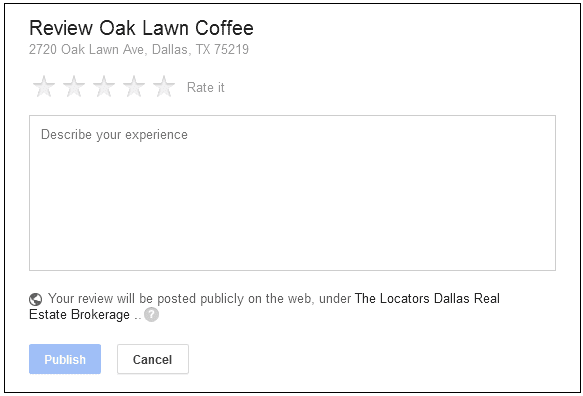
BARNACLE SEO ON GOOGLE +: THIS REAL ESTATE COMPANY IS LEAVING A REVIEW OF THEIR FAVORITE LOCAL COFFEE SHOP, A POPULAR DESTINATION.
For a truly tricky business, review other businesses as your business. This can be done on Google + and many other citation websites. If you have created a Google + Local or Brand Account, login and review vendors, suppliers, friendlies in your industry and more. Just make sure you can actually vouch for their services, remember it’s your company reputation on the line. This is also of great benefit. A business to business review on Google + links to your business Google + account! This could lead to more visibility and hits to your local business review page. It also sends a message to the business to reciprocate and review your company, adding more reviews to your own profile. David Mihm popularized this practice, now seeing a resurgence as barnacle SEO.
Corey Barnett is a Globe Runner Online Marketing Specialist. Follow him on Google Plus.
- « Previous Page
- 1
- …
- 32
- 33
- 34
- 35
- 36
- …
- 44
- Next Page »