









HARNESSING THE MAGIC OF META DESCRIPTIONS FOR INCREASED WEB TRAFFIC
By definition, ‘meta’ describes a thing that refers to itself. The word might also conjure something small. Both of these descriptors appropriately characterize the snippet that HTML tags use to summarize a page’s primary content and focus.
But these brief precursors are no small matter. They’re arguably the most significant determinant for whether or not your site gets visited or passed over by a potential customer.
And yet, in short supply these shorties are not – every second, search engines flash millions of metas in response to search queries. Here’s how to stay above the fray and increase your web traffic with compelling meta descriptions.
More about Metas
Meta descriptions are the short block of text that sits below a suggested website on the search engine results page (SERP) – see below. The space in which they appear is limited, and so are your characters.
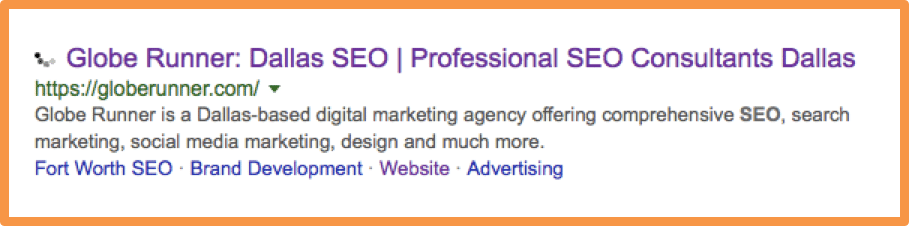
In late 2017 Google released an algorithm update that lengthened meta descriptions to 320 characters. Since then, there’s been some debate about length. Our recommendation? Pack in the most critical elements within about 160 characters. Otherwise, you risk all that compelling content being trunked (by the search engines that be).
How do Meta Descriptions Improve your Page Rank?
“Officially” you’ll reap no explicit ranking benefits from your meta descriptions. True, they aren’t directly built into the algorithm, but they still heavily impact your site’s click-through-rate (CTR). This, in turn, tells Google whether or not you’re a good match for specific search queries and subsequently where to order you on the SERP.
Writing Magical Meta Descriptions
Google Dallas SEO agency and you’ll get an onslaught of companies vying for your business. Before a customer ever has the chance to be swayed by your company’s prestigious awards, expert web design, or testimonials, the 2-3 sentences in your meta description will form the basis of their decision.
Meta descriptions are a fantastic way to your showcase services and collect clicks, so long as you:
- Write them like an elevator pitch. If you had just 15-seconds to make your sell, what would you say? Now’s the time to make sure your words are concentrated and direct, punchy and enticing. There’s no room for fluff. Every syllable counts.
- Create one for each page. Unique meta descriptions are a critical element of every page on your website. The more context and clarity you can provide up front, the more clicks you can solicit. Give each page the stage for a few brief seconds to capitalize on its full potential.
- Proofread then re-read. Give your meta copy the same level of care you would a billboard. Though the spacing may be small, the impact is substantial. Typos in your meta descriptions rob you of legitimacy and could very well cost you potential sales.
- Include a CTA. Whether you want them to learn more about your product, try it out risk-free, or redeem a discount code, the more action-oriented perks you give, the more clicks you’ll get.
- Make them keyword-focused. You aren’t turning up in searches by pure luck. Users are on the hunt for something specific. Make sure you target that special something with well-researched keywords. Not only does it make the search engines take notice, potential customers will, too.
Get meta with your meta descriptions and optimize them down to the smallest detail. Doing so could mean the difference between ranking on Google’s first page and being crowded out by a louder, more compelling online elevator pitch.
Want to increase your page ranking on Google SERPs? Let us give you a lift.
GOOGLE POSSUM UPDATE
The Possum update. Yet another animal update from Google. This one actually wasn’t named by Google. The search industry as a whole came up with the name.
What is the Possum update? It specifically addresses the map search portion of Google. It doesn’t address the rest of search. If you are affected by Possum, it would only be the maps or the locations part of your search. I have five points I want to cover about the Possum update.
The first one is separating the maps algorithm and the organic algorithm. Possum really pushes those algorithms apart and we find a stronger differentiator between what shows in maps versus what shows in organic. Back in the day, it was pretty muddled and a little more mixed. Now with Possum, there are very distinct algorithms.
Point two is the location of the searcher. The location of where I am physically standing when I do the search plays a massive part in results. That’s gone up tremendously since Possum. Google has gotten much more sophisticated about picking up the exact location of the searcher and serving the best result based on that location.
It completely makes sense. It’s actually a really good part of this update, I would say.
Another one is outside of city limits or surrounding areas are getting included more often. Before Possum, the name of the city that you were physically in made a big impact.
If I, for instance, looked for plumbing companies in Frisco, I would get plumbing companies that physically were in Frisco. It was less likely that I’d get a plumbing company in a neighboring city, even if that plumbing company was the best result for me.
Now, Google is much more likely to pull results from surrounding cities or adjacent cities into that result if they’re physically in good proximity and have good user reviews and things like that.
Another one is stricter filtering. Stricter filtering applies to a lot of businesses that maybe were trying to game the system a little bit by having locations that maybe weren’t their headquarters or weren’t their main location.
Maybe they had a Regus office or something like that, or maybe they were using their home address as their business address. Google has gotten much better with stricter filtering.
My last point is double location. Google has gotten much better at filtering out double locations. A lot of business owners had a building that they could split into two parts and have two different addresses and try to rank twice for the same search term.
Google has gotten much better identifying that. In fact, they’re going all the way up to the business ownership information to identify facts like these.
Let’s look at an example. Maybe somebody owns two buildings on the same street. There are two different addresses but they are really the same business, even if they have completely different names. Google can identify that through the business ownership information and will now only show one result.
Your likelihood of getting two listings by naming your business two different things has gone down dramatically. Local search has gotten a little more complicated, and just managing your citations is not enough anymore.
We’ve come up with a strategy specifically for Possum to help our clients get better results with these new algorithm updates. If you’d like to learn more about our strategy and have that implemented for you, give us a call. We’d love to talk to you and come up with a strategy that fits your business needs.
B2B VS B2C: LINK EARNING AND CONTENT MARKETING
We have customers that are B2B, and we also customers that are B2C. I think it’s interesting to dive into some of the differences in the way that we approach their marketing and some of the similarities between the two arts.
Today, I want to focus in on content marketing and link building for a B2B company versus a B2C company.
On the B2B side, some tactics that have been very successful are influencer outreach and guest posting in industry publications. We start the process of getting our clients involved in different industry organizations and getting links from those.
Other tactics include infographs. An infograph can be very successful in B2B marketing. Partners and vendors will commonly share or repost infographs on social media. They also can be successful in B2C, but it’s a little more targeted on the B2B side.
Now, B2C marketing is different. We’ve got to capture everybody’s attention. The content that we produce has to be very creative. Usually, it’s more fun and less serious, but that’s not always the case. It’s content that grabs people’s attention and people want to share it because they enjoy interacting with your brand.
What I’ve noticed is brands that link build using content are generally the brands that people like. People love that brand and they want to share their posts. They want to post about them on their Tumblr account. They want to show brand affiliation. On the B2C side, brand affiliation is a huge part of successful link building.
One of the most common strategies we do to get people excited about a brand is product reviews. Everyone values external validation. Reviews are great even for small brands or brands that no one’s ever heard of. A product review can validate the product and also can get links for that product and elevate your presence in search.
When you think about the two, you really have to separate your mind and go, “Who are we selling to and why are they buying?” It’s really the same question on link building. It’s “Who would link to us and why would they link to us?” Usually, it’s not always your customers.
A lot of the time on B2B, it’s your vendors or people you have business relationships with and B2C is your brand advocates. Think about that when you’re coming up with link strategies and separate in your mind what you do for B2B and B2C.
Thanks so much for reading. If you have any questions that you’d like answered in a future video, leave them in the comments. I look forward to reading them and hopefully answering those questions in a future video.
HOW TO IMPLEMENT SCHEMA INTO YOUR CONTENT
If you’re looking for a new technique to enhance your SEO, Schema is a powerful tool to boost your search engine result pages, also referred to as (SERPs). Not too many people use Schema, but it’s something that most people see and interact with on a daily basis.
Why Is It Important?
Not only does Schema enhance your general search engine results, and the way that they are displayed to users, but they can improve your click through rates on your website. Schema allows Google to show your website to a larger variety of searches, further gaining the attention of a wider audience.
Where & How To Use Schema
There are a variety of ways you can implement Schema into your own content in order to enhance your rich snippets, and expand your audience.
When you use Schema markup on your own company reviews, you can cherry pick which ones you like the most, and have those displayed to users. Keep in mind you might consider throwing in at least a 4.0 star review, over 5 star reviews to make it seem more realistic. A 4.8 star review will make your company stand above the rest, without looking too good to be true.
Health plays an important role in our lifestyles today, and with everyone monitoring their calories (especially with the New Year just starting), restaurants will want to inform their customers of the nutrition facts for their food. If you’re a restaurant owner, or any type of food related industry, an easy way to add Schema to your business page is to use the markup to create nutritional facts for your users to read.


Other Examples
Celebrities/Public Figures
This example of Oprah Winfrey shows specific information about her life, including her birth date, zodiac sign, and educational background. This information was embedded in the code in order to produce the rich snippet and improve SERPs.

Events
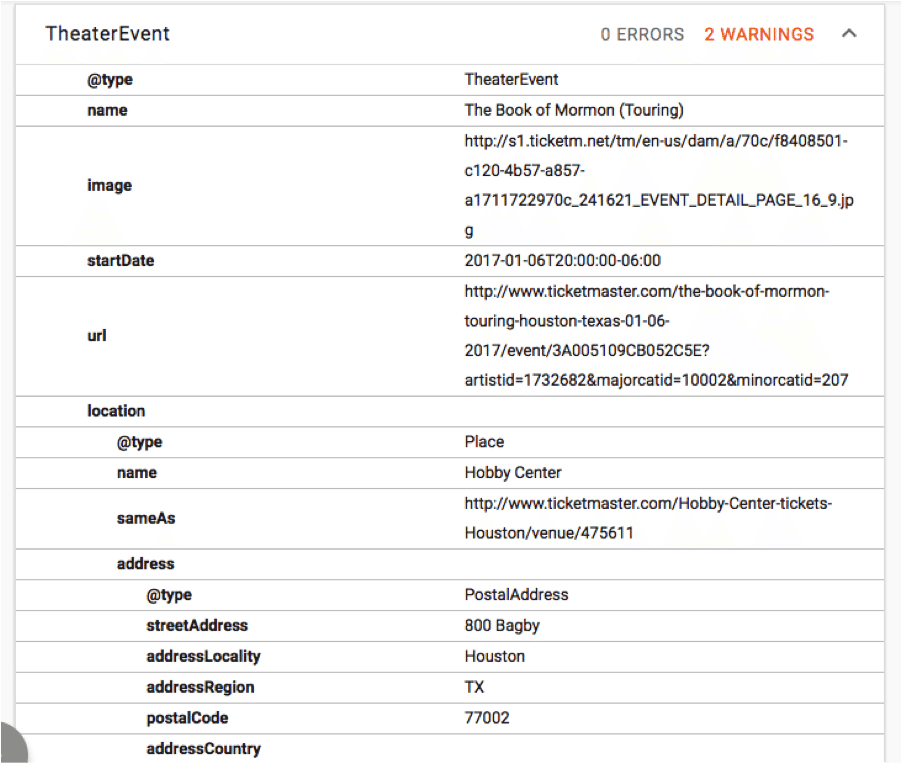
When you use a site, such as Ticketmaster, it’s easy to see the Schema implemented in the search results. By incorporating Schema, they’re getting free additional links, as you can see in the sample, by providing specific dates and show times that link directly to that performance to purchase a ticket.

Movies
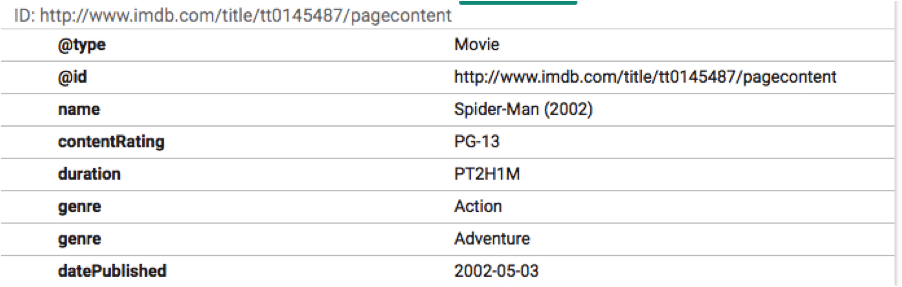
The next time you search for a movie, or a website, such as IMBD, you’ll find that Schema comes in handy when trying to find specific information, like ratings and genre.


GOOGLE CHANGES NEW SEARCH RESULTS PAGE LAYOUT
Google is constantly updating to keep up with the latest in trends and digital developments, and recently they’ve made some subtle, yet important changes to the search results page layout. Although they are cosmetic, these small changes can have quite a big impact, and play a much larger role when it comes to tracking analytics for both paid and organic searches.
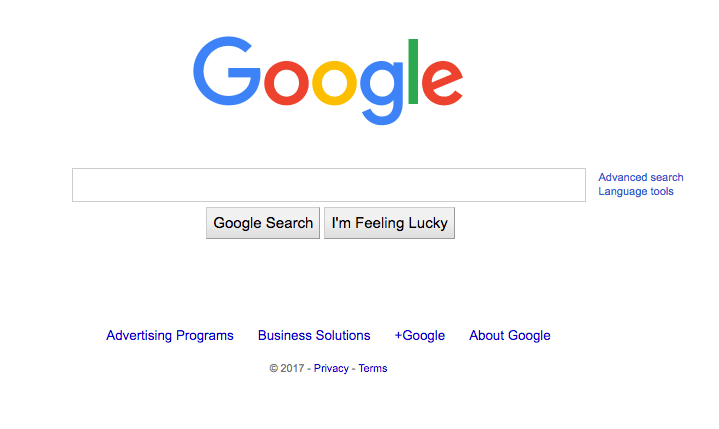
Below is the before and after pictures of what Google’s design was, and what it looks like today for their homepage.
Before
After
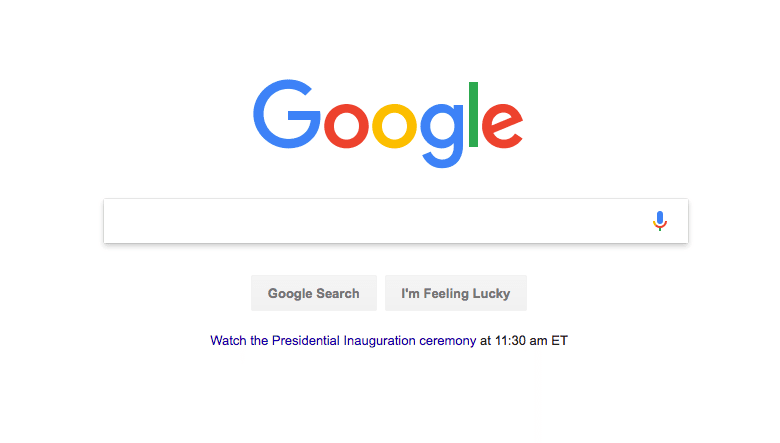
The subtle design features a much more distinct box around each item, with a drop shadow on the home page. You can find that changes were made to both the search results, as well as the search engine page.
Each search result is now more distinguished, and as you can see from the image below, the ads are more difficult to decipher from the organic results. The only thing that really separates the ads from the organics is the small green box to the left of the ad. This small separation will make it more difficult for users to identify the difference between the two, and I expect it to increase click through rates on the ads.
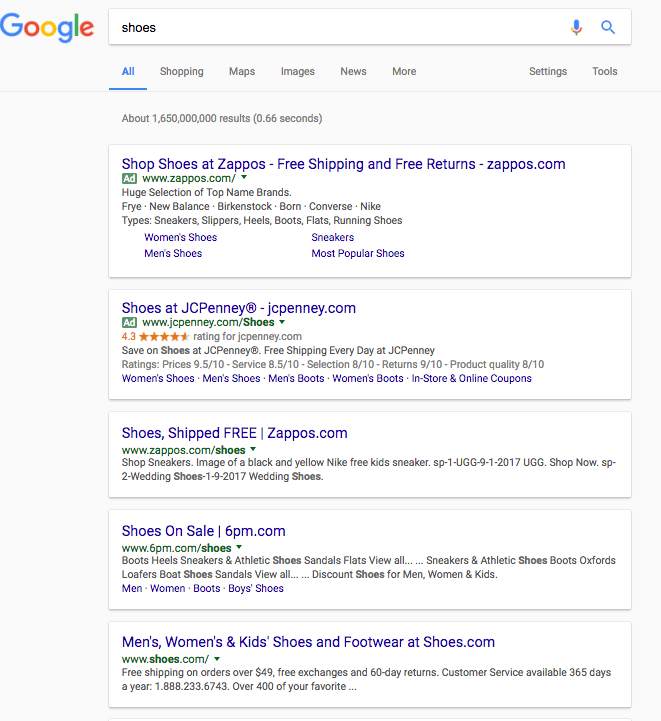
I first noted this change as of 01/19/17, and we’ll continue to track changes to the search results. We will be tracking to see if there’s any change in paid versus organic traffic for our clients.
5 REASONS TO RUN SEO AND PPC TOGETHER
When determining their online marketing strategy, many companies feel like they need to opt for either SEO or PPC. After all, they both ultimately achieve the same end—attracting visitors to your site and increasing revenue. Using both might seem redundant.
The truth is it’s not redundant at all. SEO and PPC do reach the same ultimate goal, but they do so by different means. PPC is highly targeted, whereas SEO is more organic, and the two can bolster each other dramatically. Following are five reasons why the two should be combined:
- Expanded data: When researching the effectiveness of keywords, using SEO and PPC helps you figure out what’s most effective by providing more overall data. This lets you quickly figure out what changes to make and increase clickthrough and conversion rates more promptly, making you more agile.
- PPC generates results quickly: Not only does PPC bolster keyword data, but it does so very quickly. This makes it optimal for testing keywords prior to use in an SEO campaign.
- SEO helps find long-tail keywords: Just as PPC helps inform short keywords, SEO can help you gather data on long-tail keywords. It does this naturally, and it can help you improve your PPC campaign with more targeted wording.
- Dominate the results page: A very practical way that PPC and SEO help each other out is by essentially doubling your presence on search engine results pages. Assuming both your ads and your content are well designed, you’ll be able to have organic results as well as paid ads appear on relevant searches.
- SEO can reduce PPC costs: In certain industries, high ranking keywords will demand a large price for PPC. In these cases, it’s more cost-effective to use these expensive keywords for SEO while targeting the cheaper ones in your PPC campaign.
At the end, the two combined add up to far more than either could accomplish independently. Contact the dedicated Digital Rockstars at Globe Runner to learn more about how our Dallas SEO services and PPC services can benefit your business.
GOOGLE PUSHES MAP PACK DOWN WITH ORGANIC RESULTS
UPDATE: Our discovery was picked up on 09-15 by Barry Schwartz at Search Engine Roundtable with comments from others in the industry.
Many are already familiar with Google’s Local Map Pack. Originally known as the ‘Local 7 Pack’, where 7 local businesses were featured, we saw it cut down to just 3 being featured in August 2015. Landing a spot in the Map Pack, whether it’s been 7 or 3 listings, has provided local businesses many benefits, including:
1. Enhanced visibility in search results
2. On occasion, 2 organic listings – one in the map pack and another in the traditional organic results
3. Reviews, phone numbers, and other items featured that encourage / make it easier for customers to reach you
Google Pushes Map Pack DOWN with Organic Results
Originally, the Map Pack came directly after paid ads which appeared at the top of the page. But this morning, Daniel Thomason, one of our senior SEO specialists, noticed multiple organic listing appearing ABOVE the map pack, in addition to paid ads:
As you can see in the image above, 4 paid ads are still featured at the top, but directly under those paid ads and BEFORE the 3 Pack are 4 organic results.
This means the local map results are HALF WAY DOWN THE PAGE!
How Did We Find This?
In this case, a search for ‘air duct mold removal’ triggered the results. It appears Google might have interpreted this as a do-it-yourself query, as the first 4 results have info on how to tell if you have mold in your air ducts, steps to remove it, etc.
This was the first time anyone on our team had seen this and we hadn’t seen chatter of it online either. We’ve got a discussion started at the Local Search Forum if you’ve got any input or can replicate these results.
How Might This Affect Local Businesses?
Clearly, this is not good for local businesses trying to achieve high organic visibility in Google.
From a mobile perspective, we’ve already seen the local map get pushed off the screen just due to paid ads appearing above it, but now it could potentially be even further down with these organic results included above.
For desktop searchers, it likely prevents a certain amount of results from ever being seen by them.
We know through use of user-tracking tools that people are very unlikely to scroll through pages to find what they’re looking for. Similar to what’s happened with mobile, this pushing down of the map pack makes it more likely searchers end up going to a paid ad to solve their problem, regardless if that company’s actually the closest service provider to them, the best reviewed, etc.
Final Thoughts
We don’t think this is something to freak out over – everybody in our industry knows Google’s always testing things in their search results. In fact, when searching ‘air duct mold removal’ later in the day, we saw results without any local map, results without any paid ads, and results with an answer box at the top.
But we do think it’s something to watch and be concerned with – local SEO is filled with enough challenges already, and if this becomes a standard feature in Google’s search results, it’ll be another challenge we face.
6 SEO TIPS TO HELP YOUR SMALL BUSINESS SIZZLE THIS SUMMER
The year is half way over, but there’s still time to heat things up in 2018. Whether you’re bent on driving more traffic to your site or simply need more sales in the pipeline, search engine marketing has never been hotter.
We’ve pooled six of summer’s best SEO practices to help you sizzle this season. Look out, these SEO optimization tips are coming in hot!
1. Make sure yourmenu of services is up to date
In essence, this is your secret sauce to help out-market your competitors, get clear about your brand’s keywords, and define your categories in Google. Adding a FAQ, testimonial, and case study section to your service page will really sell it, too!
2. Utilize Google Trends and Insights to plan compelling content
‘Editorial data-based stories’ is a new feature of Google Trends that’s helping content creators make their blog topics, keywords, and social media strategies more specific – and effective! With access to data trends culled from trillions of online searches, digital marketers can gear content based on what users all over the world are querying both in real-time and overtime – for free.
3. Take advantage of new tools like In-Marketing Audiences
Want to improve your search campaign performance on Google and Bing? In-marketing Audiences allows you to target users with search histories that align with your product or service. It’s free, has the potential to lower your CPA, and helpful for gearing your search campaigns and online ads toward audiences at the end of the buying cycle.
4. Have your web dev team code for priority hits
Wish you could control what loads first on your site? Chrome Beta is about to help your most important features take center stage. In our quarterly review of the most promising digital marketing trends of 2018, we learned that developers will soon have the power key in code that distinguishes certain digital assets on your site as high-priority. This means that critical header or prized picture can start captivating your target audiences sooner than other content.
5. Set up local service ads (LSAs)
Whether you build houses or clean them, you’re likely operating in a defined SBA (service business area). Makes sense to put your online advertising dollars there, right? Google local service ads is a pay-per-lead ad platform that can help small businesses keep their review ratings high and increase their brand awareness in their local market.
6. Drill down and really look at your data
Google analytics used to be the end-all-be-all for making discoveries through data. However, Google Tag Manager, GA’s more sophisticated older sister, can track any activity you program it to. It collects information from a variety of verticals, giving marketers the freedom to isolate activity on any number of key metrics. Essentially, the more you understand what users are doing on your site, the better chance you have of making them customers.
Hot on the trail of more SEO best practices for the rest of 2018? Give us a shout! We promise we won’t just blow hot air at you.
VIDEO: THE DIFFERENCE BETWEEN SEO AND PPC
Hi, Eric McGehearty from Globe Runner here, and today I want to talk about the difference between SEO and PPC.
I think most of us know that search engine optimization is a process of getting a website to rank better in search results on Google, Bing, Yahoo, or whatever search engine you choose in the organic section.
Pay per click is a form of advertising, generally in search, that is the process of buying ads at the top of a search engine based on certain keywords.
They have a lot in common, because with both we’re targeting specific keywords and phrases to get a relevant customer or buyer to come into the website. If you have a number 1 result on SEO and a number 1 result on pay per click, you’ll achieve a similar outcome.
But with all that said, what should you expect from a campaign? The biggest difference is speed. SEO is something that is built over time and earned based on lots of factors including your popularity on the web. Other factors include how many people are linking to you, who is linking to you, your content, how great it is, your keyword usage, your site architecture, and your indexability.
When you are thinking about an SEO campaign and evaluating the performance, it should be looked at monthly, quarterly, annually. As much as you would evaluate any other KPI.
But it is a long term goal and not expected to see huge gains from month to month. With compounding interest in mind, you will see massive gains over extended periods of time.
Pay per click is a little different. It’s much quicker. you will see results very fast. in fact, you will see traffic the first day you turn it on. And that traffic hopefully will convert to leads and sales fairly quickly.
It usually takes a few weeks to a few months to really dial a pay per click campaign in and start generating really measurable, good results, but nonetheless, it’s a fast return on your investment.
Will it have a compounding interest effect? Generally no, not without doing extensive A/B testing and conversion rate optimization. Those will improve over time and ongoing enhancements to the campaign will improve but it won’t compound the same way SEO does. You will need to spend more money to get better results.
If your pay per click campaign is profitable, that’s exactly what you should do. If it’s not profitable, you should cut if off or make some significant changes to the way the account is structured before it continues.
Thanks so much, I look forward to talking to you next time.
- « Previous Page
- 1
- 2
- 3
- 4
- 5
- 6
- …
- 12
- Next Page »