













TOP 10 GEOGRAPHIC NEW GTLD EXTENSIONS
As part of Globe Runner’s efforts to watch the New gTLD extensions in regards to SEO (Search Engine Optimization) and our SEO Power Rankings Index, we looked at the geographic extensions. We wanted to know which of the new domain extensions actually have live websites being developed on them. And of those developed websites, which new geographic extensions have the best websites on them. Here’s our list of the top 10 geographic New gTLD extensions.
1 .nrw
2 .scot
3 .brussels
4 .eus
5 .bzh
6 .bayern
7 .hamburg
8 .nyc
9 .paris
10 .berlin
Honorable mention:
11 .vegas
12 .quebec
13 .ruhr
How We Determined the Rankings
We looked at the top 500 new gTLD extensions based on number of registrations. Then we pulled all of the websites that have been developed on those new extensions and looked at the quality of those websites. Some of the factors we used to determine quality were the number of backlinks, the Trust of those sites, and the Trust Flow/Citation Flow of those sites. Trust Flow and Citation Flow are Majestic.com quality factors.
For our geographic-related extensions, we determined that a new gTLD domain extension was geographic-related because of the extension’s restrictions. For example, .NRW has restrictions:
— Restricted to individuals with residence in the postal code area of the federal state of North Rhine-Westphalia; or
— individuals that have place of business in connection with self-employment or freelance work in the postal code area of the federal state of North Rhine-Westphalia; or
— entities that have place of business in the postal code area of the federal state of North Rhine-Westphalia
A few of these extensions technically don’t have registrant restrictions (i.e., they don’t have to have an address in the region), but they sites being built on those extensions are related to the region, so we made an exception.

The top sites that we’ve identified during our review of the data include:
https://land.nrw/
http://www.gov.scot/
http://be.brussels/
http://www.eitb.eus/
Our favorite website built on a New gTLD Extension? Of course it has to be the Eiffel Tour website: https://www.toureiffel.paris/fr.
**Note: Keep in mind that this list is based on the quality websites built on these extensions. There are other geographic extensions that are popular that have a lot of registrations and websites–but they didn’t show up on this particular list. Highly trusted websites have to be built on an extension in order for it to be considered and thus show up on this list.
THE CONTENT TAKEOVER
How much content is on the web and how has it grown over the years?
In March 1989, the World Wide Web turned 26. What was once a thing of sci-fi, the web has grown from Star Trek fiction to an everyday survival tool during its 26 years of life. As newspapers become scarcer and books slowly move towards electronic versions, the web has quickly become the hub for a variety of content from all around the world. Now it’s more than just what content is on the internet, it’s also about how users are engaging the content and what they are using to get to it. Let’s take a look at how the web and its content have grown over the years by looking at when programs and other milestones that encourage content marketing came to be:
1895 – 1987 Magazines take off starting the industry for published and print advertising.
1995 Personal homepage service, Geocities, launches.
1996 Placeware starts offering web conferencing services.
1999 Blogger launches.
2001 $20 billion. The amount spent on custom content.
2003 MySpace launches. As does LinkedIn.
2004 a blog is born. Microsoft launches Channel 9, the first ever corporate blog from a big wig company.
- Also, Facebook is launched.
2006 Twitter is born.
2009 Revised FTC endorsements and testimonials guidelines go into effect impacting endorsers and bloggers.
2010 Content Marketing Institute is born.
- 25% of marketing budgets spent on content marketing.
- 88% of all brands use content marketing
2011 Importance of content is starting to take lead. Chief Content Officer Magazine launches in print and digital.
2013 33% of total budget spent by B2B marketers on content marketing initiatives.
- The most popular content marketing tactics include social media, articles, enewsletters and blogs.
2015 70% of B2B marketers are creating more content than they did one year ago, even those who say they are least effective (58%) and those without any type of strategy (56%). (Content Marketing Institute)
We’ve quickly shifted from worrying about prices and promotions to creating a true connection with consumers through content. If marketing used to be about the 4Ps (Product, Place, Price, Promotion) Socialnomics author Erik Qualman claims it’s increasingly about the 4Cs (Creating, Curating, Connecting and Culture).
As content continues to grow, evolve and take over the web, three things are certain. With content you should:
- Always provide value. It’s about building lasting relationships with brand ambassadors excited to spread the word about your product or service.
- It won’t be read because it exists. Use the content to find your audience by making targeted distribution a key component to your overall content marketing strategy—approach owned media, paid media and earned media channels for a strong three-pronged approach.
- Set specific goals. Set clear objectives and measure your success metrics so you can track, measure and optimize against branding campaigns. Instead of being a jack of all trades, create a niche for your brand and lead the way.
How has your practice evolved alongside content and it’s growth over the years?
PERHAPS THE MOST AWESOME TRADE SHOW BOOTH ON EARTH
When trade show booths turn out just perfect
Last week we got an early present from our client National Trade Shows Displays: The new Globe Runner trade show booth. It will be making its debut at this month’s Texas Restaurant Association Marketplace trade show.
For anyone who’s ordering a booth for the first time or replacing their current one, we feel your apprehension. Choosing the right structure, then the right design, and then practicing dismantling and erecting it can be an intimidating exercise. Fortunately NTSD’s David and Cherie Ostermann (here flanking Globe Runner CEO Eric McGehearty) made the process easy and enjoyable. We have to admit the booth is making us pretty excited for the show.
We chose a 10 foot Coyote curved Pop-Up and, to stand out from other exhibitors, decided to go for a whimsical illustration as the backdrop. Hence this fun cow jumping over the moon, one of several illustrations commissioned from artist, illustrator and muralist Jen Carnes of Little Cloud Design.
Thank you National Trade Show Displays, for making this awesome booth. We promise to pack it up properly and not kink it or anything.
And thank you Jen, for this fab drawing. We think it captures the spirit of Globe Runner perfectly.
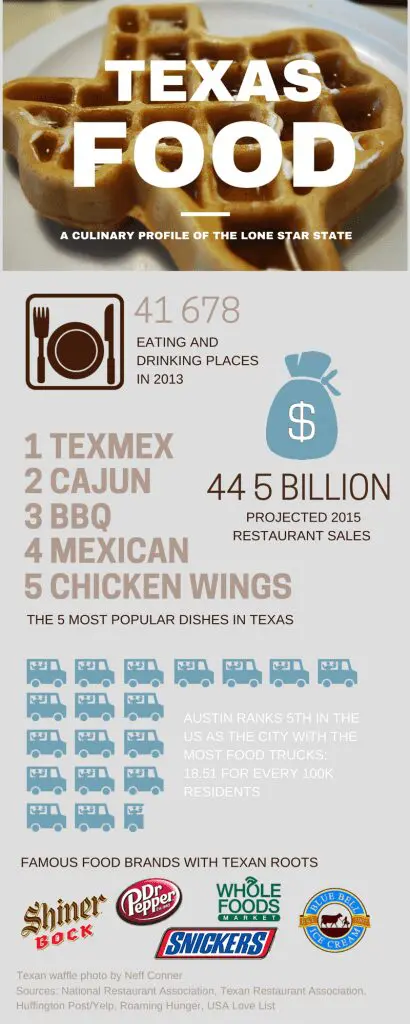
Globe Runner will be at the Texas Restaurant Association Marketplace event on June 28-29, 2015. Visit us at Booth 1210 if you are attending. Eric will also be speaking at the Technology Pavilion about how to get found on Google. Plus: Check out this infographic on Texas food that we created in honor of the occasion.
A TEXAS RESTAURANT ASSOCIATION-INSPIRED INFOGRAPHIC
The Texas Restaurant Association’s annual Marketplace is one of the largest and most prominent food and beverage industry events in the Southwestern region of the United States. Over 300 exhibitors from the restaurant, food supply and food services sector will be at the trade show which will be held at the Dallas Convention Center on June 28 to 29, 2015.
Globe Runner will be exhibiting for the first time at Marketplace, and CEO Eric McGehearty will be speaking at the Technology Pavilion about how to improve your local search rankings. If you are at the event, do drop by our booth or attend Eric’s talks. We have a lot of experience in marketing, branding and SEO for the food and beverage sector, so feel free to pick our brains over these two days!
In the spirit of the occasion (and since Marketplace is making us think about food), we created this short infographic about Texan food stats and famous food brands. Feel free to share it or embed it in your own blog.
THE THREE MOST IMPORTANT CITATIONS FOR A CONSISTENT ONLINE BRAND
Dun & Bradstreet, Assumed Names & Secretary of State Records
But First, Are Citations Still Important for Search Rankings?
In regards to Local search engine optimization, citations are mentions of a business name, address and phone on an authoritative site, and they still play a role in rankings online. Search engines like Google use this data to understand where your business is located and what it is called.
In the most recent Moz study of Local SEO ranking factors, citation consistency is still a top contributor. 15.5% of the reason your business or a competitor ranks well in local results is due to a consistent business name, address and phone number online.
Brand signals are also becoming more important in 2015 and will continue to affect organic results. The number of customers searching for your business name in Google, is a widely speculated ranking factor, revealing strong brand awareness. Press and media should refer to your business name and products correctly, spelled correctly. Ideally, all online mentions of the business name and address, should match Dun & Bradstreet, Assumed Name Records and Tax Records.
These three citations in particular are often overlooked by business owners and SEO consultants, yet reveal issues in NAP (name, address and phone) and the brand, that can plague a business online and cause more headaches if ignored.
The Most Official Citations
Dun & Bradstreet, Doing Business As (DBA) or Assumed Name records and Secretary of State Listings are the most official citations, created when the business was originally started or each year during tax season. Dun & Bradstreet is the oldest business directory in existence, since 1841. That predates YELP by a few years I believe!
The first task of a local SEO campaign is to lock down the business data: the official business name, address, phone, website, pictures, categories etc. Here’s the problem, you can’t simply ask the business owner what the official name of the business is… In the same way you should check address formatting using the USPS zip code tool, it should be a mandatory step to check the legal business name on all three of these official sources.
More reasons why these three citations are important
- The NAP is indexed by Google and visible to customers
- The NAP is shared with other data aggregators, meaning inconsistency on these three citations will affect many other sites.
- The NAP is official government information and a strong signal of brand name and geolocation signals.
Ready to get started? Find out how to update and claim these citations in the following guide. As a bonus, we will even address several common questions around business names and the implications it can have online.[contact-form-7 404 “Not Found”]
TOP 20 BEST NEW GTLDS BASED ON QUALITY
As a part of Globe Runner’s New gTLD SEO Power Rankings Index, we gathered data from over 20,000 websites that have been actually built–or developed, on New gTLD domain names. From that list of over 20,000 websites, we have studied these websites’ qualities, and pulled a lot of other interested data. We were able to find the best New gTLDs based on quality.
Sure, there have been a lot of New gTLD domain names registered, but just because a domain name is registered doesn’t mean that an actual website has been built on that domain name. Globe Runner took the time to come up with an extensive list of fully developed websites–most of which are indexed in the search engines, and some actually ranking well in the search results.
One of the data points that we analyzed was related to the quality of the websites built on the New gTLD domain names. What we wanted to know is which New gTLDs have been more successful in attracting quality websites to be built on their TLD.
Based on quality–mainly the Majestic.com Trust Flow factor. Here is our list of the top 20 New gTLDs with the best domain names, based on Trust Flow.
Top 20 TLDs with Best Domains Based on Trust Flow
.nrw
.scot
.brussels
.eus
.bzh
.agency
.wiki
.foundation
.tips
.today
.bayern
.hamburg
.nyc
.digital
.farm
.domains
.london
.marketing
.beer
.guru
Trust Flow is defined by Majestic.com in this way:
Trust Flow, a trademark of Majestic, is a score based on quality, on a scale between 0-100. Majestic collated many trusted seed sites based on a manual review of the web. This process forms the foundation of Majestic Trust Flow. Sites closely linked to a trusted seed site can see higher scores, whereas sites that may have some questionable links would see a much lower score.
Globe Runner considers Trust Flow to be a very important factor when gauging the overall quality of a website, as the most trusted websites have a higher Trust Flow value.
Globe Runner also looked at the actual websites with the highest Trust Flow values assigned to them from Majestic. The following is a sample of the best New gTLD domain names that we found based on Trust Flow:
URL Trust Flow
https://land.nrw/ 71
http://www.gov.scot/ 69
http://be.brussels/ 69
http://www.eitb.eus/ 67
http://www.bretagne.bzh/ 67
http://yanntiersen.bzh/ 66
http://www.leefmilieu.brussels/ 65
http://rabbithole.agency/ 62
http://www.berria.eus/ 61
http://kodi.wiki/ 61
http://lgbt.foundation/ 61
http://www.argia.eus/ 60
http://thehub.tips/ 60
http://www.flowercarpet.brussels/ 60
http://www.kreuzfahrten24.today/ 59
http://cirb.brussels/ 59
http://www.gruenderland.bayern/ 58
https://www.medianet.hamburg/ 57
http://www.pik.bzh/ 56
http://gaycitynews.nyc/ 56
GOOGLE CHANGES NAME OF GOOGLE WEBMASTER TOOLS TO SEARCH CONSOLE
Google has changed the name of Google Webmaster Tools to Search Console, announcing the new Webmaster Tools. They have updated Google Webmaster Tools to now include the Search Analytics, but right now the only real change that’s taken place is the name change.
As you log into the Google Webmaster Tools, which is still available by going to Google.com/Webmasters, I have a feeling that that URL will soon be removed, and we’ll need to go to the Search Console URL, which Google says is at http://g.co/SearchConsole
My suspicion is that over time, we will be phased out of Google Webmaster Tools, and eventually will be using something different then Google Webmaster Tools. For example, we may be losing some tools that we’re used to using, and we may continue to see other tools that are either more helpful or pretty much useless.
Typically, when we see a name change of a product or service, that comes along with some other major changes, and the name is only a small part of the changes. For what it’s worth, frankly I have been fairly happy in the past with using Google Webmaster Tools, as that’s what it’s intended for: a site’s webmaster to use, and not the typical “business owner” or website owner. There are a lot of business owners that I know who would not feel comfortable with using Google Webmaster Tools, and they generally wouldn’t understand what it all means (nor do they care to use it).
As of this post, though, the only major change that’s happened to Google Webmaster Tools is then name change (and the addition of the Search Analytics tool). Let’s wait and see what other changes happen. I’ll keep you posted.
5 MYTHS OF B2B MARKETING
5 Myths of B2B Marketing
B2C marketing is trendy. There’s a glut of information available about how a business can reach out to individual customers. There is relatively little information available regarding B2B marketing. Because of this lack of information, it’s important to take a discerning look at B2B on its own instead of lumping it in with B2C. Let’s take a look at 5 common myths of B2B marketing to elucidate some key differences and challenges of B2B marketing.
1. B2B Marketing is Essentially the Same as B2C Marketing
Although there are many aspects of B2B marketing that overlap with B2C, B2B marketing is still a completely different beast than B2C. Your target audience in B2B marketing is going to be a business and employees within said business. B2B customers usually have a pretty good idea of what they want. They may desire to be educated to some degree, but they have honed in on their goal much more completely, in general, than your average B2C customer. Don’t make the mistake of assuming that all of your standard B2C techniques will transfer over to B2B marketing.
2. Social Media is Always Beneficial for B2B
Social media is an incredibly powerful tool in this digital age in which we live. It allows a company or individual to reach out to millions of people in a moment through numerous compelling media channels. Despite this value, it is not always ideal for B2B marketing. The customers you attempt to target often won’t be interested in finding product or service information on Facebook. They may feel that Pinterest is not professional enough to yield valuable results. LinkedIn can be among the social media networks that are effective for B2B, but before you start to launch a concerted social media campaign, make sure that you first verify that your audience is interested in using social media for business.
3. Outbound Marketing is Ideal for B2B
Let’s start by clarifying that outbound marketing most certainly has its place in an effective marketing strategy as a whole. However, it may be more effective in B2C than in B2B, and here’s why: As previously mentioned, B2B customers usually have a better idea of what they are looking for than B2C customers. This means that reaching out to them with outbound marketing can be ineffective or even counterproductive. B2B customers are used to parsing through the fluff to get what they want, and pestering them with constant outbound marketing can drive them away. Instead of outbound marketing, take a look at inbound marketing for an effective B2B strategy. Inbound marketing is basically marketing that focuses on helping customers to find you, instead of reaching out to them. Therein lies its B2B marketing power.
4. B2B Marketing Should Only be Done Through Networking
This is actually a rather common, and surprising, viewpoint. Many marketers, both agency and in-house, have become jaded after watching various marketing efforts not show results in the B2B sphere. This is largely due to our first myth. After various marketing techniques fail, very traditional methods such as networking are reverted to. There is definitely a place for networking in B2B marketing and business development. However, it most certainly is not the only effective method. There are numerous marketing techniques available today that, when slated for B2B effectiveness, can produce sustained positive results.
5. B2B Marketing Starts At the Contact Form
There’s a rather pervasive belief in many B2B businesses that the sales and marketing process only begins when a potential customer submits a request for quote. This belief hampers marketing efforts to a very significant degree. Although you may not hear directly from a customer until they submit an RFQ, make no mistake, they have been researching and vetting your product or service long before they get to this point.
It is for this reason that SEO is such a valuable tool for B2B marketing. SEO allows a B2B company to get involved in the pipeline earlier and more effectively. If you actually believe that you have no control over the process until an RFQ is submitted, then you have already missed an opportunity. Making sure that not only what you present is the message your customer wants, but also that they can find said message is absolutely crucial to marketing in a B2B world.
SEO allows a B2B company to have some control in the initial search stage over what the customer finds and how quickly they find it. This is critical to not only bringing satisfactory volume to your product or service, but also to closing the sale. The less a potential customer needs to search to find what they want the more likely they are to convert into a paying customer. SEO for B2B marketing is about enabling potential customers to find and be delighted by what you have to offer.
Sometimes we forget that for anyone desiring to perform effective marketing for any business, one must first understand their market. B2B is a unique market and there are many tactics that simply don’t transfer from B2C. If you make sure that you are marketing within the proper context you will have much more success in the long term.
Andrew Dean is an account manager at Globe Runner.
Photo credit: Zachary Korb
TOP WEBSITES BUILT ON NEW GTLD DOMAINS WITH THE MOST BACKLINKS
As a part of our generating the Globe Runner New gTLD SEO Power Ranking Index, where we gather a list of the websites that have actually been built on New gTLD domain names. Once we gather the URLs (this latest update has over 20,000 websites included in it), we look at lots of interesting data. One of the data points that I was very interested in looking at is the number of backlinks that these New gTLD domain names have. Keep in mind that we’re only really talking less than two years of availability, since around January 2014 when these started to get registered.
This time, I looked at the top fifty websites with the most backlinks to them. Interestingly enough, I found that there was a broad spectrum of backlinks and types of websites that were built. But only ONE website with over 1 million backlinks. There are a few others with a lot of backlinks, and I was amazed by the fact that there are so many insurance and .cheap domain names on the list. Here is the most interesting data points that I gathered from our list of the top 50 websites that have the most backlinks. All built on New gTLD Domains.
10 of the top 50 sites with the most backlinks are “pills” websites.
24 of the top 50 sites with the most backlinks are insurance websites.
Only 4 of the top 50 sites with the most backlinks are adult websites.
Only 1 websites of the top 50 sites with the most backlinks have over 1 million backlinks. 3 have 900,000 backlinks, one with 800k backlinks, one with 700k, 6 with 600k, and 9 with over 500,000 backlinks. The rest have over 200,000 backlinks.
27 of the top 50 sites with the most backlinks are hosted on .cheap domain names.
The top 50 New gTLDs for backlinks include:
.careers
.cheap
.center
.life
.wtf
.build
.buzz
.today
.bid
.estate
.nyc
.systems
.sexy
.foundation
.discount
.guru
.black
There is only one “backlinks” website on the list, in the business of building backlinks, and it has 600,000 backlinks.
The website that has over 1 million backlinks is an employment website.
Only one website of the top 50 sites with the most backlinks uses a subdomain other than the www subdomain.
Online 3 of the top 50 sites with the most backlinks use the www subdomain on their website. ALL the other 47 websites do not use a www in their main URL, they use the non-www version of their site. For example, they use keyword.gtld rather than www.keyword.gtld. I find this to be a very interesting trend amongst the New gTLD domain names.
The top site, with more than 1 million backlinks, has a “create date” of March 5, 2014. That means that they built over 1 million backlinks in 14 months. That’s 74,360 backlinks per month. Would you call that unnatural building of backlinks? Apparently it’s not a huge problem, because the site ranks #1 in Google for the keywords in their domain name (i.e., keyword1.keyword2).
Because of the nature of these sites (the topics of the top 50 websites built on New gTLD domain names with the most backlinks), we feel that we don’t want to reveal the actual URLs publicly but listing the full list in the post. If you are genuinely interested in the list, feel free to contact us and we’ll be happy to send you the list offline. However, here is the list of the top 20, in an image file:

We use the Majestic toolset to gather the link statistics, and we use a variety of Google search queries to gather our list of over 20,000 websites that have been developed on New gTLD domain names. Our process is proprietary to identifying the list of these websites, but generally the process involves starting with the list of New gTLD domain names, sorted by the most registrations. We then use Google search queries, over a period of a few weeks, to identify websites that have actually been developed on New gTLD domain names. No “parked”, redirected, or “low quality” content websites are included in our list. Once we gather the initial list, we use Majestic.com to gather link data and other data that Majestic’s variety of tools provides.
In an upcoming post, we’ll reveal the updated New gTLD SEO Power Rankings Index.
- « Previous Page
- 1
- …
- 28
- 29
- 30
- 31
- 32
- …
- 44
- Next Page »