
















RANKBRAIN: GOOGLE’S AI ALGORITHM
On October 26, 2015, Google unveiled its newest algorithm, RankBrain.
What is RankBrain?
RankBrain is an artificial intelligence (AI) system that sorts through Google’s indexed content and provides the most relevant websites for particular queries. RankBrain is one of many algorithms that make up Google Hummingbird. Hummingbird is Google’s overall search algorithm that consists of Panda, Penguin, RankBrain and others.
How does RankBrain work?
RankBrain is just one component of Google’s search algorithm, but its goal is to answer unique queries that Google has never seen before.
Now, according to Danny Sullivan, Google answers 100 billion searches per month. That equates to over 3 billion searches a day. On top of that, roughly 18% of daily search queries have never been asked before.
Therefore, 500+ million searches/day have never been seen before. Answering those queries has been a difficult process, but this is RankBrain’s strength.
RankBrain’s purpose is to interpret queries that may not contain the exact words/phrases that the searcher is looking for. Essentially, it attempts to re-route misguided searches.
How important is RankBrain?
According to Greg Corrado, a senior research scientist at Google, RankBrain is the third-most important ranking signal contributing to the result of a search query. That’s huge!
Google has over 200 hundred rankings signals, all of which are unknown, but highly speculated. For a Google employee to say outright that it’s the 3rd most important ranking signal is big news.
SOCIAL MEDIA ROI: HOW TO TELL IF IT DRIVES TRAFFIC TO YOUR WEBSITE
by Claire Parker
The subject of social media ROI is a vast, complex area that we won’t get into — there are far more substantive sources out there on the topic.
What we do want to share is how you can tell if your social media posts are driving traffic to your website. It will however require viewing Google Analytics. If Analytics hasn’t been deployed on your site, make sure it is so you can follow along.
(These would be the most straightforward instructions for creating a Google Analytics account and installing it, with pictures of the process for all of you visual learners out there.)
Let’s say you shared a blog post via social media. On the left-hand menu, go to Behavior –> Behavior Flow –> Site Content –> Landing Pages. Cut and paste the URL path name of the blog post into the search field, then enter.
So for example, we want to see whether our social media shares of https://globerunner.com/a-free-customizable-content-calendar-for-2016/ were effective. You will only paste /a-free-customizable-content-calendar-for-2016/ into the search field. The table that shows up will show the number of visits attributed to this blog post. In this example, we see that the content calendar post was the source of 1,113 visits.
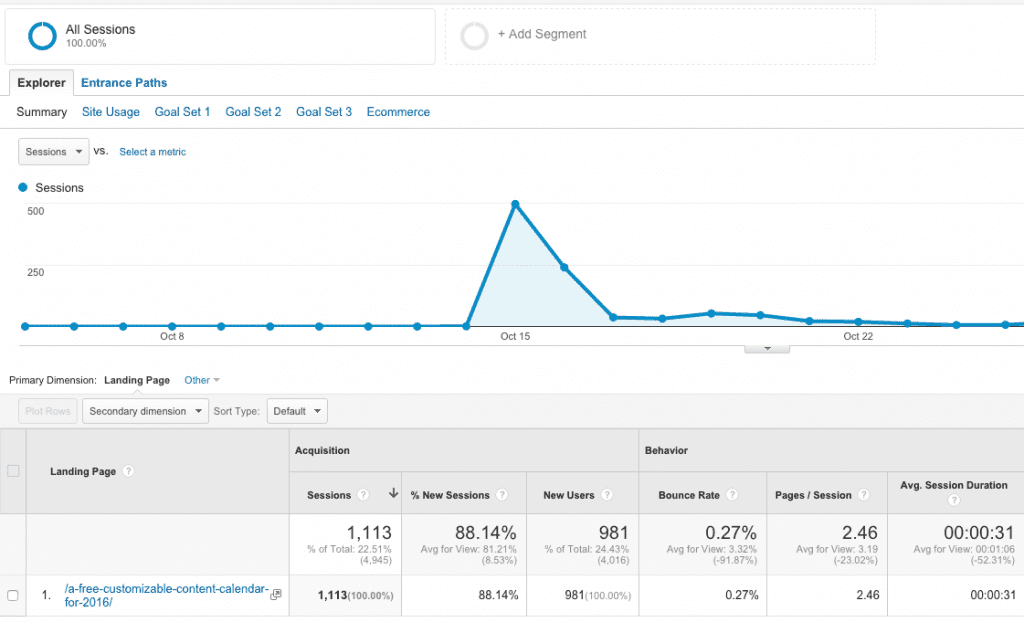
To find out which social media platforms were behind the visits, click on the Secondary dimension drop down menu on the menu bar. Select Social –> Social Network to see the specific platform. In our example, the top network was Reddit, followed — rather distantly — by Facebook.

What is ‘(not set)’? Good question. According to Google, there could be many reasons for getting this value, but it’s generally due to a session having no page or screen views. Other reasons could be bot traffic or the visitor not allowing a cookie to be placed.
One way to get more clarity is to click on the Secondary dimension drop down menu again and choose Acquisition –> Source/Medium. Source would be the originator of the traffic and medium is the method. You should see some social media platforms among the sources.

This appears to be a more substantive view in that you can see visits via mobile which are identified by the ‘m’ before the platform.
Having said that, it’s better to be pro-active rather than reactive.You must’ve noticed that when you share newsletter content that arrives in your inbox that the URL contains UTMs? These were created using Google’s URL builder. Use this tool to generate URLs for your social media posts that will show up in the Campaigns section. The generator will create a unique URL for you showing the source, medium and name of the campaign.
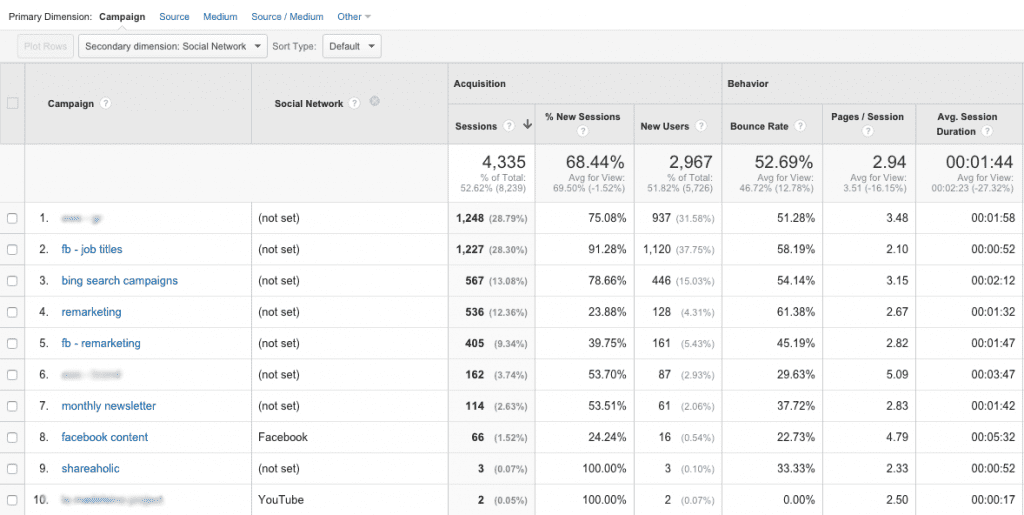
In this example from a client’s campaigns, you will see that Facebook posts drove 66 visits to the website while a video on YouTube resulted in two visits. Identifying these social-sourced visits in a campaign allows you to find richer data along their customer journeys, whether that be downloading a gated piece of content, filling in a contact form or, in the case of e-commerce, ending in a purchase.
Claire Parker is Globe Runner’s account manager for small- and medium-sized businesses (SMB). Determining whether your social media efforts result in site visits is just one metric that SEO can teach social media or public relations practitioners. Read more about what SEO can teach PR and vice-versa.
13 MUST-HAVE MARKETING TOOLS
At Globe Runner, we’re constantly presented with marketing tools to review and hopefully adopt. As we soon discovered, there are hundreds of marketing tools for every conceivable purpose but only a select few are the ones that we just can’t live without. Following are the marketing tools that Globe Runner has perpetually open on browser tabs:
AdWords Editor
PPC Lead Stephanie Bradam says AdWords Editor is “constantly open” on her browser. The tool allows users to make changes in bulk and across multiple accounts, even offline. Apart from the convenience, it’s free — instant brownie points.
Asana
This task management tool is perpetually up on our screens. Asana acts as the central nervous system for the agency, the platform from which we assign tasks, determine work capacity and record time. “It’s great for listing and tracking tasks as well as figuring out what’s going on,” said account manager Jenna Yoder. One fun feature of Asana is the occasional unicorn that appears when a task is checked off.
Canva
“Just about the easiest way to whip up banners, collages, social media headers and what-have-you” is how director of brand strategy Alicia Kan described Canva. The platform offers excellent pre-sized templates, easy drag-and-drop functionality and, if you’re lacking pictures, the option to buy good looking visuals for $1.
CODA2, Dreamweaver and Atom
Our web developers Daniel Edwards, Johnny Rodriguez and Jeff Baker use these “integrated development environments” (their words) on a daily basis. “All of them are like multiple programs rolled into one,” said Johnny. “It’s just a matter of preference on which tool to use. Since a visual interface is easier for me, I tend to use Dreamweaver.”
Google Analytics
Given that Globe Runner’s core competency is SEO, Google Analytics is always one of the first tools we check everyday to look at the status of clients’ websites. Their performance on Google Analytics tells us whether the strategies and tactics we’re employing are working, whether that be visitors to the blog or sales from e-commerce. Installing Google Analytics on a client’s site is always the first priority whenever we onboard a client, in order for us to work from a common baseline and to provide tangible metrics going forward.
Google Sheets
Sorry Bill Gates, but the sharing capabilities of Google Sheets give it the edge over Excel. “You can share [files] in real-time, with hardly any need to send emails back and forth,” said Ashley Bonner, quality manager. We’ve used Google Sheets for various purposes, from silo documents to content calendars like this one we made for 2016.
Hootsuite
According to Globe Runner’s head of content Zain Haidar, one of Hootsuite‘s main benefits is the functionality for planning and rescheduling social media posts across multiple accounts. “You can plan posts weeks in advance which is great,” he said. (Now if only Hootsuite could improve a rather clunky interface, our joy would be immeasurable.)
Moz.com

Apart from having various tools for 0nline marketing, Moz has an excellent video series we follow called Whiteboard Friday (usually over a Friday team lunch, like the one we’re having in the picture). Topics covered in the videos range from the latest ranking trends to male programmer dress tips.
Moz’s Beginner’s Guide to SEO is still one of the best introductions to the field to be found. Which is why Globe Runner staff are tasked with reading this guide as part of their onboarding.
PandaDoc
A fairly recent addition to our favorite marketing tools list, PandaDoc eliminates the drudgery and hours involved in proposal writing. The tool allows users to create a library of commonly used content, create templates and automate sending. “It makes it easy for me to collaborate [with others] on a proposal,” explained Globe Runner CEO Eric McGehearty. “It also organizes my sales pipeline.”
Passpack
Before Passpack, we were like every other business: Storing passwords in a common file that could be accessed by multiple internal users. After one too many ‘who changed the password!?’ conversations, we settled on Passpack to be the official repository. “Whenever I forget a password, it’s Passpack to the rescue,” said digital strategist Donnie Hanes. Not only is it convenient, but Passpack’s two-step login gives us an additional, reassuring layer of security.
RGB to Hex
Ever had to recommend colors for websites? Recreate palettes using online logos? Using Pantone colors as a guide is great for print but when it comes to websites, hex codes rule. So if you and your developer can’t agree on the exact shade of blue, use hex codes as a common basis for discussion. RGB to Hex is a simple calculator where you enter the RGB values and it spits out the hex code.
Screaming Frog
Screaming Frog is an SEO tool that crawls websites for data such as title tags, meta descriptions and external links. The data is served up in spreadsheet form so a user can easily find errors and issues at a glance instead of manually combing through a site. It’s especially useful for larger sites with hundreds of pages. Screaming Frog is an essential part of every SEO audit we do for clients.
SEM Rush
A must-have for any SEO, SEM Rush shows a site’s organic and paid traffic, keywords it’s ranking for, backlinks, competitive set and more. “It’s invaluable in researching keywords and identifying keyword opportunities,” said quality team lead Brian Meller. SEM Rush also allows domain comparison for up to three properties for quick top-level competitive analyses.
What marketing tools are must-haves in your position? Share them below as a comment.
SEARCH MARKETING STUDY: HOW NEW GTLDS ARE BEATING .COM
SEARCH MARKETING STUDY: HOW NEW GTLDS ARE BEATING .COM
Since May 2014, Globe Runner has been actively researching and studying the Search Engine Marketing (PPC) effects that the New gTLD domain name extensions are having on the industry. The results of our first initial deep dive into real-world data was released back in September 2014. We then provided an update 8 months later. Originally, the .COM beat out a new gTLD domain name when it came to quality traffic: but .COM traffic was more expensive. However, one year and four months later, the tide has changed.
New gTLDs convert much higher than .COM. Conversions on .COM continue to deteriorate.
Back in May 2014, we found that domains of new extensions were converting at about 34 percent, and .COMs were converting at about 52 percent. It cost more to advertise using a .COM than a new domain extension. However, over a year and a half later, that has all changed. New domain extensions are converting at about the same rate–but .COM domains are converting now at a record low, of nearly 20 percent. It still costs more to advertise using a .COM domain name than using a new domain extension. Here are some quick stats from our updated research:
Results: Average CPC
3Carat.Diamonds: $.77 Sept. 2015 vs $.69 in Jan 2015 vs. $.77 in May 2014
3CaratDiamonds.com: $.83 Sept 2015 vs $.82 (vs. $.81 in May 2014)
Conclusions:
23% Conversion Rate on .COM, 35% on .Diamonds in September 2015.
Previously, January 2015: 31.76% Conversion Rate on .COM, 29.11% on .Diamonds
Previously, May 2014: 52% Conversion Rate on .COM, 36% on .Diamonds
New gTLDs convert much higher than .COM. Conversions on .COM continue to deteriorate.
According to our re-running of the testing during January 2015, the conversion rate of the .COM was very close to what the conversion rate on the .diamonds was–only a 2 percent difference between the two. Back in May 2014 the .COM converted a lot better. But that wasn’t the case in January 2015. The New gTLD domain name was converting the same as a comparable .COM domain name.
In September 2015, however, the conversion rate of the .COM has continued to go down. It’s now at an all-time low. Yet the conversion rate on the .Diamonds domain name has remained about the same (it’s actually up 2 percent over May 2014’s data).
Our overall goal when setting up these tests was ultimately to determine whether using a .Com domain name or a new gTLD domain name is better when it comes to search engine marketing and Google AdWords. Back in January 2015 we were not totally convinced that one is necessarily “better” than the other. However, our view of this, after over a year and a half of looking at the data and running test, we have changed our tune.
Ultimately, if we had to decide whether to use a New gTLD domain name extension or a .COM domain name for our Google AdWords campaigns, we would choose to use a New gTLD domain. The prices for clicks (CPC) haven’t changed much over time. They remain fairly consistent. However, it appears that the overall relevance for the .Diamonds TLD has gotten better: we’re seeing a better Average Position than what we did back in May 2014: an 18 percent increase! This could be because Google has ‘tweaked’ something in the back-end that makes .Diamonds domains more relevant because the keyword is in the domain name extension, but we can only speculate.
Globe Runner’s goal is to be totally transparent with the results our Search Engine Marketing research, so we have included all of the data, as well as our detailed analysis, in a white paper. Use the form below to download the latest results of our testing.
A FREE, CUSTOMIZABLE CONTENT CALENDAR FOR 2016
When multiple clients have multiple content needs, it can get hairy keeping track of everything. At Globe Runner, we developed an annual content calendar on Google Sheets that allows content producers to view the entire year at a glance and plan content as far ahead as possible. And we’re sharing it with you.
How to use this content calendar template:
- If you can open it, then it’s saved onto your Google drive. To save your own copy that you can edit, simply go to File –> Make a copy to have your own. There is no need to request us for access to use the sheet. Repeat: There is no need to request us for access to use the sheet!
- Navigate the months using the tabs at the bottom of the screen.
- US Federal holidays are highlighted in blue. Weekends are highlighted in pink. Just so you don’t mistakenly schedule a blog post for the weekend.
- Key dates for the months are listed in Column C-D. We deliberately added a generous helping of silly days (hello, Barbie Day on March 9), famous birthdays and today-in-history entries for the occasional moment when we run out of clever things to say on social media. You can change these of course to the type of content that makes sense for you.
- This calendar was completed in September 2015. Obviously a lot of things can happen between then and 2016. We encourage you to check other sources in case you’re building campaigns around sports and other special event dates.
Ready to start planning content for 2016? Go.
3 THINGS YOU CAN DO NOW TO OPTIMIZE YOUR IMAGES FOR MOBILE SEO
Images are like the helpful elves of content: They can aid your mobile SEO efforts by increasing engagement with users and boosting your presence on search engines. To do that however, they need to be in the best condition possible to assist you.
Here are 3 simple things you can do now to optimize images and make them fighting fit for mobile:
1. Resize your images to a size that suits mobile
It’s estimated that images make up 65% of an average page’s total size. A mobile user waiting minutes for a site to load due to 5,000 pixel pictures will navigate away to find faster alternatives. It’s critical to scale down the size of your image to allow pages to load faster.
This can be as simple as resizing images using the image preview function of your computer or using the save-for-web function in Photoshop. You can also find different tools online to resize images for social media, web pages and other purposes, or to resize/crop in bulk.
The objective is to get to as near as possible to the ideal site load speed of 1 second. Even 5 seconds can be the kiss of death for retailers.
2. Rename your files to make them more descriptive
Surprisingly a lot of people still upload photos without renaming original file names. Renaming can seem like a time waster but it actually isn’t: Many people now use Google Images to conduct a search, and we’re certain none of them involved searching for IMG688. But they are searching for the service, solution or object that your site is about.
In renaming your image files, use descriptive words and include keywords only if these are natural, not contrived.
3. Add alt text to your images
Alt text or alternative text is an attribute that allows web users to determine the contents of an image — think of it as tagging your picture with information that is helpful for viewers who can’t see it. You’ll see alt text in boxes where an image ought to be, but was stripped out.
Why add alt text? Originally alt text benefited sight impaired individuals, but now their applications have become mainstream. Like descriptive file names, alt text helps users searching for your product or service. Alt text can act as flares for your content, pointing users to your page.
You can add alt text to images and shapes very easily by right clicking and adding copy in Microsoft Office. Daunted by the prospect of adding alt text to lots of pictures? You can batch process them using tools like FastStone for PC and PhotoMill for Mac.
GLOBE RUNNER IS A PROUD SPONSOR OF THE DOMAIN CONFERENCE
Globe Runner is proud to support the upcoming domain name conference called “The Domain Conference“, taking place in Fort Lauderdale, Florida from September 26 to 29, 2015. Globe Runner will join several stellar conference sponsors, including:
Premier Sponsor
.Club
Show Sponsors
Above.com
Coffee.Club
DCG.com
Escrow.com
ionmag.asia
NameJet
Protected Parking
Domain Sponsor
Ambition Insight
NamesCon
Frakes on a Plane
donuts
Sedo
101Domain.com
Verisign
GoDaddy
The Domain Conference is taking over for the previous T.R.A.F.F.I.C. conferences, which have been held in Fort Lauderdale, Las Vegas, and in New York City. Run by the Neu family – Howard Neu, Barbara Neu, and Ray Neu -the Domain Conference offers Cabana Networking, DomainFest sessions, and some stellar speakers, many of whom I know personally, including:
Morgan Linton
Braden Pollock
Michael Cyger
Ron Jackson
Brett Napoli
John Ferber
Jeff Sass
Chris Sheridan
Adam Dicker
Fred Mercaldo
Mike “Zappy” Zapolin
Monte Cahn
Dan Schindler
Dr. Gregg McNair
Scott Richter
Michael Gilmour
Tessa Holcomb
Jothan Frakes
Alan Ezeir
Daliah Saper
Colin Campbell
Alfredo Pinochet
Solomon Amoako
Luke McCormack
George Verdugo
Andee Hill
Stevan Lieberman
Dave Evanson
Yancy Naughton
Larry Fischer
Sevan Derderian
George Hong
Ilze Kaulins-Plaskacz
Come by the Globe Runner booth while you’re at the Domain Conference in Fort Lauderdale, and we’ll have a few goodies for you. We’ll also have updated research details from our latest .Com vs. New gTLD data.
Mention that you read this post and we’ll give you a free (on the spot) verification of one of your domain names using our new patent-pending service Verified Domains.
We’ll see you in Fort Lauderdale!
LINK BUILDING EVOLUTION IN ONE INFOGRAPHIC
From exchanges to earning, link building has evolved over the course of the last decade and a half.
Link building, as Moz says, is an art, and the way we approach that art adapts in response to a fast-changing digital environment.
The quality and relevance of your links matter when it comes to building up your ranking. If you can manage to develop high-quality links that point back to your website, Google rewards you. Over time Google has refined its process in combing out ‘bad’ link building practices.
To help map that change, we created an infographic that takes you from the early days of link building and carries on to the future. Feel free to share and embed it on your blog.
Share this Image On Your Site
PREPARING FOR 2016: DIGITAL STRATEGY IN THE NEW YEAR
It may not seem like it, but 2016 is right around the corner, and with a new year comes a whole new batch of digital considerations.
Traditional advertising continues to morph into the digital realm with social media juggernauts at the reins.
It’ll be important to stay organized in the coming months. With that in mind, here are a few tips to keep your digital strategy fresh in 2016.
Keep it Social
Many of our clients use Pinterest as a tool to stay connected with their customers and share dynamic, creative content. Going into 2016, keeping up to date on Pinterest and other important social media entities means a greater ROI for your brand. Shopping a brand with promoted Pinterest pins can generate hundreds of thousands of views for hundreds of dollars or less.
On more unexplored territory, Instagram has been working with marketing affiliates on a phased rollout of its advertising platform, which should become available to the public by the end of this year. Instagram says its ad recall for sponsored posts is over two times the norm for online advertising.
We have the opportunity to leap into this unprecedented area feet forward and establish innovative ways to increase brand exposure.
New Year, New Rules
What else to keep in mind as we barrel into a new year? Mobile. Data. Ease of Access. Now that you’re tidying up and preparing new budgets, take mobile into account if you haven’t already and consider a mobile-friendly website. If users on mobile devices can access your site, that means more traffic and a boost in your search engine rankings.
We’re seeing mobile develop into a new digital frontier, and sometimes even a battlefield. In late August, T-Mobile CEO John Legere declared open battle against what he calls data “thieves” who swallow thousands of gigabytes of data.
Why is this important? More and more, it’s becoming evident that the way we interact with data online (and now through mobile devices) can have a real world impact on the bottom line of a thriving business.
Clean Up
Okay, it’s been months since spring cleaning. You enjoyed the summer, but now the dust is starting to pile up again and you might be worried about clearing your mental space to tackle 2016. Here’s a couple useful tools to keep data in check:
Infogr.am – Take client reports and mounds of data and turn them into easy to navigate, colorful infographics. You can share these internally to better understand your business or distribute externally to increase brand exposure with something more elegant than hard data.
AdWords enthusiast? Check out Google’s new Report Editor they’ve started to tease on their blog. Google’s new tool will allow you to explore, sort, segment and visualize account data so you can take control of any frazzle over the next few months.
Finally, if you haven’t already, connect with a time tracking service like Everhour to hold yourself accountable and get a better understanding of when and where to allocate resources.
- « Previous Page
- 1
- …
- 26
- 27
- 28
- 29
- 30
- …
- 44
- Next Page »