












3 QUICK TIPS TO IMPROVE YOUR DIGITAL MARKETING STRATEGY
by Samantha Arigapudi
Digital marketing has become the norm, replacing the term marketing altogether. As an evolved form of traditional marketing, digital marketing uses the web and digital channels to connect consumers with brands and brands with partners to help each other grow in this dynamic digital age. Digital touch points such as tablets, smartphones and wearable devices are becoming more ubiquitous around the world.
As the digital world changes with every new invention, app and upgrade, it can become a challenge to keep up with today’s digital marketing needs and outlets. Digital marketing however is a practice essential to modern marketing and here are some easy ways to help you improve your digital marketing.
#1 Focus on Customer Acquisition
“Content is king,” is a saying that’s foundational to digital marketing. Use content creatively to define your company and what you offer to acquire your target audience so they too can spread your creative word.
Before you start, set up acquisition goals for your digital marketing and create a timeline with goals working backwards from your end-goal. What steps do you need to take? Where can you improve your content? Have you identified your keywords and attractive links?
A must of digital marketing is to have web traffic and to gain traffic to your website, blog and e-commerce store. To do so, it’s important to share your content in a smart way. Social media platforms such as Facebook, Twitter, Instagram and Vine are all effective ways to draw a new crowd to your website, and other methods such as search and display may also help you optimize your media plan.
#2 Examine Your SEO
In 2014 until now, SEO’s impact has grown 29% for B2C brands. It is now just as important as email for a more positive ROI. Hiring an outside company to evaluate your SEO is a great way to see where you fall on the map in your industry and get a step-by-step list of how to improve your digital presence. Get a report that allows you to understand the quality of each of your website’s pages and how they compare with the quality of your competitors’ pages.
A good starting point for any SEO strategy is to first determine who you have to beat! Look at your competitors and do a thorough competitor analysis—what niches and keywords do they seem to be targeting? Do what your competitors are doing right to get in front of them on the search results page.
#3 Focus on Retention Rates
Customer retention has unique challenges of its own and to keep up, you need to react to your messaging. Where have your customers gone? Are competitors stealing your base? Is your customer turned off by bland communications that are no longer personalized and engaging? Concentrate on the customers that are more likely to convert based on their positions in the buying cycle, which will improve your company’s digital-marketing efficiency.
Deliver the excellent experience customers expect by interacting with them through multiple digital outlets with engaging and more importantly, genuine content. Constantly reevaluating your overall digital marketing strategy is one of the best ways to stay ahead of your competition, acquire new customers, retain your brand ambassadors and produce more personalized experiences.
What is your digital marketing tip?
PUSH YOUR DIGITAL MARKETING WITH PUSH NOTIFICATIONS
by Samantha Arigapudi
A cheap way to spice up your digital marketing efforts is by pushing your way into people’s phones. Push notifications get you front and center of a valuable space — the mobile phone in the hands of your target audience.
Push notifications are the perfect addition to your digital marketing campaign. They literally get your message on a phone’s home screen in basically real-time. Having a sale tonight? Let your customers know about it by sending them a push notification through your app. Push notifications, not to be confused with texts, can do so much for your digital marketing efforts.
How Push Notifications Work
Push notifications help you communicate and constantly re-engage users. They can be sent based on a consumer’s location or even time zone through your app—they are a great way to prompt a mobile user at the right place, at the right time. For example, the Target Cartwheel app will show up on a phone’s home screen reminding them to use their Cartwheel App because the app picks up your location and realizes you are near a Target.
Simply put: Push notifications are simple messages from apps installed on a device that wake up the handset and alert the user with a message displayed on the home or lock screen.
Why Use Them
The best push notifications tend to be personalized, contextual, timely and relevant. And in fact, your app doesn’t even need to be open for a notification to be sent. Also, notifications have similar guidelines as Twitter — they are limited to 140 or less characters. Some guidelines to keep in mind:
- Keep Consumers in the Know. Push notifications are a great way to reach consumers on the go at any time of day — which makes it all the more important to have a mobile-friendly site.
- Be courteous. Don’t be a spammer. When planning your communications, organize your messaging so that you are only sending when it’s really worth it. Start with two pushes per week and work your way from there based on user feedback and analytics.
- Keep it short, stupid (KISS). No offense, but users have an attention span shorter than goldfish. Make a big impact with few words because all you need is a swipe. As soon as they react to your notification, your app or site will launch anyway.
- Always have a CTA. With that short notification, always include a call-to-action (CTA) that is as straight-forward and as obvious as possible.
- Bring something to the table. Add value with your messaging, just as you would with all other channels. Use their purchase history, previous interactions through other channels and CRM information to create a personal journey for each customer.
With the Great Power of Push Notifications…
…comes great responsibility. Don’t abuse the system … this only leads the consumer into disregarding your notifications. Don’t replace them for email — don’t send company or weekly updates via push notifications.
Push notifications are easy to implement and when best practices are followed, can be a great way to interact with users. Don’t overstep your boundaries and cross the line into harassment. Back up your action plan and only enable push notifications when they are worthy.
5 TIPS FOR DIGITAL MARKETING SUCCESS
The key to digital marketing success is to deliver a rewarding customer experience that equates to brand and profit growth for your company. Fuel your digital marketing with these 5 tips:
- Track Everything
The goal of digital marketing is to attract your target audience and this means telling them, nicely of course, what to do. You can accomplish this with a call-to-action. Help them help you by using a click-to-call extension that uses something like a tracking number so you can identify and measure which click-through’s measure best. Your focus should be on content with conversion.
- For Social Media…
Be content ready. Identify your audience and three types of buyer categories and their stages in the buying cycle. Use social media to reach your buyers and build a relationship that leads them to your site, to share your content and eventually build a following of brand ambassadors willing to do the same. They take care of the “attract and convert,” cycle for you, but first you need to appeal to who they are as people instead of buyers.
- Optimize, Optimize, Optimize
There’s a reason “O” in SEO means Optimization, and that’s because as a component of digital marketing, search engine optimization means identifying and following the rules of major search engines like Yahoo! and Google. Find the target keyword in your headlines and copy that closely matches keywords in your bid to boost your chances of standing apart from your competitors.
- Bam! Take Mobile Marketing Up a Notch
No digital marketing plan is complete without a mobile approach. First things first, see how your site and click-through’s look on your phone. “Googling” your business is important to do on your desktop but be sure to run the mobile test on your phone as well. Review your business information in search results. With organic search results, you should find the following:
- Your website
- Your social media pages
- Google Maps results
- Sites and online directories on which your business is listed
- Links to verifiable third-party content about your business
When checking on desktop and mobile, check:
- That your business name appears in organic search results
- That your information is up-to-date
- The sentiment behind your reviews
- Whether your site is as it should be when viewed via mobile
- Automate to Increase Engagement
Emails may seem like an out-of-date outreach approach but automation still helps increase engagement. When was the last time you were enticed by an email from your favorite department store only to click and click and click until you purchased a pair of shoes you don’t really need. According to SilverPop, automated emails have an average 23.6% unique open rate and 5.0 click-through rate, which is higher than manual sends.
There is a positive impact from automated emails, especially transactional emails, if you provide additional value: where can they go for help? How can they check their status? For you as the marketer, are there cross sell/upsell opportunities you can provide in the email to take advantage of an email’s shelf life?
Examine your email engagement to see your highest-performing communications and, conversely, where you are performing most poorly. During your examination, look at ways you can incorporate more personalization into your emails (back to the social media tip) to nudge your marketing into that of a top performer’s.
Still need help sailing into the marketing wind? Let us help you kick up your marketing strategy. Contact us today!
5 MYTHS OF B2B MARKETING
5 Myths of B2B Marketing
B2C marketing is trendy. There’s a glut of information available about how a business can reach out to individual customers. There is relatively little information available regarding B2B marketing. Because of this lack of information, it’s important to take a discerning look at B2B on its own instead of lumping it in with B2C. Let’s take a look at 5 common myths of B2B marketing to elucidate some key differences and challenges of B2B marketing.
1. B2B Marketing is Essentially the Same as B2C Marketing
Although there are many aspects of B2B marketing that overlap with B2C, B2B marketing is still a completely different beast than B2C. Your target audience in B2B marketing is going to be a business and employees within said business. B2B customers usually have a pretty good idea of what they want. They may desire to be educated to some degree, but they have honed in on their goal much more completely, in general, than your average B2C customer. Don’t make the mistake of assuming that all of your standard B2C techniques will transfer over to B2B marketing.
2. Social Media is Always Beneficial for B2B
Social media is an incredibly powerful tool in this digital age in which we live. It allows a company or individual to reach out to millions of people in a moment through numerous compelling media channels. Despite this value, it is not always ideal for B2B marketing. The customers you attempt to target often won’t be interested in finding product or service information on Facebook. They may feel that Pinterest is not professional enough to yield valuable results. LinkedIn can be among the social media networks that are effective for B2B, but before you start to launch a concerted social media campaign, make sure that you first verify that your audience is interested in using social media for business.
3. Outbound Marketing is Ideal for B2B
Let’s start by clarifying that outbound marketing most certainly has its place in an effective marketing strategy as a whole. However, it may be more effective in B2C than in B2B, and here’s why: As previously mentioned, B2B customers usually have a better idea of what they are looking for than B2C customers. This means that reaching out to them with outbound marketing can be ineffective or even counterproductive. B2B customers are used to parsing through the fluff to get what they want, and pestering them with constant outbound marketing can drive them away. Instead of outbound marketing, take a look at inbound marketing for an effective B2B strategy. Inbound marketing is basically marketing that focuses on helping customers to find you, instead of reaching out to them. Therein lies its B2B marketing power.
4. B2B Marketing Should Only be Done Through Networking
This is actually a rather common, and surprising, viewpoint. Many marketers, both agency and in-house, have become jaded after watching various marketing efforts not show results in the B2B sphere. This is largely due to our first myth. After various marketing techniques fail, very traditional methods such as networking are reverted to. There is definitely a place for networking in B2B marketing and business development. However, it most certainly is not the only effective method. There are numerous marketing techniques available today that, when slated for B2B effectiveness, can produce sustained positive results.
5. B2B Marketing Starts At the Contact Form
There’s a rather pervasive belief in many B2B businesses that the sales and marketing process only begins when a potential customer submits a request for quote. This belief hampers marketing efforts to a very significant degree. Although you may not hear directly from a customer until they submit an RFQ, make no mistake, they have been researching and vetting your product or service long before they get to this point.
It is for this reason that SEO is such a valuable tool for B2B marketing. SEO allows a B2B company to get involved in the pipeline earlier and more effectively. If you actually believe that you have no control over the process until an RFQ is submitted, then you have already missed an opportunity. Making sure that not only what you present is the message your customer wants, but also that they can find said message is absolutely crucial to marketing in a B2B world.
SEO allows a B2B company to have some control in the initial search stage over what the customer finds and how quickly they find it. This is critical to not only bringing satisfactory volume to your product or service, but also to closing the sale. The less a potential customer needs to search to find what they want the more likely they are to convert into a paying customer. SEO for B2B marketing is about enabling potential customers to find and be delighted by what you have to offer.
Sometimes we forget that for anyone desiring to perform effective marketing for any business, one must first understand their market. B2B is a unique market and there are many tactics that simply don’t transfer from B2C. If you make sure that you are marketing within the proper context you will have much more success in the long term.
Andrew Dean is an account manager at Globe Runner.
Photo credit: Zachary Korb
BRANDING: GLOBE RUNNER UPDATES BRAND MARK, CORPORATE IDENTITY
IN a nod to the times and surging demand for SEO services, Globe Runner unveiled its new logo, part of a branding and corporate identity refreshing exercise that started in May 2014. The new brand was produced by upcoming Texan design shop Steadfast Creative.
The rebranding was prompted by unprecedented demand for strategic SEO services, particularly in the booming DFW market. Globe Runner is poised to meet its 2014 revenue targets by the third quarter of the year. The bump in business, which began in March, has forced the agency to seek larger premises. It will be moving to a new office in Addison, Texas in September.
“It was time,” commented Globe Runner CEO Eric McGehearty about the branding exercise. “Our clients are upping their game, and so should we.” The new logo is a clean orange maze forming a G. “It’s a minimalist play on the globe that is part of our name; at the same time it references our agency’s mission of getting to the heart of clients’ online issues,” said McGehearty.
BEFORE AND AFTER: GLOBE RUNNER’S ORIGINAL LOGO HAD A GRADIENT GLOBE AND THE COMPANY NAME WRAPPING AROUND THE SPHERE. STEADFAST CREATIVE RETAINED THE GRAY AND ORANGE COLOR SCHEME, WHILE CREATING A NEW MAZE-LIKE G AS THE ICON.
The agency is slowly rolling out the different elements of the new identity, starting with its website, social media platforms and business cards. All touch points will carry the new branding by the end of 2014.
Globe Runner was started in 2008 by Eric and Heather McGehearty out of Lewisville, Texas. It has over 60 local, national and international clients in North America, the UK, Brazil and Malaysia. Among Globe Runner’s DFW clients are Sylvie Collection, Terry Costa, Jefferson Dental, Coach Posting, Skylane Autohaus, Old World Stoneworks, AgeWait and NICMAXX Online.
Globe Runner employs 20 full- and part-time staff specializing in SEO, pay-per-click (PPC) advertising, content strategy and development, branding, and social media.
The agency’s core competency is SEO, for which it consistently ranks on page 1 of Google for searches relevant to Dallas. Among Globe Runner’s artillery is Senior SEO Strategist Bill Hartzer, a nationally recognized expert on search engine optimization who has practiced, written about and presented on SEO since 1996.
WORLD CUP 2014 MARKETING: FIFA PARTNER ADIDAS CRANKS UP SOCIAL MEDIA; NIKE WARMING UP FOR AMBUSH CAMPAIGN?
With only 30 days to go to kickoff, Adidas and Nike’s World Cup 2014 marketing strategies are ratcheting up.
Online buzz in the US for the week of May 3 to May 9, 2014 shows Adidas winning by a handy length as the SociaLitmus chart above shows. Nike’s share of voice World Cup-wise across all major social media platforms registered only 5% compared to Adidas which captured 95% of mentions.
This online state of affairs should satisfy soccer’s governing body FIFA which brooks no nonsense from brands flouting World Cup marketing rules. In March the organizer issued a warning to non-sponsor brands about free riding on official sponsors’ coattails. At the last World Cup in 2010, FIFA famously sued a Dutch brewer for allegedly trying to hijack attention by dressing two fans in orange, the brand’s colors. The case was settled out of court.
Adidas averaged 134 social media mentions a day in the past week, with a total of 938. Majority of these were on Twitter, where an EA-branded soccer ball and Panini sticker book were being raffled off to retweeters of the promotion. Mentions of Adidas made up roughly 10% share of voice overall for all the keywords being monitored, which generated over 10,000 mentions. Keywords being tracked on SociaLitmus include the US Men’s National Team (USMNT), US team captain Clint Dempsey and player Landon Donovan, and official FIFA partners and sponsors.

Nike may be relatively quiet, but it would be foolhardy to think that the sports brand would not try to pull off another Johannesburg. Nielsen research figures for the 2010 World Cup show that online buzz about Nike was twice as high as that of official sponsor Adidas. In fact Nike was the number one brand associated with the World Cup, followed by Adidas.
Repeating its playbook in 2010, Nike on May 9 released a slick World Cup-themed ad, Take It To The Next Level, which was directed by Guy Ritchie. Their 2010 ad, Write The Future, received over 14 million views during the event. It will be interesting to see what else Nike has up its sleeve for 2014.
INTRODUCING A NEW GOOGLE PLUS QUALITY METRIC: VIEWS PER FOLLOWER VPF
Google Plus recently introduced a new public metric on user profiles where they show the total number of post views the user has generated. This, in itself, is an interesting metric, because it shows how active each user is on Google Plus, and how many people have actually viewed posts they have made. But I have decided to take this number one step further, and introduce a brand new quality metric: Views Per Follower (VPF).
Views Per Follower (VPF) should be calculated as follows:
Number of Total Views / Number of Followers
That the number of total views a user has generated, divided by the number of followers the user has. The higher the VPF number, the more “reach” this user has, and, I believe, the higher the quality posts that the user is posting. It could also indicate how “engaged” those followers are, because the more engaged they are the more Google Plus tends to show that users’s posts to followers. Let’s look at some specific examples, using specific users:
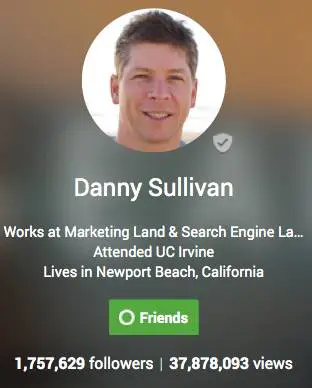
Danny Sullivan (Search Engine Land):
Number of Followers: 1,757,629
Number of Views: 37,878,093
Views Per Follower VPF: 21.5
As you can see, for every follower that Danny Sullivan has, each follower has viewed an average of 21.5 of his posts. Let’s take a look, though, at another public profile, the profile of Sergey Brin from Google:
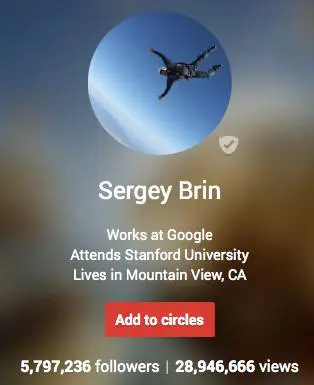
Sergey Brin (Google):
Number of Followers: 5,797,236
Number of Views: 28,946,666
Views Per Follower VPF: 4.99
And, just to be fair, let’s take a look at my personal Google Plus profile, as a comparison. Remember, the higher the VPF number, the better: which means that this user’s followers are more “engaged”, and they view more posts that the user makes.

Bill Hartzer
Number of Followers: 16,139
Number of Views: 9,163,089
Views Per Follower VPF: 567.76
Danny Sullivan’s posts on Google Plus are viewed by more of his followers, but what his numbers show are that there are a lot of followers who do NOT see his posts, and I bet that a lot of those followers aren’t very active on Google Plus. They know they should be following Danny Sullivan because, well, he’s Danny Sullivan. But they’re not very “engaged” with Danny’s posts. But compared to Sergey Brin’s followers, Danny looks really good: Sergey’s followers are really, really not very engaged, are most likely not very active on Google Plus, and just don’t see many of Sergey’s posts.
But let’s take my profile, for example. Sure, I don’t have a million or five million followers on Google Plus. But, if you look at my VPF, you’ll see that my 16,000 followers are highly engaged, active Google Plus users. They see my posts. They engage with my posts enough so that Google Plus shows them more of my posts.
There are a lot of different reasons why your Google Plus’ profile VPF is what it is, but you have to keep in mind that a quality profile on Google Plus isn’t dependent on the number of followers you have. In fact, it’s all about how engaged your users are: and by calculating the VPF for a user’s profile will show how active, how good their posts, are, and, how engaged that users’ followers are on Google Plus.
So, what’s your Views Per Follower VPF? Is yours higher or lower than mine?
Bill Hartzer is Globe Runner’s Senior SEO Strategist. Follow him on Google Plus.
Gideon Rosenblatt has also come up with, essentially, the same type of metric, and there’s an interesting discussion going on over on his Google Plus post.
DIGITAL MARKETING NEWS: FEBRUARY 2014
Digital Marketing News: February 2014
As a digital marketing specialist, it is absolutely necessary for me to stay up-to-date with the latest industry news, updates, and consumer technology trends. In February, I found the following articles to be especially noteworthy or interesting.
Link Building
‘Link Building in 2014 is All About Your Brand & Reputation‘ is a great article discussing the impact Google search algorithm updates can have on businesses, especially small and medium sized businesses. The writer gives a detailed and easy to read description of past algorithm updates which directly targeted specific link building strategies. Quoting sources such as Matt Cutts, Google’s Head of Webspam, this article explains why it’s important to include branding more than ever when developing a digital marketing strategy and link building campaigns. My favorite quote from the reading:
If you read the interview carefully, you’ll see that it’s a blueprint for content marketing. Basically, it lays out the components of how you can create great content on and off your site, promote it with strong social media presences, press releases, and other tactics to build a great brand online.
Keyword Research
Another article, ‘Keyword Research After The Keyword Tool, (Not Provided) & Hummingbird Apocalypse‘, describes the “Keyword Apocalypse” and how to move forward and understand the new era of keyword research. Because of the destruction of valuable keyword data and tools which were used to make data-driven and justifiable decisions, digital marketers now have to adjust to a new Google and a new tool set.
Google shifted to a new algorithm called Hummingbird in late August, 2013. I found trying to describe the updated algorithm to somebody who doesn’t work in the digital marketing industry to be fairly difficult. This article includes the easiest-to-understand description of Hummingbird I have read:
In fact, the only thing that Hummingbird changed was how the actual search query was processed. In short, Google rewrites your search query. [What’s a good place to get Chinese food?] might be rewritten as [chinese food canton ohio].
The author then goes into detail about the correlation between words and how that relates to your keyword research and content strategies. He introduces readers to new and existing tools that can help discover keyword phrases, search volumes, synonyms, and more. He does a great job of explaining how to perform thorough keyword research using techniques that will support your online presence and marketing initiatives moving forward.
Keyword research is still very important, but knowing your user is more important. If you pay attention to your users and listen to what they have to say, you’ll discover plenty of valuable information that can be used to develop great marketing strategies used to attract the customers you want.
Google AdWords
A third article titled ‘The Real Reason AdWords Isn’t Working For Many Small Businesses‘ is a good read because it describes some common misconceptions with Google AdWords. Evidently, the article is a response to a New York Times write-up which describes AdWords as not being practical for small business. The author uses the examples from the New York Times article to show the usual mistakes AdWords customers make and why they struggle to find success with AdWords. My favorite quotes are:
“Here’s where the biggest disconnect occurs for many people when it comes to PPC. It’s not about the cost per click – it’s about how much effort advertisers put in.”
“…dismissing paid search as a customer acquisition strategy would be crazy. Why? Because for many AdWords customers, the cost of the ads isn’t the issue.”
In the author’s opinion, the top three mistakes that cause an unsuccessful AdWords campaign as the following:
1) Infrequent Logins
2) Not Enough Activity
3) No Negative Keywords
I’ve witnessed great success with Google AdWords and believe it should be a part of any company’s digital marketing strategy. The information that can be gained from AdWords is almost invaluable. You can discover converting categories, sticky keywords, niche online communities, and more.
THE KEY TO YOUR ONLINE PRESENCE
Customers are more tech-savvy than ever and the number of consumers who grew up interacting online is growing. Businesses have been flocking to the online world to spread their message and look for new buyers, but all too often the message is fake, forced, or just not relevant to modern customers.
Perhaps the most important orthodoxy underlying a brand’s online presence should be authenticity. Being online isn’t enough; you have to be real. It’s what people expect today, and they know the difference when it’s forced.
“I just met you, and this is crazy, but here’s my business card, so pay me maybe?”
The Internet IS the public sphere, especially in the area of social media. It’s where people gather, exchange comments and ideas, and network. But just because this is taking place online instead of face to face doesn’t mean common rules of personal etiquette don’t apply, even for a business
If you go to a dinner party or industry networking event, do you walk around introducing yourself to people, hand them your business card, and brow-beat them with information about your services and company? No. You try to have a real conversation with equal parts speaking and listening. You begin to build real relationships. And so should any authentic business looking to create a positive presence online.
Luckily, there are more tools for businesses to do this than ever. Don’t worry about being everywhere; no one belongs to every social club in town. Pick the ones that work best for your business and be real.
Authentic People Are Aware
Another key to online authenticity is awareness. Authentic people are aware of what’s going on around them. They follow up with friends and ask how their recent vacations are or how that big meeting went at work last week. Unaware people are sloppy. An unaware person forgets names. An authentic business has the same awareness about their community of online followers and the general world around them.
Unfortunately, there have been quite a few examples of brands online who haven’t made awareness, and therefore authenticity, a priority in their online presence. Take the National Rifle Association, for example. The morning after the tragic shootings in Aurora, CO, earlier this year, the NRA tweeted, “Good Morning, Happy Friday! Weekend plans?” While the NRA commented that the tweeter wasn’t aware of the shooting, the tweet stayed on their page for hours. A more aware online presence would have addressed the issue, or at least deleted the tweet, much more quickly.
Compare this with episode with Kitchen-Aid. During the first Presidential debate of 2012, the Kitchen-Aid twitter account posted: “‘Obamas gma even knew it was going 2 b bad! ‘She died 3 days b4 he became president’.” The tweet instantly went viral, and was almost immediately deleted and followed with a swift succession of tweets explaining that a staffer posted to the wrong account, apologizing for the comment, and reaching out to press outlets offering official comments. That is an aware brand.
Now, this brings up the situation of allowing others to tweet on your company’s behalf or scheduling posts ahead of time. There’s a lot of conjecture about both of these practices, but long story short, if the underlying principal of authenticity is maintained, neither are “wrong”.
Penguin And Panda Will Get You
Thanks to Google, we’ll never look at cute penguins or cuddly pandas the same way ever again. Penguin and panda are code-names for recent updates Google made to their algorithms that return search results, with Panda targeting online content and Penguin focusing on links. Google is always working to show the most relevant and legitimate search results, so it wants to weed out spam and bad content as much as possible. That means Google is looking to reward authentic content and punish bad or unauthentic content.
Websites with weak content, content that doesn’t relate to the purpose of the website, or was copy and pasted from another source, will face the wrath of penguin and panda. However, websites that have original, thoughtful, and engaging content are rewarded.
There’s more online content being generated by businesses than ever. It’s a lot to sift through. And while most businesses won’t ever have the great viral video that the whole world sees, having an authentic presence online will help ensure that when you’re brand is found online, potential customers will want to spend time with/on what you have to say.
- « Previous Page
- 1
- …
- 3
- 4
- 5
- 6
- Next Page »