
















CONNECTING TO CUSTOMERS WITH USER-GENERATED CONTENT
What if we told you that you had a team of team of untapped marketers and salespeople waiting to help spread the word about your business? They don’t require a salary, and you might never meet them in person, but you also can’t afford to ignore them.
No, we’re not suggesting you “invest” in an unpaid intern. Instead, we recommend crowdsourcing content from willing brand ambassadors.
Need a refreshed marketing strategy to help you break through the noise and increase your organic reach? By connecting with your customers with user-generated content, you can.
User-Generated Content Defined
Anyone outside of your business who interacts with your brand on social media has the potential to supply you with click-worthy user-generated content (UGC). This type of collaboration turns followers into content producers. With it comes a steady supply of photos, videos, and unsolicited testimonials about your business.
Why is UGC Effective?
User-generated content satisfies two key pillars consumers base purchasing decisions on: trust and authenticity. Not only are they more likely to trust peer recommendations, according to Social Media Today, “60% of consumers said user-generated content (UGC) is the most authentic form of content – 3X more authentic than brand-created content.”
User-generated content also helps your business by:
- Giving your marketing department a break, allowing them to focus on other essential tasks outside of content creation.
- Expanding your organic reach, turning followers who evangelize your brand to their family and friends into mico-influencers.
- Building relationships with your online community, providing personal insights into your target market audiences.
How to Source User-Generated Content
Now you know what UGC is and why it’s essential, but where do you find it?
It’s probably not as simple as a Google search. However, your customers and their lives are most certainly online. It’s just a matter of zeroing in on the compelling content that furthers your brand.
Here are five ways to hone your hunt for quality user-generated content:
- Host a contest or give-a-way. Very often you get what you give(-a-way). Try incentivizing users to offer up their personal content in exchange for prizes or experiences that directly relate to your business. Putting out a call for photos or videos that have a specific theme will help you broadcast on-brand messages. Pro tip: specify that the photo with the most likes will win, and you can all but guarantee good engagement when you re-post it.
- Cruise your geo-tags. Periodically check to see who’s been tagging themselves at your place of business. If you see something you like, use an app like Repost to re-share with your followers. Be sure to tag them in the post, so the original is credited appropriately.
- Brand your hashtags. You’re well within your rights to search out general hashtags as they relate to your brand; however, creating hashtags that are specific to the work you do will instantly catalog and categorize potential submissions. Airbnb had of the most popular campaigns of 2017 using this social media strategy. While the #WeAccept branded hashtag reinforced them as a global brand, the UGC they posted was wholly representative of their mission of non-discrimination. (A value-based marketing win that we can definitely get behind.)
- Call for submissions. You can use your existing social media presence to simply request customers tag you in their photos and stories, but if you want to take it a step further, request photos:
- in your newsletters – have a specific section with hashtags to use and other instructions to ensure you can find the photo.
- on your homepage – create a banner directing them on where and how to submit.
- with signs onsite – put up an irresistible background or photo booth that will make folks naturally want to gravitate and re-share.
- Don’t forget about the employees. We recommend letting customers peer behind the curtain once in a while. The backstage look has an inherent core of authenticity. And what better way to personalize your brand than to share a bit about the people who make it run? Even if you remain strangers IRL, having employees share your company content and supply you with personal posts of their own will help users feel more connected.
In the end, there’s no wrong way, or place, to share user-generated content. Be it on your website, in your email marketing, or posted to your social media accounts, the message is clear: polished and perfect is out. ‘Real’ is the real deal.
BURGER KING INSTA STORIES
Online ordering is the way of the future. Whether it’s through apps or desktop websites, more and more eateries are now offering consumers ways to assemble a meal, pay for it online, and either have it delivered to their door or be ready for pickup at a store within the hour. Not all eateries offer this kind of service, of course; many still require customers to either call in their orders or simply drop by in-person. But restaurants that DON’T allow people to obtain food with a few keystrokes or screen taps definitely run the risk of being left behind. How comfortable are you with online ordering? Does your company offer it for the goods and services that it provides?
In this video, we discuss a special promotion that was run jointly by Burger King and Instagram in Spain. Spanish burger-lovers were able to use polls on their Instagram Stories to customize their perfect Whopper, adding and subtracting ingredients as they saw fit. But this wasn’t just an exercise in opinion gathering. After sharing their ideas for their ideal sandwich, customers could then go to their local restaurant and enjoy their one-of-a-kind Whopper…for free! By the end of the event, Burger King had given away over 30,000 hamburgers, and they’d engaged with even long-time customers in a way that was fun and revolutionary.
Small businesses eager to get on track with online ordering systems would be wise to keep an eye on Instagram. This social media giant has already experimented with an in-app payment system, meaning that it could one day be a viable platform for virtual shopping. Folks who adore Instagram will likely welcome this additional use for the application…and people who just like the speed and convenience of e-commerce will be happy for the opportunity to expand their horizons.
RETENTION MARKETING 101: HOW CURRENT CUSTOMERS HELP YOU SELL MORE
Without customers, your brand isn’t worth much. Most large and small business owners have been conditioned to focus almost solely on acquiring more and more customers. And sure, there’s a time and place for that. But what good is a growing customer base if you’re losing the ones you already have?
The literal and figurative cost of acquiring new customers is steep – not unlike customer acquisition marketing itself. According to Marketing Profs, taking a new customer through the sales cycle will cost you more than five times what it typically takes to make a second sale to an existing customer.
Looking to expand your profit margins in 2018? Time to deepen and nurture your current relationships. Here’s how customer retention marketing strategies can help.
Sell More, Do Less
Five happy customers who each sing your praises to one friend are worth 100 potential clients waffling in your pipeline. In this way, retention marketing helps to reframe your approach with current customers. Done right, and you’ll turn them into free marketing and sales help.
Your current customers are also likely to be more responsive to your cross-promotional marketing efforts. When they know the quality of your goods and service, they’re less likely to hesitate in the face of an upsell or price increase.
Keep your name (and excellent service) in the brain’s current customers, and you might just insulate yourself from customer attrition due to competition, too.
Retention Marketing Basics
There’s only one way to get where you want to go: start where you are.
We recommend you begin with your brand voice. The more your internal goals and external communications align, the more likely customers are to actually listen. Make them clear, make them consistent, and just like your customers, make them current. Bonus points if you have a customer support lead weigh in on crucial marketing copy. They can help you make sure your messaging is airtight.
While you’re at it, why not give your most loyal customers the floor? Whether by testimonial or social media review, make sure you’re amplifying the voices of those you’ve impressed along the way. Keep your ear to the ground for truly compelling stories, and don’t stop shy of handing them the mic. (Literally, invite them to speak at your next hosted event or a conference you’re attending.)
Of course, there are still two groups aside from your happy customers that can’t be overlooked: the unhappy ones and the competition. Lose sight of the former, and you miss a valuable opportunity to learn how to improve your processes. Ignore the latter, and you’re out a chance to plug a potential customer leak.
The more you prioritize current customers in your content marketing and social media strategies, the more you’ll recognize ways to engage, stay in touch, and reach out with new opportunities.
Ultimately, stands to reason the more time and attention you pour into your current customer base, the fuller your sales – and leaner your marketing budget – will be.
Need help crafting an out-of-this-world marketing strategy? Get us on retainer.
How to Map the Customer Journey
The customer journey has transformed over the years. What was once driven by analyzing outbound channels has transformed into a two-step process. The old and linear process is now a dynamic one that goes beyond concentrating on outbound alone.
Today, the customer journey should be analyzed with email and how it mixes with outbound and inbound channels. Analyzing the customer journey from both the inbound and outbound sales point-of-view will give you more insight into the customer experience and what they know about your business to help you improve your SEO, your reputation and more.
Customer Journey Basics
Mapping the journey starts with you: You need to use what information your organization has to create an interesting offer to be able to see what catches the customer’s eye. Once the customer bites, this is where the customer journey is initiated for organic or paid search.
TIP: Providing valuable, actionable information to new customers regarding their recent purchase or inquiry is a great first step.
Once the customer inquires about or buys your product, your job is to follow up with the customer journey by emailing them with content to help them get the most out of their purchase while also helping you increase your SEO (should they research about what you sent them for further information). After this, send out relevant information about local attractions, events and the nearest store location.
Your most important job in defining the customer journey is developing interactions that build value, relevance and brand trust with your target audience.
It is after you do your email marketing and event-driven marketing that you go back to analyzing your customer journey. See how the customer reacts to your outbound marketing by gauging their wants, needs and interests at a particular moment—i.e. when the email was sent out, correspondence about a particular event, etc.
Understand the distinct needs of your customers by analyzing how you may need to refine your message based on response rates, purchases and upgrades or changed in location. The way you analyze your data is your one-step away from creating a personalized customer journey.
Be sure to subscribe to our blog so you can get up-to-date information and a notification when our next post on how to turn the customer journey into sales goes live. We will also delve into the specifics of what to look for in your analytics when tracing the customer journey.
GLOBE RUNNER RANKS ON THE 2018 INC. 5000
Top 10 Fastest Growing Marketing and Ad Agencies in the Dallas-Fort Worth Metro
Dallas, TX August 16, 2018 – Inc. magazine today ranked Globe Runner 4203 on its 37th annual Inc. 5000, the most prestigious ranking of the nation’s fastest-growing, privately-owned companies.
Globe Runner achieved a three-year sales growth of 81%. The Addison based company joins a select number of digital marketing agencies recognized in this year’s list.
The Inc5000 represents independent small to mid-sized businesses with revenue and employee growth year after year. Notable companies in the Dallas Metroplex include Poo-Pouri, Studio Movie Grill, and Nothing Bundt Cakes.
“When I started Globe Runner in 2009, our mission was to help companies grow digitally,” said Globe Runner CEO Eric McGehearty. “We are growing today by continuing our mission of full-service digital, delivering results to clients.”
In January 2017, Globe Runner acquired Black Lab Creative allowing the internet marketing company to offer in-house design, creative, and printing solutions.
Recently, 2018 delivered two Addy awards (Bronze and Silver) to Globe Runner by the American Advertising Federation.
More about Inc. and the Inc. 5000
The 2018 Inc. 5000 is ranked according to percentage revenue growth when comparing 2014 to 2017. To qualify for the list, companies must have been founded and began generating revenue by March 31, 2014. They had to be based in the US, privately held, for profit, and independent—not subsidiaries or divisions of other companies—as of December 31, 2017. (Since then, a number of companies on the list have gone public or been acquired.) The minimum revenue required for 2014 is $100,000; the minimum for 2016 is $2 million.
As always, Inc. reserves the right to decline applicants for subjective reasons. Companies on the Inc. 500 are featured in Inc.’s September issue. They represent the top tier of the Inc. 5000, which can be found on www.inc.com/inc5000.
About Inc. Media:
Founded in 1979 and acquired in 2005 by Mansueto Ventures, Inc. is the only major brand dedicated exclusively to owners and managers of growing private companies, with the aim to deliver real solutions for today’s innovative company builders. Winner of the National Magazine Award for General Excellence in both 2014 and 2012. Total monthly audience reach for the brand has grown significantly from 2,000,000 in 2010 to over 18,000,000 today. For more information, visit www.inc.com.
The Inc. 5000 is a list of the fastest-growing private companies in the nation. Started in 1982, this prestigious list of the nation’s most successful private companies has become the hallmark of entrepreneurial success. The Inc. 5000 Conference & Awards Ceremony is an annual event that celebrates their remarkable achievements. The event also offers informative workshops, celebrated keynote speakers, and evening functions.
5 WAYS TO PERSONALIZE YOUR WEBSITE AND BOOST YOUR CRO
All humans like to feel seen, valued, and dare I say, special. It’s one reason why targeting is such a huge part of effective marketing. Try to capture the attention of everyone, and you’re unlikely to impress anyone.
If you’ve been unknowingly – or willfully – gearing your web content toward an unspecified, broad audience, it’s time to get personal. Your CRO (conversion rate optimization) depends on it.
Think about it. Your target audience is bombarded daily with tens of thousands of ads that are all but screaming at them for a sliver of their fragmented attention. Successful brands know how to treat their websites like a handwritten love letter personally addressed to their ideal customers and clients.
Here’s how to break through the noise and capture the mind of your potential customer by personalizing your website.
- Stick the landing (page) by personalizing it. Load your landing page up with unnecessary details, and you’re likely to lose a user’s interest, quickly. Repeat information they already know, same story. To get the conversions you’re after, you need personalized messaging. That’s what ultimately turns browsers into buyers. Keep your text, short, sweet, and with a personal beat. Try adding a personalized CTA to the bottom of your copy and see how it impacts your conversion rate optimization. Something as simple as “Greetings, Googler! We appreciate you searching for Dallas SEO Companies. Here’s a free case study to show our gratitude. Enjoy!”
- Show some emotion. Emotions are the one thing we all have in common. They’ve evolved over eons to help us navigate the wilds of life. Today, the more you can relate on an emotional or personal level, the more likely you are to convert prospects into purchasers. Your messaging should center around positive sentiments that inspire confidence or evoke nostalgia. Show them you understand their pain points and tell them how you’ll swoop in to make the fix with the click of your CTA button. Here are some more examples of emotional marketing done well.
- Make your content buyer-specific. Read: time to bust out your buyer personas. Before you ever sit down to put pen to paper (or fingers to keyboard) pull out your personas and review their preferences. Pretend you’re writing to Erin Sanchez, young professional who loves cats, not 22 to 32-year-old females. It’ll help make your content more pointed and personal. While you’re at it, make sure the copy itself is broken up into bite-sized pieces that Erin, or any other reader, can easily take in. The larger your text blocks, the less likely she is to wade through them. Instead of straining her eyes, get to the point quickly, and make your ask as obvious as possible, as soon as possible.
- Speak to them through videos. The importance of video marketing is present on a lot of fronts. None so much as its ability to increase your conversion rate optimization. Users are likely to spend loads more time on a website with video. Be it product videos or video blog content, including vids can improve a customer’s chances of buying by up to 64%-85%. It’s a no-brainer way to literally speak directly to your target audience in a highly personal way. In fact, we do it every week! In essence, the more visually you can show off your products or get customers comfortable with the folks who’ll be performing your services, the better. Have your CEO speak, or better yet, let them hear from the rest of your staff, so they get to know the everyday people behind the brand!
- Provide local specials. What better way to connect than by addressing them on the home front? With geo-targeting, you can use available technology to post content that’s specific to the locales of your ideal consumer. While you’re at it, don’t forget to bring these changes directly to the hands of your customers. In other words, ensure all your content is mobile ready or be prepared to get left behind.
We live in a world where digital and personal are seemingly at odds. All the more reason to tailor-make your online spaces personalized. Not only will it help you stand out from the competition and improve your CRO, it’ll show you understand your customer, creating the long-term relationship that leads to brand loyalty.
Want some help writing your personals? Let us pen some compelling, personalized content to help you make contact!
AVOID THESE WEB COPY WORST OFFENDERS TO WIN CUSTOMERS WITH WORDS
The language-processing center is one of the most developed parts of the adult brain. It’s a highly advanced system that allows us to decipher meaning from pure silence. With little effort, black and white symbols take on all kinds of meaning.
- Prioritize your keywords over your customers. If you’re too focused on creating a keyword driven content calendar or devoting too much space to talking about yourself, it’s time to shift focus. Remember that your audience is more interested in what you can do for them rather than the keyword(s) that brought them to your site. Sure, you absolutely need to sprinkle in some specific turns of phrase that will ping the search engines. But it’s more important to use your words to show and tell customers how you’ll bring value to their lives. Do so in a storied way that grabs their attention. A keyword or two may have gotten them there, but it’s the rest of your words that will make the sell.
- Present a problem in an abstract way. All good stories need a little bit of tension. It adds interest and keeps readers engaged. Use the sections of your website to create mini-vignettes that bring your potential customer’s problem into focus. The quicker you do so, the more likely you are to hold their fragile and limited attention. The more crystalline your mission to address their pain points, the more likely you are to move them down the sales funnel.
- Forget to push readers to take action. In life, and good writing, action is almost everything. Pretty words count for a lot, but they alone aren’t enough to close the deal. For that, you need to be explicit about what you want your reader to do next. Simple instructions like ‘click here’ are banal and diluted from overuse. Instead, try turning your CTAs (calls to action) into problem-solving hybrids like “start getting more web traffic” or “increase your Google ranking.” Make an action item out of the pillars that matter the most to your potential customers.
- Hit them with a wall of words. Precise and concise is the name of the game here, folks. You may have a compelling backstory, but save it for your About Us page. When they first land on your website, you want to quickly move them through your most important offerings and on to the commitment portion of the evening. Create a labyrinth with your language, and you’ll lose them forever.
- Make mindless headlines and hyperlinks. For the text you do have, be sure to break it up with thoughtful headlines that are at once compelling and descriptive. That way if they only skim your text, which, let’s face it, is highly likely, they’ll at least get the main takeaways out the gate. It’s ok to pepper some hyperlinks into the copy, too. But just like salt, too much or too little is a problem. Over link and the search engines that get grumpy. It implies that your content is unoriginal. Too few, and you might not be able to back up your words with the right level of authority.
- Fail to let others speak. Few of us are really gifted at talking about ourselves. In fact, businesses do much better when they let at least a few other authors toot their horns in the form of compelling testimonials. The more past success you can show, the more future success you’re likely to have.
Still not sure how to use your words wisely? Let us do the talking for you! Our expert content marketers know how to write for both human and electronic readers to help you stand out.
IMPORTANCE OF EMPLOYER BRANDING FROM THE CEO DOWN
Top down isn’t just a leadership strategy it’s also a branding strategy. Though we typically refer to the top tier of the c-suite as a CEO, the acronym could easily be exchanged for CBA (Chief Branding Ambassador).
So much of a company’s overall reputation is attributed to the personal brand of its chief. Talent and client acquisition depend on it. Investors take notice of it. It even helps brands distinguish from the competition and solidifies their company values.
Whether as part of an overall brand rediscovery or an effort to drive sales, we recommend implementing these CEO branding tactics as part of your marketing plan.
Employer Branding in the Age of Transparency
There’s a reason why sites like Glassdoor and Yelp exist. Our industry is a review-driven culture. Potential employees, clients, or investors know this and can turn up a staggering amount of info with just a few clicks.
But this forced transparency doesn’t have to negatively impact your business. Your client-facing communications can encourage conversation and steer the dialog in your favor. What you may not realize is how ‘loud’ the social media profiles of your executive brand truly are.
While your marketing team focuses on your brand’s external messaging, it needs to be supported by the CEO’s online presence. If that’s been neglected or nonexistent thus far, time to start nurturing it.
Social Media and Company Reputation
Social media is making it harder and harder to divest a CEO’s reputation from the company’s reputation. Your executive leadership’s words have weight. People are always watching and listening, or at the very least, researching.
Here’s where social CEOs can make a big difference.
Through personal branding, your executive leadership can show how the company brand is reflective of their values. Take Tom’s give a pair, get a pair model as an example. With this 1/1 approach, Chief Shoe Giver, Joan Blake, has solidified his brand with generosity and philanthropy. Their company upholds a reputation of giving back to communities in need.
Similarly, Globe Runner CEO, Eric McGehearty, an MFA holding, award-winning artist, runs a digital marketing agency that doubles as an art gallery. He also uses his unique point of view as a dyslexic artist, entrepreneur and consultant to national non-profits to serve as an advocate for people with learning disabilities. These have helped shape the GR brand and bring their value-based marketing to the forefront.
Steps for Online Reputation Management
Now that we’ve established CEO reputation management as mandatory, here are some tangible next steps for how to manage your company reputation online.
- Register a website with your name. If you don’t get to it first, someone else might. And less scrupulous types could use it to tarnish your image.
- Get personal URLs on social media. Repeat after us, “vanity URLs aren’t vain.” Key social media platforms like Facebook, Twitter, and LinkedIn will allow you to personalize their domains with your name embedded in the web address. It’s an important step in solidifying your personal brand.
- Pay attention to search engine results. Set up a Google Alert that sends an email to yourself or someone on your team anytime your name is mentioned online. Monitor who’s saying what and insert yourself into the conversation when you don’t like where it’s headed. Don’t be shy about posting replies on reviews and comments. The more proactive and solution-oriented you appear, the better. Use your full, real name and double check that grammar before you post!
- Create positive content to counter negative comments. Of course, you want positive content about your CEO to turn up in search results. Plus, when undesirable or inaccurate articles come out, positive content is the best way to take away their power and push them off their first-page ranking. Publishing updated blog posts and company news is a good start. Remember that social media profiles will also populate first, so utilize those to their full extent. Don’t forget to update your CEO headshots and photo uploads, too!
Truth is, with one simple post, a poor customer experience or begrudging comment can reverberate across any number of social media platforms, taking your brand down with it. As the lines between company and CEO reputations begin to blur, CEOs have an ever-increasing impact on brand experiences.
Need a little help shaping your Executive Brand? Let us do the sculpting
GOOGLE TRENDS REDESIGN + INSIGHTS FOR A PROFITABLE Q3
Marketers spend a significant portion of their working lives attempting to get inside the heads of consumers. What better way to peer into the minds of internet users than to review their search histories?
Whether we realize it or not, every query we plug into a search engine is like a digital diary of our thoughts, our wants, our curiosities. Businesses looking to harness this information need look no further than the Google Trends tool.
Its recent redesign focuses on ‘editorial data-based stories’ helping content concerned marketers tailor their blog topics, key in on keywords, and solidify their social media strategies by utilizing trending data from trillions of online searches.
The data explorer lets you see what users around the world are querying in real-time and overtime – for free. It’s like looking at key topics in Google’s search engine with a magnifying glass. Newer features also let you drill down and get granular, as though you were analyzing searches with a microscope.
What else should you know about the Google Trends update and how can you use it to improve your digital marketing strategy? That’s what we aim to unpack.
Redesign Features
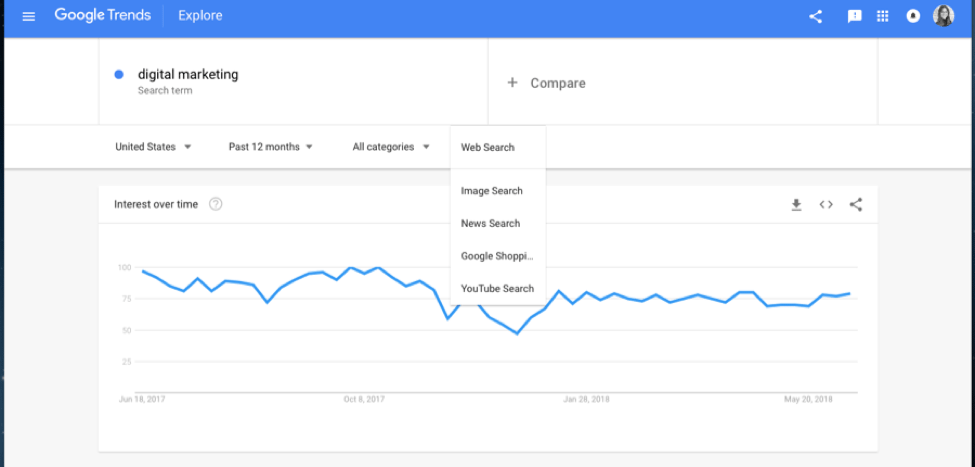
It all starts with a search term. Type your topic of choice into the search bar at the top, and you’ll see four subcategories below. These drop-downs let you contextualize trends based on geographic location, timeframe, different industries, and, most notably, types of search.
Since Google’s algorithms, and search results, are so multi-faceted it makes sense to broaden yours beyond web links alone. The update allows you to also refine your exploration across verticals like videos, news, and images.
In addition to these, other standout feature updates include:
- Real-time trending search data denoted by the word ‘breakout’.
- Curated data stories courtesy of the Google News Lab team. (Plus real-world visualizations created by international newsroom designers.)
- Aggregated official Year in Search information for the last 17 years, showing how various topics have performed over time.
- Intensity mapping and info graphs for meaningful topic comparison.
Once you have the data, it’s time to put it to good use!
Best Ways to use Google Insights
Internet users have done the work of popularizing certain terms. Now, it’s your job to put them to use. Next time you sit down with your team to create or present a content strategy, make sure you leverage Google Insights and Trends to help you pique the interest of your target audience.
Some of the best ways we’ve found to make use of Google trends are:
- Optimizing your keywords for your PPC and online advertising campaigns.
- Creating content calendars and press releases that resonate.
- Marketing to potential customers based on what they’re searching for in their location.
- Researching which keywords have grown in popularity from year to year.
- Seeking out new audiences that resonate with your products and services.
- Visualizing your product with new photos that correspond to different markets.
- Utilizing the related topics section to create compelling video content based on searches.
Simply put, anyone with a Google account has access to this wealth of info, and businesses looking to increase their web traffic and conversions have found it to be an invaluable part of their marketing plans. The way we see it, as far as free tools go, this one is more than a passing trend.
Want some help analyzing Google Trends? We’ll help you strategize into the stratosphere!
- « Previous Page
- 1
- …
- 11
- 12
- 13
- 14
- 15
- …
- 45
- Next Page »