












THE SURPRISINGLY OVERLOOKED TRICK TO IMPROVE YOUR SITE’S PAGE LOAD SPEED
by Brian MellerWe all know that a faster site leads to usability, conversion and SEO gains. And sometimes it doesn’t require specialized SEO knowledge to improve site speed, as we’ll show you in this blog post.One often overlooked way to improve the page load speed of your website is to compress your images.This may not apply to everyone, but most websites have a portfolio section or a blog that contains images. If that’s the case, it’s important to reduce the file size of your images.Most people think you can’t reduce the file size without reducing the quality, but there are two ways to get around that problem.1. Resize the image to the height or width that will be displayed on the siteSometimes we’ll see images that are 5472 x 4648 pixels, but the site’s maximum width is set at 1200px. So if you upload that original file size, it’s not useful because the site will resize the image width to 1200px and the file size will still be 3 MB instead of 600 KB.But let’s say you want the 5472 x 3648 pixel image on your site to give users the option to view it full size. That’s fine, but you should compress the image to reduce the size.How do you do this? Simple.2. Go to Tiny PNG and upload your .png or .jpg file to the siteTiny PNG will compress the image and reduce the size up to 80%.Here are two files of the same image, but in different sizes. Can you spot any difference in quality?
Brian is Globe Runner’s Quality Team Lead. He’s our resident SEO expert who can also enlighten us on the intricacies of sci-fi and Formula 1.
WHAT ARE MICRO-MOMENTS IN MARKETING?
People are using their mobile devices more than ever before, and not just for casually browsing the web or actively shopping. Mobile users are highly likely to pull out their smartphone when faced with a dilemma or problem, such as when making purchasing decisions at the store or finding a place nearby to eat. These moments when people use their smartphones for small, everyday tasks, are being referred to as “micro-moments.”
The Research
Research by Google indicates that micro-moments can be divided into four categories:
- I-want-to-know: These are instances when people look up information on their phones, such as something they might have seen in a commercial.
- I-want-to-go: People will look for nearby businesses on mobile devices.
- I-want-to-do: “How-to” searches and consultation with the web for ideas are moments included in this area.
- I-want-to-buy: Prior to making a purchase, people will use their smartphone to evaluate their buying decisions.
The research also indicates that these instances are becoming vastly more common, making it important for businesses to take advantage of these moments.
Micro-Moments Marketing
These micro-moments mean that consumers are more likely to make decisions and try to solve problems in the moment. This has given rise to micro-moment marketing strategies that take advantage of the tendency consumers have to consult the internet at a moment’s notice. To properly take advantage of this phenomenon:
- Make sure your online content is quickly searchable and digestible
- Understand your customers’ needs, including “in-the-moment” needs
- Determine in which moments your brand should come up
- Consider location, time of day, and other contextual elements in developing content
Using these effectively will lead consumers to choose your brand over others by providing helpful information on how it can help them right in the moment.
Using Micro-Moments
Designing content and implementing marketing strategies to make effective use of micro-moments is a task that requires careful planning and keen online marketing expertise. Accelerate Online Marketing can help you put together actionable strategies that will reach your audience right when they need you most, so contact us today!
VIDEO: THE DIFFERENCE BETWEEN SEO AND PPC
Hi, Eric McGehearty from Globe Runner here, and today I want to talk about the difference between SEO and PPC.
I think most of us know that search engine optimization is a process of getting a website to rank better in search results on Google, Bing, Yahoo, or whatever search engine you choose in the organic section.
Pay per click is a form of advertising, generally in search, that is the process of buying ads at the top of a search engine based on certain keywords.
They have a lot in common, because with both we’re targeting specific keywords and phrases to get a relevant customer or buyer to come into the website. If you have a number 1 result on SEO and a number 1 result on pay per click, you’ll achieve a similar outcome.
But with all that said, what should you expect from a campaign? The biggest difference is speed. SEO is something that is built over time and earned based on lots of factors including your popularity on the web. Other factors include how many people are linking to you, who is linking to you, your content, how great it is, your keyword usage, your site architecture, and your indexability.
When you are thinking about an SEO campaign and evaluating the performance, it should be looked at monthly, quarterly, annually. As much as you would evaluate any other KPI.
But it is a long term goal and not expected to see huge gains from month to month. With compounding interest in mind, you will see massive gains over extended periods of time.
Pay per click is a little different. It’s much quicker. you will see results very fast. in fact, you will see traffic the first day you turn it on. And that traffic hopefully will convert to leads and sales fairly quickly.
It usually takes a few weeks to a few months to really dial a pay per click campaign in and start generating really measurable, good results, but nonetheless, it’s a fast return on your investment.
Will it have a compounding interest effect? Generally no, not without doing extensive A/B testing and conversion rate optimization. Those will improve over time and ongoing enhancements to the campaign will improve but it won’t compound the same way SEO does. You will need to spend more money to get better results.
If your pay per click campaign is profitable, that’s exactly what you should do. If it’s not profitable, you should cut if off or make some significant changes to the way the account is structured before it continues.
Thanks so much, I look forward to talking to you next time.
VIDEO: THOUGHT LEADERSHIP, NOT JUST CONTENT MARKETING
Hi, this is Eric, CEO of Globe Runner. I want to talk to you today about content marketing – but I’d really like to change the way we talk about content marketing.
I have a lot of customers that come in and say ‘shouldn’t I be blogging and doing stuff on social media?’ And the answer is yes, you probably should. But how you do that is important.
So, let’s use a different word. Instead of content marketing, let’s call it thought leadership. Thought leadership is actually much more important than content marketing.
There’s a couple things that thought leadership does for your business that just writing content doesn’t do.
1. When somebody does read your content, they’re compelled to stay with your business and interact with you, maybe get more. Even better, they might give you their email for downloading a white paper or a case study or getting further involved in your sales process. This allows you to take advantage of the traffic you’re bringing in. It’s one thing for somebody to visit your website, but to convince them to take an action is so much more powerful.
2. The next thing that thought leadership can do that content marketing by itself could never do is generate links to your site – generate other influencers in your space to link back to your site as a relevant source that contributes interesting thought leadership to their ideas. Those links are the number one signal that Google is looking for to determine whether or not your site has relevant information to a potential searcher.
So, just two compelling reasons to put a little more energy into your blogging than just blogging or just being on social.
Instead, approach it as a thought leader and try to bring something new to the table.
If you’d like to share this video on your blog or website, use the following embed code: <iframe width=”560″ height=”315″ src=”https://www.youtube.com/embed/GcvXmt7D6ZQ” frameborder=”0″ allowfullscreen></iframe>
5 TAKEAWAYS: GOOGLE’S PERFORMANCE SUMMIT KEYNOTE
by Alicia Kan
If you watched yesterday’s Google Performance Summit keynote, quite a bit of the information shared impacts marketers of every stripe — most notably local businesses and retail. Following are five of what we felt were the showstoppers, and potential implications for you.
(Want to watch the entire keynote instead? You can on YouTube.)
1. Farewell desktop; mobile, make yourself at home
Perhaps one of the most hated words is ‘paradigm shift’ but Sridhar Ramaswamy, Google’s VP for Advertising & Commerce, was pretty much expressing that with his choice of verbiage on mobile.
“The shift to mobile is no longer something that will happen or is happening. It has happened.” Factoid thrown out to support this: More than half of all global web traffic comes from tablets and smart phones. Cue the rush of marketers fleeing the desktop Titanic.
Google has reworked AdWords into a mobile-first tool and significant changes herald this shift in focus. Changes include the removal of the righthand ads on desktop (no wonder, because desktop’s kicked the bucket) and the recent expansion of the number of characters in description lines to 80, which totals 50% more text in text ads. Google’s test results showed that mobile users responded better to ads with longer headlines and click-through rate (CTR) improved by 20%.
Similarly, marketers will have more control over bidding. Starting over the next few months, advertisers can do individual bid adjustments over each device type and anchor keyword bids on the device(s) that work for them, within a single campaign. This announcement drew a round of applause.
Furthermore, display ads will also be able to unlock native ad territory. Publishers will be looking forward to that for sure.
IMPLICATIONS FOR MARKETERS B2C brands will be thinking furiously about how they can ramp up their mobile advertising with these new options. And, if it has been relegated to the side as an afterthought, bring mobile front and center in your chosen ad platforms. Anticipate budgets being shifted around and oh, horrors, for you to become a mobile advertising expert overnight.
2. The customer journey is moment-driven
Google has been heralding the ‘micro-moment‘ movement for some time now and to marketers, it can be daunting. According to Ramaswamy, successful brands are the ones who have rethought their approach to marketing by supplying actions that speak to consumers where they are, when they need them.
The example supplied was Macy’s, which masters I-want-to-buy moments by directing searchers to the right storefront, whether online or physical. People searching on laptops are directed to the Macy’s website; searchers using smartphones are sent to their nearest Macy’s, and have the ability to see whether the merchandise they seek is in the store.
Google wants us to latch onto these two words: Intent and context. What the consumer searches for and wants the minute he rolls out of bed and reaches for his smartphone is not what he wants when, say, he is searching idly for lunch takeaway options while coming back from the bank or gym.
IMPLICATIONS FOR MARKETERS The buyer persona exercise will expand to cover micro-moments. It won’t be enough to just know who’s buying what and why, but when and in what conceivable scenario.
3. Local search is a bigger deal than we all thought
VP for Search Ads Jerry Dischler shared research findings that supported this theme: 90% of purchases are made in stores, not online. Nearly 1/3 of mobile searches are related to location. In 2015, location-related mobile searches grew 50% faster than mobile searches overall. “Smartphones have created a new front door, bridging the physical and digital world,” he said. In that Stargate vein, Google has helpfully supplied us with new toys.
Over 1 billion people worldwide now use Maps, which was created to help people navigate the physical world. For added functionality, wouldn’t it help to also provide useful items like reviews to recommend where to go, popular times when you can escape crowds and lines, or real-time transit times that help you avoid delays? Google thinks so, therefore they’re allowing ads within Google Maps.
The next generation of local search ads will also have Pinterest-type pins relevant to the searcher. Advertisers can customize the page with content or offers unique to the location that would enhance foot traffic to the establishment.
Google has already been testing the marrying of data between search, location (opt-in) and beacons to determine what online behavior truly drives offline purchase. According to the 10 big box retailers that participated in the study, the number of incremental visits driven by mobile search ads exceeded online conversions.
IMPLICATIONS FOR MARKETERS Finally, there’s a way to directly link search and online advertising budgets to offline purchase other than coupons — very handy when budget-planning time rolls around. Smart small- and medium-sized businesses (SMBs) will study how they can take full advantage of local’s growing halo. We foresee location-based marketing, which had its heyday in 2010, to make a comeback.
4. Machine learning is helping us target and understand untapped customers
Because marketers can’t keep track of Stacy, a 32-year-old Midwestern mother of a two-year-old with another child on the way, who is shopping for a minivan. A Google longitudinal study on Stacy unearthed 900 touch points from her in three months, from researching vehicle reviews during playdates to checking out videos in the rare spare minute. That’s a lot of micro-moments for just one consumer. Multiply that with all your other consumers and it gets tricky.
Fortunately Google’s machine learning can handily assist with identifying and reaching the Stacies of this world. With data and automation, marketers can be there during critical micro-moments. Display advertisers can turn to programmatic to deliver the right message at the right time. DoubleClick Manager and Google Display Network will deliver ads based on intent, context and demographics.
Google is also launching a cross-exchange inventory that will reach additional websites and apps across the world, said Brad Bender, VP of Display and Video Ads for Google. Additionally, they’ve just launched Similar Audiences for Search, a new product that allows remarketing lists to extend to buyers unfamiliar with a brand. Marriott has already tested Similar Audiences and reported a quadrupled ROI. Similarly, Fiat Chrysler has experimented with the product and bid aggressively on new audiences that have a lot in common with their consumer. The results were 5% more click-through rates (CTR) and 14% less cost per acquisition (CPA).
Bender said a parallel offering called Demographics for Search Ads is set to launch in the foreseeable future.
IMPLICATIONS FOR MARKETERS Remember that legendary story in 2012 about Target exposing a teen girl’s pregnancy? That was done with the help of statistical genius Andrew Pole. From the sound of it, Google is set to make online targeting even more eerily accurate. Except this time there will be less perplexed parents — the coupons should be delivered to a smartphone given the emphasis on mobile.
5. Reporting changes are more than a facelift
In March, SEOs learned of the new 360 Suite that integrated six Google products, from Analytics to Tag Management, into one enterprise platform. Significant news today:
- All 360 Analytics customers can join the closed beta
- Data Studio 360 will have Google Docs’ collaboration ability, allowing several parties to edit at the same time to create rich, dynamic reports that integrate data from different sources — very neat stuff demonstrated by Babak Pahlavan, Google’s Senior Director of Measurement & Analytics
- Integration of Google Assistant into Analytics: You’ll soon be able to ask a question about Analytics findings via voice or a typed question — even more impressive demo-ing by Pahlavan
- A free version of Data Studio 360 for up to five reports was launched today in the US for all Analytics accounts (although we haven’t seen any sign of it yet). The free version will be rolled out across the world right after
AdWords was not forgotten in the redesign. Samantha Lemmonier, Director of Engineering for the AdWords platform, showed a new homepage with insights at-a-glance, such as top performing campaigns, top devices, even best time of day to run a campaign. Advertisers can supply their objectives and actions they want to drive; AdWords will offer a campaign creation flow.
Best of all, no migration or upgrade is required, Lemmonier said. Campaigns will run the same as they do today. The AdWords team will continue building out what she called ‘the [new] AdWords experience’ and invite marketers to try it out.
IMPLICATIONS FOR MARKETERS Start thinking of the five clients who should get the Data Studio 360 report. Possibly prospects to impress? Presenting Analytics data to clients face-to-face should also be a novel experience now that you can verbally ask for insights and get a Siri-like reply (for safety, practice first so you get the right answer).
IMPLICATION FOR APPLE Oh dear. Siri is going to have to one-up this.
WHY ARE VIDEO ADVERTISEMENTS IMPORTANT FOR MY MARKETING STRATEGY?
With sites like YouTube receiving vast amounts of traffic every hour of every day, video advertisements have become much more prevalent on the internet. Whether it’s a 13 second ad before a streamed video or a URL sent via email, video advertising is an engaging, memorable, and cost-effective way to promote your brand on the vast sea of the internet marketplace. Here are a few reasons why:
- Engaging: Videos are inherently engaging, and interesting vids are shared frequently by people on social media. Of course, to get this to happen, you need a video that’s neither too short nor too long and that contains engaging content. Engaging content must be either entertaining or informative (or both), and it must provide that value quickly.
- Memorable: Engaging videos are memorable (seriously, just try forgetting Gangnam Style). The very nature of video makes it stick in people’s minds since it incorporates both visual and audible elements. Your audience will see, hear, and—if you do it right—feel your message, making it a highly effective way to get people thinking about your brand.
- Data-driven: Sites like YouTube now use data to drive their video advertising. They track what videos people usually watch, enabling your message to get to people who are most likely to be interested. Think of the effect a hardware store ad will have when streamed right before a DIY project video, for example.
- Promotes brand recognition: Written and visual content both build your brand’s identity. Add sound and movement to that, and you suddenly have a much stronger way to convey your voice online. In addition, it adds a whole new dimension to your brand identity, which makes your brand that much more memorable. This is what video does for you—it fleshes out your identity and makes it more distinctive.
- Cost effective: For the value it provides, video advertising is highly cost effective. It has far more click-throughs than written content, and it will usually keep people on your site longer. Add that to the reach and recognition it gives you, and it’s easy to see why video is such an important part of your online marketing strategy.
To be truly effective, a video needs to be well crafted and used in the right way. Otherwise, it won’t get the reach and click-through rates it needs. This requires the marketing expertise of digital rockstars, which you can find at Accelerate Online Marketing. To learn more about the importance and use of video advertisements, contact Accelerate today!
WHAT IS THE PURPOSE OF CONTENT MARKETING?
Content marketing has become a valuable part of online marketing campaigns, but many companies might wonder why. It might not be immediately clear exactly what content marketing is or what it’s meant to accomplish. Others might feel like they have an idea, but actually go about it in the wrong way.
Defining Content Marketing
In reality, the purpose of content marketing is actually quite simple, but first, just for fun, let’s look at what content marketing is not:
- Advertising
- Brochures
- Keyword spamming
- Sales gimmicks
- Carrots
It’s not about holding a carrot out in front of your audience and baiting them into a purchase, nor is it about ranking first on Google (though it certainly helps with that). It’s about informing people, raising awareness of your brand, and cultivating trust. In a nutshell, content marketing is creating valuable content and making it available online.
Results of Effective Content
The positive effects of good content go beyond simple advertising. While a strong advertising campaign does help consumers consider what you have to offer and make purchases, it isn’t as effective as content marketing at building lasting relationships with your customers. Effective content will have the following results:
- Informs the customer: First, effective content informs the customer. Your potential and current customers want information prior to making a purchase. They often have questions, ranging anywhere from “What type of mouthwash should I buy?” to “What do I do if I’m accused of a crime?” If you can answer relevant questions, you help them along the process of making an informed decision about your services.
- Builds awareness: Quality content that provides valuable, practical information will build awareness of your brand. It is very useful in link building, especially when other sites use your content as a reference and give you credit for it. Effective use of keywords also helps spread your name across the internet as your content comes up in web searches.
- Establishes trust: As you build awareness and credibility through quality content, you establish trust among your client base. They see you as reasonable, knowledgeable, and competent. This leads to lasting customer-business relationships.
- Keeps you current: It’s not just about keeping your audience informed. You also need to be kept up-to-date on what’s going on in your field. By putting out regular content, it helps you be aware of news and events relating to your area of business. In addition, it helps keep your site current as well, which is helpful for SEO.
So how do you get content that does this? Web marketing services like Accelerate Online Marketing can help you out there, so don’t hesitate contact us!
GOOGLE INCREASES LENGTH OF TITLE TAGS: WHAT NOW?
This past week, it was widely reported that Google made changes to their search results pages. One of the changes that they made was to increase the width of the main search results column. Then, since the width of the main search results column received an additional 100 pixels, there was room for Google to increase the length of title tags. Now, more of your title tag will show in the search results. The length of Title Tags has increased in the search results. Or, another way to look at it is that more keywords will show in the search results. But before you go out and update all of your title tags, you need to consider a few things.
- The length of Title Tags in Google’s search results has increased to 70–71 characters, which is up from its previous 50–60 characters.
- Just because a keyword in your title tag doesn’t show in the search results doesn’t mean that Google isn’t considering it as a part of their algorithmic review of your page.
- Well written title tags are still important.
- A good excuse to review your title tags on all pages.
- Google still may rewrite your title tag depending on the search query.
The length of Title Tags in Google’s search results has increased to 70–71 characters, which is up from its previous 50–60 characters.
Since Google increased the size of the search results column from 500 pixels to 600 pixels, they had more room for our title tags in the search results. I suspect that this increase is most likely due to the fact that more of us are using larger screens for our desktops. I use at least a 27 inch screen on my desk, and in my home office I use a 42 inch screen. On a laptop, even if it is a 15 inch laptop, the screen resolutions have gotten much better, so it’s logical that Google would make this change.
Just because a keyword in your title tag doesn’t show in the search results doesn’t mean that Google isn’t considering it as a part of their algorithmic review of your page.
If you have a title tag that is longer than what is being shown in the Google search results, Google still may use keywords that you put in your title tag. For example, if you have a blog post with a long title, there may be words in there that are relevant even though Google isn’t showing those words in the search result. In an ideal situation, though, shorter titles are better, you generally don’t want a long title that’s in the form of a sentence. Unfortunately, I still see people write title tags as if they’re a place to write a sentence. We need to think of Title Tags as if they’re a headline–and something that the Google user sees in the search results. That title tag should encourage someone to click on through to your website.
Well-written title tags are still important.
Don’t underestimate the power of a great title tag. As I mentioned before, the Title Tag should encourage someone to click on through to your website. Don’t just stuff keywords into the Title Tag because you think they will help your site rank better. Just yesterday I reviewed Title Tags on a website and the site owner had stuffed their main website’s keyword (the one keyword they want to rank for) into all Title Tags on every single page. That’s excessive and is just plain outright search engine spam.
A good excuse to review your title tags on all pages.
Google’s update of the length of Title Tags is a good time to review all of the title tags on your website. I would use something like Screaming Frog’s SEO Spider to crawl your site and review your Title Tags.
Other alternatives: review the HTML suggestions in Google Search Console. You can also use the site:yourdomain.com search query at Google to look at all of the pages they have indexed. Review all of the title tags as they appear in the search results. You may see some that need to be updated and ones that are just too long. But I would, though, crawl your own site and review the Title Tags, as there can be pages with duplicate Title Tags that Google is not indexing.
Google still may rewrite your title tag depending on the search query.
Keep in mind that at the end of the day, Google may still feel the need to rewrite your page’s Title Tag no matter how you write it. Their algorithm will decide when and for which search queries they will rewrite your Title Tag if they think you’ll get more clicks on your search result. I once saw Google rewrite every single Title Tag on a website–I simply saw what Google liked and what they didn’t, and rewrote all of the Title Tags on every page based on what Google was telling me it should be. That’s an extreme case, but if you notice that your Title Tags are being rewritten, you may want to rewrite it.
Sure, Google has given us more room for adding more keywords or words in our Title Tags. But that absolutely doesn’t mean that we need to rush out and rewrite our Title Tags. Quite the contrary. If you’ve optimized the website and you’ve done what you need to do to write great Title Tags, then this is just another change by Google. If you have good Title Tags, you don’t need to do anything.
OPTIMIZING CONTENT WITH HELP FROM GOOGLE SEARCH CONSOLE’S SEARCH ANALYTICS

As SEOs, we’re always looking for new and innovative ways to get content ideas, and optimize content on websites. Here is one way that you can optimize the content on your website at individual page level, and get content ideas for new content at the same time. Using Google Search Console (formerly called Google Webmaster Tools), you can use Search Analytics to look at each individual web page on your website and see how that page is being found in Google’s organic search results.
We’re always looking for ways to get content ideas and optimize content on websites. Here is how to optimize the content using Google Search Analytics.
Let’s go through the process, using a specific example web page, and see how we can optimize it better, update it, and maybe get some new content ideas.
First, log into Google Search Console. Select the website that you want to work on.

On the left side, choose Search Traffic, then Search Analytics, as shown above. You’ll be taken to the Search Analytics tool.
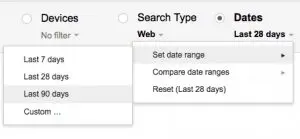
First, choose the past 90 days of time, as shown above. We’ll want to look at the maximum amount of time we can (currently 90 days) unless, of course, the page you want to analyze hasn’t been online for 90 days. But in this case, the page we’re going to analyze is a blog post that’s ranking “okay” but we want to get more organic search traffic to it. It’s been posted more than 90 days ago, so we should have plenty of data to look at.
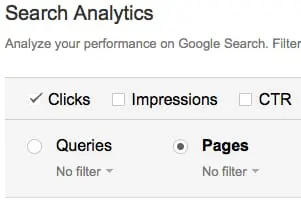
Next, choose the Pages option, as shown above.
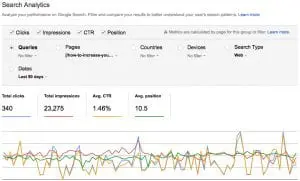
For this next step, you’ll need to click on a specific page on the list. That will take you to the individual page’s details. In the screen capture above, I went further and selected the following:
Queries
Impressions
CTR
Position
In this view (as shown in the above screen capture), we’re looking at the Search Queries for one particular page on a site, which was a blog post about increasing followers on Google Plus.
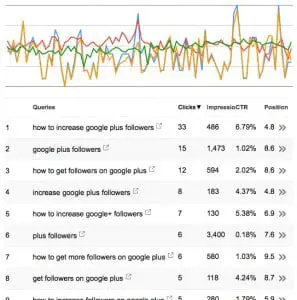
As you can see from the screen capture above, there are a lot of search queries. In this list alone there’s 200 search queries (I believe that’s the limit that Google will show). I’m showing only the first few search queries at the top of the list here.
If I were to optimize this blog post further, I would concentrate on looking at the search queries here to see how searchers are thinking about the page’s content–and what their user intent is. Based on the search queries, “how to” appears to be used a lot in search queries, so I may want to rewrite or add to the content on that page and specifically add a how-to list of action items or tasks that someone can use to increase their followers on Google Plus.
Since this page is currently ranking about #4 to #10, by getting it to rank higher for certain queries it will get more traffic. I can sort the columns by impressions to see which search queries have a lot of impressions, which is an indication of where the traffic is–so I can take advantage of it. Certainly if there is one particular keyword phrase that brings in more traffic, I’d want to adjust or rewrite the title tag and the title of the post so that it includes that keyword phrase.
Also, any social media posts promoting this content should include those keywords in the description, and any link building efforts can actually use those keywords as well. In fact, technically speaking, if I were going to build links to this page, I would use a lot of those search queries (keywords) to diversify the anchor text of links to the page–as much as I can, rather than focus specifically on one or two main keyword phrases.
By looking at the list of keywords that this page is found for, there are other search queries on the list that the content if being found for–but it’s not necessarily exactly what those searchers are looking for. Rather, here are some related keywords that are interesting, and I’d want to create more content around these keywords, perhaps linking those new blog posts to the original content (about increasing your Google Plus followers):
how to get followers on google plus business page
how to get likes on google plus
google plus management services
Finally, as you start analyzing each page of your site, you’ll find that there may be pages where the search queries that the page is being found for is totally wrong–or the user intent doesn’t appear to match the content of the page. That will allow you to figure out how to adjust the content on the page so that it reaches the right searchers.
- « Previous Page
- 1
- …
- 24
- 25
- 26
- 27
- 28
- …
- 45
- Next Page »