















GLOBE RUNNER EXTENDS REACH WITH NEW FORT WORTH SEO SERVICES
It’s official: Globe Runner’s Fort Worth operations are now up and running under the helm of local entrepreneur Chris Miller.
Extending our operations to Fort Worth was logical given the growing number of clients we have in the area.
Miller was one such client of Globe Runner. A native of Fort Worth, his online business Jerky Dynasty flourished and saw improved traffic under Globe Runner’s proprietary SEO methodology.
“Fort Worth has the highest population growth right now in the US, which is spurring a never-before-seen level of business activity,” Chris says. “Whether an entrepreneur plans to benefit from this surge with a bricks-and-mortar or online business, SEO is critical to getting buyers through the door.”
Artistic links with Fort Worth
In addition to business reasons, Globe Runner’s other ties with Fort Worth are artistic. In 2007, Globe Runner CEO Eric McGehearty, a sculptor by profession, created United We Stand, an outdoor bronze sculpture and window installation for Fire Station #8.
Eric’s work was nationally recognized at the 2007 Public Art Year in Review as one of the 40 best public art projects of the year. It was also voted that same year as Best Outdoor Art by Fort Worth Weekly’s Reader’s Choice Award.
Eric has since been commissioned by the city of Fort Worth to create another public art piece, this time for Six Points Urban Village.
The mission to provide Fort Worth world-class SEO has started
We’re happy to be part of Fort Worth’s artistic and economic evolution. In November, Globe Runner Fort Worth founded the Fort Worth SEO/Online Marketing Meetup group which has 95 members. The group has already held two Meetups talking about SEO and remarketing.
For more information about our Fort Worth SEO services and joining the Fort Worth SEO/Online Marketing Meetup group, contact Chris Miller for details.
WHAT SEO CAN TEACH PR AND WHAT PR CAN TEACH SEO
The impending extinction of public relations due to SEO and the looming death of SEO at the hands of public relations were gripping topics in 2014, no matter which side of the fence you found yourself on.
Searches for ‘Is public relations the new SEO?’ and ‘Is SEO the new public relations?’ were roughly parallel at 1.5 to nearly 1.6 million results. All riveting questions, especially since they were premised on intelligent musings and coached in respectful dialogue. Well, most of the time.

As a PR person thrown into the deep end of the SEO pool this year, experience has shown that nobody will be replacing anyone anytime soon. SEO and PR will not only continue to co-exist, they will be elemental to each other’s survival. And they still have a lot to learn from each other about how their roles can evolve.
What SEO can teach PR
Apart from the fact that NAP does not mean a quick snooze (it’s the SEO acronym for name-address-phone number) and that citations are not traffic violations, there are a few useful lessons PR people can learn from SEO, if only to avoid the one constant irritant in our lives:
Quantifying our efforts.

The following will sound dismally familiar to every PR person, especially in-house hacks:
When introduced, you are described as ‘the girl who handles our Facebook.’
You never have enough budget, resources or authority because people think what you do is fluffy, i.e. not deserving of serious investment.
You are at the periphery of strategic planning unless you’re lucky to have a boss or company who recognizes the value that PR brings to the table.
Learning SEO – at a minimum, Google Analytics with all its squiggly blue charts – will teach you:
How to demonstrate tangible ROI
We’ve always been told that there is no hard link between PR and sales. SEO blessedly tells us otherwise.
Every piece of content created with the purpose of driving visitors to a website kick-starts the sales process, whether it’s a press release, a link shared on social media, or advertising creative.
With SEO, you can determine which channels send visitors to your site and what actions they should execute afterwards to qualify them as sales leads. These actions are goals that you can set up via Google Analytics. A goal that is completed is a conversion.
For an e-commerce firm, goals are as straightforward as hitting specific revenue. For a B2B firm selling professional services, relevant goals could be completing and submitting a contact form, downloading a white paper, even making a phone call.
Agree with your boss what type of goals and number of conversions are relevant to your company. And use these are your yardstick in assessing your performance.
If your company’s Facebook page is driving 90% of the traffic to your website, being described as ‘the girl who handles our Facebook’ loses its sting, does it not?
How to create content more efficiently
A huge part of public relations is content. Writing blog posts, posting on social media, creating corporate videos — it never ends. This is the reason behind the popular notion that journalists make good publicists, a controversial topic that needs delving into some other time.
What comes as a rude surprise is how much of this content goes to waste, mostly because there’s a flood of stuff out there competing for shrinking attentions and increasingly jaded appetites.
Knowing SEO gives PRs a leg up by a) determining content that has historically performed well (BuzzSumo is really helpful), b) using keywords that help content rank higher on search engines (Google Webmaster tools) and c) knowing who to pitch because they’ve covered the subject before (thank you, ahrefs).
Google Analytics will tell you what pages of your website are most visited and dwelt upon, what blog posts delivered and which didn’t. Want to check out what’s working for the competition? Look them up on Majestic SEO or SpyFu.
Knowing what works and gets the most response is more productive than dedicating six hours of your day waxing lyrical on a blog post that no one will read.
How to have the final word on creative decisions
Exhausted PR people who tussle constantly with clients over branding and design decisions should take a leaf from the SEO playbook: Facts win the day. Facts trump opinion every single time.
Is your client insisting on the stupidest brand name ever because it was their pet idea? Gently remind them smart keyword use is critical to any naming protocol, since the brand needs to be found by its customers online.
Does your boss want animation on each web page? Point out that site loading speeds are a Google ranking factor and too many page elements dilute the call to action.
Is your client too obsessed with getting social media followers? Furnish stats that her Pinterest board is driving 1% of traffic to her site and watch her focus magically shift.
The wonderful thing about SEO is that what PR people have known intuitively all along can be backed up with facts. Facts which even the most combative client cannot ignore.
Having said that, PR people’s tribal knowledge is the right brain to SEO’s left brain, the butter to their toast.
It may just be possible that SEO is the new public relations, but only if SEO learns a skill PRs have that just can’t be hacked, despite every black hat tip in the world.
Influence.
What PR can teach SEO
Working at an SEO agency and managing SEO clients brings to light the significant overlap PR has with SEO in terms of objectives, and the marked differences in rationale and solution.
Both, for example, think getting a link from the New York Times is the Holy Grail: SEOs because the New York Times has high page rank and domain authority, PRs because well, everyone reads the New York Times. Both are right.
And how does one get a link on the New York Times? To an SEO, this is what’s involved:

PRs know that not everything can be won from behind a laptop. There’s in-person or phone pitching (what separates the men from the boys); introductions through connections; networking and events.
After all, this is how PR managed to do great stuff in the Jurassic years without the Internet.
And it’s where PR can teach SEO a thing (or three), like:
How to build influence, not just links
Any PR worth his or her salt can teach you how to identify stakeholders beyond visitors to the site and how to customize channels, approach and messaging for each audience — not all of which are are best done online.
This is a massive step beyond SEO’s approach of combing online tools for backlinks to competitors’ sites, which is a reactive practice.
A PR’s job is to create bonds with all publics – from employees to management to shareholders, media and the community — and to maintain these bonds. Strong relationships will sustain your online and offline presence even through the tenth Penguin update. Strong relationships mean you are considered early in the creative process, not afterwards.
How to write for Google
Not too long ago SEO was about keyword stuffing; Panda took care of that. Google now demands high-quality content, writing for actual reading, because — shock, horror — real people read websites, and they won’t frequent a site with poor content.
To SEOs, this was a revelation; to public relations practitioners, this was like saying the sea is wet. PRs have been delivering high-quality content long before Google was around because their jobs depended on it.
Here’s the litmus test: Try pitching a story to a journalist. Even better, do it on the phone. You’ll soon get what quality content is — it’s the story that didn’t get you yelled at or hung up on.
Public relations people are initiated into this practice early in their careers. They learn that to get coverage, you have to provide value. Who better than they to determine whether your content is up to par?
Other best practices on quality content that PRs can teach SEO:
How to craft a winning lede (not a misspelling) and structure copy flow to entice readers to stay on the story and, by virtue of that, stay longer on the site. (Hopefully causing bounce rates to fall.)
How to make your content work harder: Public relations people have dozens of ideas on how to recycle content into other formats, e.g. turning a blog post into a slide show, an infographic, a video, a podcast, a quiz.
How to get people to interact with your content: PR experts can teach you how to strike the right note to invite comments, encourage conversation, and increase the likelihood of sharing.
In public relations every action — writing, events, media relations — plays a part in a complex mise en scène. And this macro view yields the best lesson SEO can learn from PR:
How to stay relevant long after the job is done
SEOs know whereof I speak: There comes a time when everything is done for a client.
The site is as optimized as it can get. The content and performance are solid. The competition doesn’t even come close in rankings, keywords, links and traffic. It gets harder and harder each month to justify your fees.
Unless you go beyond what is expected of you. One of the biggest frustrations for SEO is clients’ assumption that SEO is tactical, that it is merely a means to an end.

As much as PR is somewhat responsible for its fluffy reputation because of its slowness in embracing quantification, so does SEO not help its tactical image by focusing on, and sweating the small stuff.
What we do in SEO is so much more than driving traffic to a site, getting penalties revoked or doing local citation bursts. There is a higher purpose to SEO that tragically gets buried under the incessant rabbiting of DA, PA and other acronyms that are gibberish to a client and the refusal to look outside of Moz and the search engine world to create context for what we do.
Not to mention what we can do. Has SEO even thought about the potential that lies in providing crisis management services?
SEO’s challenge is to confidently claim its spot in the bigger marketing picture by thinking bigger of what it does and to communicate its value in language everyone understands. In short, it needs PR before it thinks of taking over PR.
For the reasons above, practitioners in both industries can climb down from the parapet. Thanks to each other, both PR and SEO have never looked as promising, exciting and further from death than they do now, 10 days away from a new year.
HOW TO CLAIM YOUR DUN & BRADSTREET LOCAL LISTING FOR FREE
Dun & Bradstreet is an authoritative source for local citations and local listings across the web, as many different sources on the pull their data from Dun & Bradstreet. The Dun & Bradstreet site pulls data from State departments (like the State of Texas Secretary of State filings and DBA (Doing Business As) records. I’ve even seen them pull data from domain name whois records, as well, and list businesses that don’t actually exist. That said, there are often inaccuracies and lots of headaches for business owners whose data (Name, Address, Phone Number) is incorrect. Luckily, you can now claim your Dun & Bradstreet Local Listings. Here is how claim your local Dun & Bradstreet local listing for free.
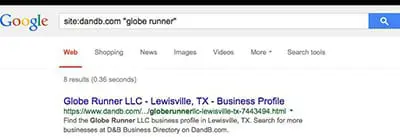
1. First, the fastest or easiest way to claim a business listing is to first find the listing itself. So, go to Google and search for this:
site:dandb.com “company name”
where “company name” is the name of the business you want to claim. In the screen shot below, I show the search I did at Google to find the Globe Runner listing:
2. Once you find the listing that you want to claim, click on it in the Google search results and visit the dandb.com website.
3. Once you’re on the listing page, then click on the “Claim This Business” link, as shown below:
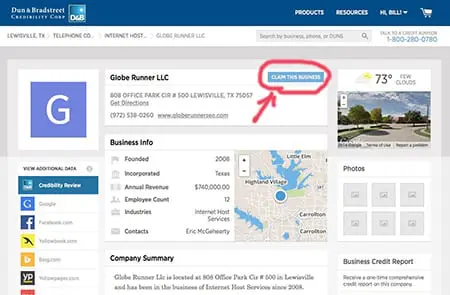
As you can see, they’re listing our old address, so we need to claim the listing and get it changed. Once you’ve clicked on the “Claim This Business” link, you’re taken to the next step.
4. You are taken to a page that says that you need to pay for the listing ($599, $899, or $1199). Do NOT pay those fees. Instead, scroll all the way down the page, where it says “Choose the free plan and claim your profile on D&B Credibility Review now”, as shown below:
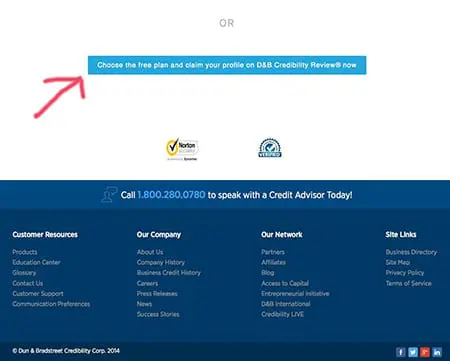
At this point, you’re going to be taken to a login page or you can easily create a new account. If you’re claiming multiple business listings (perhaps more than one location of your business?) you’ll want to log into your account. Otherwise, I recommend that you create a new account, especially if each business that you’re claiming is not associated with other businesses you’re claiming.
At this point, there is no official verification needed (they don’t send you a postcard and they don’t phone the business with a verification code) which is, quite unsettling. Hopefully they’ll actually fix that in the future. But for now, you can go ahead and claim the business listing without having to “verify” the listing.
After I verified a Dun & Bradstreet Local listing, when you edit or view your profile, they currently show that they power the following websites with data. I’m not sure about some of them, as some most likely are going to be networks that need to be manually set up, and therefore are only available if you choose the paid option. Here is the list of sites:
D&B Credibility Review
Google
Facebook
Yellowbook
Bing
Yellowpages
Merchant Circle
Tele Atlas (TomTom)
Twitter
AOL
D&B
MapQuest
Yahoo Local
Apple (Siri)
Groupon
Hotfrog
Comcast.net Search
ReachLocal
Admedia
Dealsplus
Shoptopia.com
Alteryx
Dogtime Media
KSL.com
Sirtune
AmericanTowns.com
WHAT GLOBE RUNNER IS THANKFUL FOR THIS YEAR
It’s Thanksgiving time here in the USA, and this year we thought we would share what we are thankful for this year. Several of our Globe Runner employees thought long and hard–and are offering up what they’re thankful for.
Corey: I’m thankful for my ability to grow and learn this year.
Cindy: Coffee:)
Teresa: I am grateful for my health, family, friends, pets, boyfriend, and having interesting work. Happy Thanksgiving!
Katy: I’m thankful for all our wonderful family members who helped me and Scott to get our first house this year 🙂
Amanda: I am thankful for all that makes me smile… my children, family and friends, our good health, our beloved pets, and my wonderful coworkers!
Alicia: Sleep
Andre: I’m thankful for the friends that invite us over to their house every year.
Erin: I am thankful that I am still allowed to be who I am and live as I choose, and I’m thankful for the people who helped, and help, give me that freedom.
Brian: I’m thankful for my health.
Jenna: coffee 🙂
Allen: I’m thankful for grace. Whether its in code, in a specification or design, in a persons attitude, or in problem solving… When i see grace in action… Im always thankful for it. Its like seeing a shooting star, or rainbow in the dark… Grace narrowly inched out serendipity for the great thank off 2014.
Jeff: I’m thankful for the Globe Runner team for being great at what they do.
Amy: 2014 has been one of the most profound years of my young life. Over the least 12 months I saw parts of the world I never thought I would, explored parts of the world I never knew I wanted to visit, and returned to parts of the world that I hope to someday call home. I am immensely grateful to work with incredible bosses, coworkers and clients who have not only supported my wanderlust, but made it possible. I am also exceptionally appreciative of my family and friends who have housed me on my travels, and loved me through each step of my journey.
Bill: I’m thankful for my wonderful family, my health, and awesome coworkers!
Claire: I am thankful for my family, friends, and all the opportunities this year has provided me.
Chris: Thankful for my awesome family. But mainly my hot wife.
Anusha: I am thankful for my mom who is working so hard for my marriage.
We would love to hear what you’re thankful for, let us know in the comments below.
MOZILLA AND YAHOO AGREE TO 5 YEAR PARTNERSHIP
Today, Mozilla announced they have a new partnership with Yahoo making Yahoo their new default search engine in Firefox. Yahoo outbid Google to end Mozilla’s ten-year, $280m partnership with them they formally had. What does this mean for Yahoo and Mozilla?
Does Google see the demise of Mozilla and allowed them to be purposely outbid? We all know they have more than enough money to out bid anyone. With many users going almost exclusively mobile and Firefox constantly receiving poor mobile user reviews, does this move give Google leverage to help promote Chrome for mobile and IOS users?
Clearly the big winner in this deal is Yahoo. This will be guaranteed income for them. I would fully expect to see a spike in Yahoo’s share of the searches made market. According to comScore, Google saw a net loss of .01% of the searches made in America during Q3 with Google holding 67.3% of the search market. Yahoo holds 10% with no quarterly change. Numbers for Q4 won’t be available until the end of the year, but with this change going into effect the beginning of December. I would expect some small net gains for Yahoo with even bigger gains for Q1 2015.
One thing I would keep in the back of my mind as a SEO is Yahoo optimization. We all know people who are not computer literate but know enough to know that Internet Explorer is terrible. The first thing they do is install a new browser and feel as if that is enough to protect them. Getting into settings and changing things is out of their safe zone. So they accept the default. This is why I believe there will be a gain in Yahoo searches made.
GOOGLE PENALTY REMOVAL: GLOBE RUNNER GETS ANOTHER MANUAL ACTION REVOKED
Globe Runner received yet another message in Google Webmaster Tools about a Google penalty removal: the manual action placed on a client’s website has been revoked. This client came to us in order to get the manual action that had been placed against their website by Google. According to Google, there were inorganic links pointing to their website. Within months, we were able to identify the inorganic links, get them removed, and upload a very extensive reconsideration request. After a few weeks, Google responded positively: the manual action was revoked. Our proprietary Google penalty removal process works, time and time again.
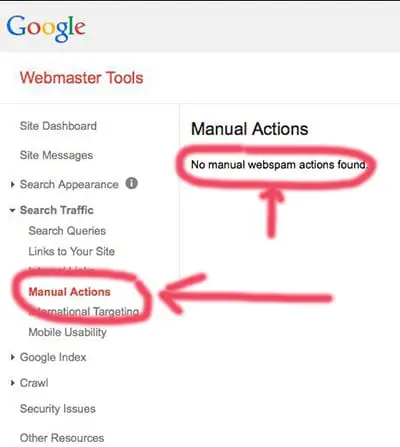
You can tell if your website has a manual action lodged against it by logging into Google Webmaster Tools (verification that the you are the website owner is required). On the left side of the screen, there is a “Manual Action” option underneath the “Search Traffic” option. It looks like this below:
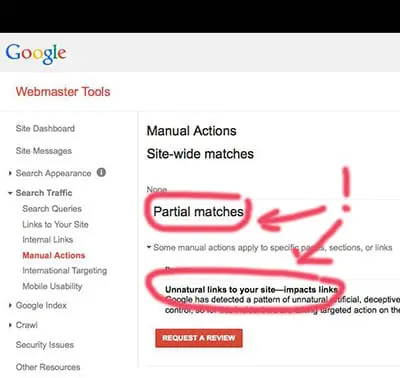
If you have no “manual action”, then the message will indicate so. But, if you have a manual action, like shown below, then you will need a Google penalty removal service, such as the service that Globe Runner provides.
Google Penalty Removal
Globe Runner’s proprietary methodology for getting Google penalties removed helped us with our latest penalty removal. Our process involves identifying the source of the penalty, getting those links removed, and documenting everything in the process. We believe that filing a disavow file, removed “some” of the links, and then requesting reconsideration from Google is not enough. Globe Runner goes above and beyond what would normally be expected: our search engine optimization experts, such as myself, have the experience to identify the links that Google has a problem with (even though Google won’t tell us which links to remove). We have the experience and knowledge in order to use the best methods to get these links removed. And, furthermore, Globe Runner documents everything: and presents this data to Google as proof that the Google Penalty should be removed.
For our latest Google Penalty Removal client, here is a sample of the information that we provided Google:
“We have found additional links pointing to the site inorganic and off-topic links pointing to the site. Many have been removed, and the others have now been disavowed. We uploaded a disavow file with 3024 domains, much more than the previous disavow file. We have also identified a lot more inorganic links, ones that were very similar in nature to the ones pointed out in your response to our previous reconsideration request.
We first identified all of the links to the website. We used Google Webmaster Tools, ahrefs.com, and Majestic.com, to identify all of the links. After putting all of these links into a spreadsheet and removing the duplicate URLs, we reviewed all of the links and classified them into separate lists: the links that are inorganic links that need to be removed, and the links that are not inorganic links (the links we will keep).
Overall, after gathering all of the links to the site, we ended up with:
62,519 Total Links
1,461 Total Root Domains
12,292 inorganic links, including “nofollow” links.
What We Did to Clean Up the Links
We manually reviewed all of the 12,292 links that were still “live”, which included links with the “nofollow” attribute as well as links without the “nofollow” attribute in the link.
We looked up the site owners of all 12,292 links, using a combination of whois lookups as well as manually visiting the sites to find the site owners.
We began contact website owners on September 8, 2014, and requested that the links be removed.
Around the end of September, we sent second requests for link removal after we hadn’t heard from site owners who didn’t remove the links.
We then continued to send third round and then a fourth round of requests for link removal after we still had not heard from site owners who didn’t remove the links.
As of October 21, 2014, we have contacted 12,292 link owners whose links to (client name) we thought were unnatural or inorganic, and got emails back from 3386 of the site owners. Of those site owners who responded:
3386 responded to our emails
5025 no response after several contacts
5294 links removed
499 refused to remove link
1474 requested payment”
Above is only a part of the message that we sent to Google to get this Google penalty removed. We also provided additional details of the links, as well the actual emails we received. We sent out over 12,000 emails. And, we received 3300 responses (about 25 percent responded to us). We got over 5,000 links inorganic links removed to the website. This is just the numbers that were sent to Google around October 21st, 2014. Since then, there are even more links that have been removed as a result of our efforts.
As you can see, Globe Runner’s efforts are extremely thorough and detailed–that’s our goal here. And that’s what will get a Google penalty revoked nowadays: you absolutely must identify the right links and get them removed. Then document everything.
“WHO RUN THE WORLD? GIRLS!”
Alright, we don’t quite run it.
In fact, despite tangible progress, we arguably have a long way to go before we’ll truly have our equal share. In an online Forbes article on Jill Abramson, the former first female Executive Editor of the New York Times, whose dismissal in May of this year sparked much debate on the treatment and standards set for women in executive positions, Abramson said, “Where are all the girls?”
It’s an ongoing issue in business, “raised until the strides of women in business match the gaits of their male counterparts…they still contribute less than 4% of all public and private business revenues — about the same share as in 1997” (Inverso). The concern was addressed on Fortune.com recently, too: “I oversee the team that puts together the Fortune 40 Under 40 list,” writes Leigh Gallagher. “And for as long as we’ve been doing it, the topic of the number of women on the list—specifically, the lack thereof—has been an issue” (Gallagher). Even when women do make the cut, many of us can’t help but notice they’re still mostly surrounded by men.
It’s sort of the opposite around here; the ladies have quite a large piece of the orange pie.
When I began working here, I was immediately struck by how many women there were in the office. The rest of the team had become so accustomed to it that, when I mentioned my surprise, the general response was a pause, a look around, followed by, “Hm, I guess there are a lot of women here.” Even in the close quarters of a team-oriented environment, with no office or cubicle-like barriers between us at all, there has never, to my knowledge, been any serious battle-of-the-sexes tension.
Since expanding and moving to the new space in Addison, we’ve added a few more men to the team, and so are closer to being equal in number. But, the relevant point for the moment is this:
Not only does Globe Runner and its CEO, in a technologically-heavy business, not shy away from accepting women for any position, but the conflict and sexism commonly associated with men and women working so close together is almost non-existent.
Even I sometimes wonder how in the world this is possible.
Particularly since, on top of that, we are a conglomeration of varying personality types. We are Baby Boomers, Gen X and Gen Y, and Millennials. We are conservative, liberal, and everything in between. We are single, dating, living with a partner, and married. How do we work together efficiently without serious strife (other than the occasional I’m-having-a-bad-day-and-can’t-deal-with-you-now drama)?
It all starts with the boss.
It may seem obvious, but it’s always relevant; the boss sets the standard.
Ours, like many, is more than a CEO. He’s a proud father and husband, an artist, and strives to be a role-model for people with dyslexia and other learning differences. He has a lot to balance in his life and work, and he needs people who work well with others to get things done. He also knows that merely being good at SEO does not a successful team member make; Globe Runner has a culture, and you have to work with and in it.
He’s created a culture that promotes equality by, well, not being sexist, and not hiring sexist people.
You’re not going to catch him making offensive jokes about women being lesser, for example. Actually, he’d be more likely to correct someone by pointing out that there are, in fact, women who can do whatever it is Mr. Funny seems to think they can’t. You’re also not going to hear complaints about him taking the advice of a male employee over a female employee again and again. “Having an idea ignored only to be repeated by a male colleague five minutes later to interest and applause” is a common issue for women in the workforce, and number six on TheGuardian.com’s list of the “10 sexist scenarios that women face at work” (Bates). He is consistent about hearing everyone out, and obviously cares more about the opinion and advice than who’s giving them (given that such a large percentage of his team is female, it would be hard not to).
We are, after all professionals.
Sexism is a nuisance, and not just for the women—or men, to be fair—on the receiving end. It’s distracting; it takes time and energy to be sexist. For example, if you get an answer to a question from a woman, and then immediately ask the same question of a man, only to get the same answer, you’ve just wasted time because you couldn’t accept, for whatever reason, that the woman knew what she was talking about. The resulting frustration is also a distraction, and makes for a tense work environment.
No business needs that.
We have fun at Globe Runner; but we’re a busy, professional group. We have a lot of work to do, and no one has time to deal with time-wasting, annoying sexism. We have to work together to get things accomplished, and not only would sexism get in the way of those working relationships, but the result would be a problem in productivity. Bosses and leaders would have to spend valuable time dealing with complaints, female employees may be less motivated to do their job because they’re not appreciated or respected, and they may quit altogether. And, of course, there is always the possibility of legal action, which is a nightmare for everyone.
Some clients would be bothered not only by the lack of productivity as a result of the tension, but by the sexism itself. These issues bleed into all areas when they’re not dealt with, and others outside the team will eventually see them. If you’re sexist around your team, you’ll eventually let it slip around clients, and that won’t get you anywhere.
We don’t have time for that here, and everyone knows it.
This isn’t Mad Men.
Gone is the martini in the middle of the day while your secretary ran your errands and made your lunch. (Though, maybe we could bring back the martini part for everyone.) But, some of the problematic parts of being a woman in the workforce still remain—Christina Hendricks’s take on them is pretty funny. It often seems that a truly forward-thinking workplace is a rarity. Just take a look at Twitter’s @EverydaySexism and #ShoutingBack.
But, we do our best.
We’re in the business of helping people function well online; it doesn’t get much more contemporary than that. We can’t afford to be stuck in the 50s, or any other noticeably less socially progressive age. This world, and this business, is constantly changing. As a result, client needs, expectations, and, of course, the clients themselves also change. We serve both male and female business owners of various ages and backgrounds, and in all sorts of industries. Our internal setup needs to reflect this progressiveness as well.
I’ve never heard anyone complain about being paid an unfair wage. I’m fairly certain we all agree that our allotted PTO is very generous. We have excellent benefits, including maternity leave.
I could go on, but I think you get my point.
We’re not perfect, and we know it. We’re very aware that things can always be better, in our work, and in our office. But, I wrote this because I’m thrilled; workplaces where female employees are valued and respected just as much as their male coworkers do exist in the world, and we’re running one.
*The opinions in this post are mine; they do not necessarily reflect those of Globe Runner or its team members and/or leaders.
ANNOUNCING THE NEW GTLD SEO POWER RANKINGS INDEX
As a part of Globe Runner’s effort to monitor and track the New gTLD domain names, starting today, we are announcing the Globe Runner New gTLD SEO Power Rankings Index. Quite simply, these are the New gTLDs that currently, on a collective basis, have the most SEO (search engine optimization) ranking power in the Google search engine.
New gTLD SEO Power Rankings Index
1 .email
2 .today
3 .cool
4 .link
5 .domains
6 .xyz
7 .sexy
8 .land
9 .nyc
10 .webcam
Our New gTLD SEO Power Rankings Indexed is from data we’ve gathered in the past two weeks. This data is based on websites that have been built on New gTLD domain names and are “good enough” to be included in the Google search index. For an explanation of how we gather the data and determine the rankings, see the “Our Methodology” section below.
Important Data Points for October 2014
As a part of calculating the New gTLD SEO Power Rankings Index, we pulled a lot of data from over 10,000 domain names, from Majestic (formerly Majestic SEO). Here are some of the more interesting top 20 lists that we compiled, which are only a few of the lists we used to calculate the New gTLD SEO Power Rankings Index.

We calculated the average Trust Flow for each website in our list, and then came up with an Average Trust Flow for each New gTLD. Overall, .NYC domain names had the highest average Trust Flow. Sites built on .NYC domains are the highest quality sites overall, with a higher average Trust Flow over all other New gTLDs.
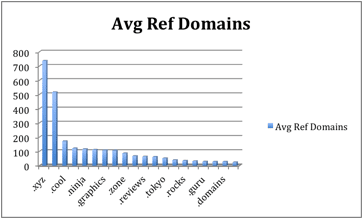
We also calculated the number of referring domain names to each website included in our list of each New gTLD. Then we calculated in average for each New gTLD. Overall, .XYZ domain names had the highest number of average referring domains pointing to them. Websites built on .XYZ domains tend to attract links from the most number of unique domain names.
This is only part of the data that we’ve gathered while calculating our first-ever New gTLD SEO Power Rankings Index. Over the next few days, look for more data that we’ll be releasing in future blog posts.
Our Metholodology
When it comes to search engine rankings and Google SEO, we felt it was important that we look at actual websites that have been built using New gTLD domain names. In determining our rankings, it was important that we pulled the data on websites, not just domain names that have been registered. So, first, we made a list of the top 100 New gTLDs, based on the number of domain name registrations. We used this list here to pull the top 100 New gTLDs. In the future, we expect this list to change, so in future rankings lists we will always pull the top 100 New gTLDs.
Once we had a list of the New gTLDs, we used the “site:tld” command in Google to pull the top 100 websites (web pages) that show up in Google.com and made a list of URLs. Keep in mind that in many cases we did not get 100 results, since there are simply not 100 websites (or web pages) that appear in Google for the search query we used. Typically, Google will not return domain names that are “parked” (parked domains), which is actually what we wanted.
We took the list of URLs for each New gTLD (100 URLs times 100 New gTLDS), which ended up being the top 10,000 URLs. We ran each of these URLs through Majestic and gathered the following data:
AC Rank
External Backlinks
Referring Domains
Referring IPs
Referring SubNets
Citation Flow
Trust Flow
Topic
If a website or web page in our list did not return all of this data, we considered the URL as not being fully developed (not enough data) and we removed it from the list. We came up with a separate list of URLs that contained all of the data. Therefore, if the URL was indexed in Google, and Google gave it to us as a result of our search query, and it was “good enough” to have all of the Majestic data associated with it, we considered that URL to be “developed” and the website to be “built” and a “developed” website.
It’s important to note that one of the findings was that in many New gTLDs there are less than 100 domain names actually developed into fully functional websites, with AC Rank and backlinks.
Once we have pulled all of the data and weeded out the domains that do not contain fully developed websites, we were able to pull the data. We began to make “top lists” of all of the data. For example, we made a list of the top 20 New gTLDs based on AC Rank. If a New gTLD made it into a list, we gave it a certain number of “points” and even more points if the New gTLD made it into multiple lists. Of the top 10 New gTLDs in our SEO Power Rankings index, all of them made it into at least 3 “top 20” lists. We used our points system to calculate the total points for each New gTLD and calculated our rankings.
Again, here’s our New gTLD SEO Power Rankings Index, #1 has the most “SEO Power” across the board, combining sample “live” websites hosted on that particular New gTLD:
New gTLD SEO Power Rankings Index
1 .email
2 .today
3 .cool
4 .link
5 .domains
6 .xyz
7 .sexy
8 .land
9 .nyc
10 .webcam
GLOBE RUNNER TO LAUNCH NEW ADDISON ART GALLERY WITH GALLERY 550
Digital agency will double as an art gallery
On November 20th, Globe Runner will celebrate becoming an Addison business resident by launching its corporate social responsibility project, Gallery 550. Among the confirmed attendees at the formal opening is the Mayor of Addison, Todd Meier.
Gallery 550 aims to provide up-and-coming DFW artists with exhibition space via Globe Runner’s walls. The first exhibition at this Addison art gallery will feature works by contemporary painter Winter Rusiloski. Her show will run until February 28th, 2015.
Coming up with Gallery 550 was an idea inspired by Globe Runner CEO Eric McGehearty’s roots as a sculptor and the company’s search to give back to the community.
“We want to be more than just another business; we wanted to contribute to the city’s culture, too,” said Eric.
With Gallery 550, Globe Runner will be the only digital agency in the area to double as an art gallery.
Rusiloski is represented by the Cohn Drennan Contemporary Gallery in Dallas and Artspace 111 in Fort Worth. She is an Associate Professor of Art at Tarrant County College Northwest Campus.

“TRAVERSE” BY WINTER RUSILOSKI, COURTESY OF THE ARTIST AND THE COHN DRENNAN CONTEMPORARY GALLERY IN DALLAS
In January 2015, Gallery 550 will be doing a call for entries for the next exhibit slated in Spring.
For more information about Gallery 550 and Winter Rusiloski’s show, please contact Globe Runner.
- « Previous Page
- 1
- …
- 30
- 31
- 32
- 33
- 34
- …
- 45
- Next Page »