














BRANDING: GLOBE RUNNER UPDATES BRAND MARK, CORPORATE IDENTITY
IN a nod to the times and surging demand for SEO services, Globe Runner unveiled its new logo, part of a branding and corporate identity refreshing exercise that started in May 2014. The new brand was produced by upcoming Texan design shop Steadfast Creative.
The rebranding was prompted by unprecedented demand for strategic SEO services, particularly in the booming DFW market. Globe Runner is poised to meet its 2014 revenue targets by the third quarter of the year. The bump in business, which began in March, has forced the agency to seek larger premises. It will be moving to a new office in Addison, Texas in September.
“It was time,” commented Globe Runner CEO Eric McGehearty about the branding exercise. “Our clients are upping their game, and so should we.” The new logo is a clean orange maze forming a G. “It’s a minimalist play on the globe that is part of our name; at the same time it references our agency’s mission of getting to the heart of clients’ online issues,” said McGehearty.
BEFORE AND AFTER: GLOBE RUNNER’S ORIGINAL LOGO HAD A GRADIENT GLOBE AND THE COMPANY NAME WRAPPING AROUND THE SPHERE. STEADFAST CREATIVE RETAINED THE GRAY AND ORANGE COLOR SCHEME, WHILE CREATING A NEW MAZE-LIKE G AS THE ICON.
The agency is slowly rolling out the different elements of the new identity, starting with its website, social media platforms and business cards. All touch points will carry the new branding by the end of 2014.
Globe Runner was started in 2008 by Eric and Heather McGehearty out of Lewisville, Texas. It has over 60 local, national and international clients in North America, the UK, Brazil and Malaysia. Among Globe Runner’s DFW clients are Sylvie Collection, Terry Costa, Jefferson Dental, Coach Posting, Skylane Autohaus, Old World Stoneworks, AgeWait and NICMAXX Online.
Globe Runner employs 20 full- and part-time staff specializing in SEO, pay-per-click (PPC) advertising, content strategy and development, branding, and social media.
The agency’s core competency is SEO, for which it consistently ranks on page 1 of Google for searches relevant to Dallas. Among Globe Runner’s artillery is Senior SEO Strategist Bill Hartzer, a nationally recognized expert on search engine optimization who has practiced, written about and presented on SEO since 1996.
CHEAT SHEET: SOCIAL MEDIA IMAGE SIZES
Whenever we engage a new client or do a website or marketing makeover for a client, one of the included parts is the social media part, where we review the current social media strategy and our client’s use of the social media websites. After all, social media is very much a part of SEO nowadays, and you need a good social media presence to help with your website’s SEO. To make the most of social, you need great photos and great profile photos as well as great posts. So, here’s our list, er, cheat sheet of social media image sizes.
Ello
Header Photo – 1800 x 1013
Avatar – 340 x 340
Facebook
Cover Photo – 851 x 315
Profile Photo – 180 x 180 (displays as 160 x 160)
Tab 111 x 74
Link Image 1200 x 627
Image 1200 x 1200
Highlighted / Milestone Image 1200 x 717
Twitter
Header 1500 x 500
Profile Photo 400 x 400
Image Display Size 880 x 440 (recommended)
Google Plus
Profile Photo 250 x 250 (visible face required)
Cover Photo 2120 x 1192
Shared Image 800 x 600
YouTube
Profile Photo 800 x 800
Channel Art 2560 x 1224
Custom Video Thumbnail 1280 x 720
LinkedIn
Profile Photo 200 x 200
Cover Photo 646 x 220
Pinterest
Profile Photo 600 x 600
Pinterest Pins 600 x (infinite height)
Board Thumbnail 222 x 150
Instagram
Profile Photo 161 x 161
Image on Desktop (Lightbox) 612 x 612
Image Feed 510 x 510
Foursquare
Foursquare Check-In Photos / Local Updates
Website Activity Feed 346 x 224
iPhone App Check-In/Update Detail 584 x 274
Website Activity Feed 530 x 224
Foursquare Tip Photos
iPhone App Activity Feed 530 x 112
Website Activity Feed 530 x 112
And for those of you who are still stuck on using MySpace, here is all of the dimensions you need to build out your MySpace profile:
MySpace
Photo Requirements (Max size is 20mb):
MySpace Stream Images:
Best Size: Highly subjective
Minimum 1×1
MySpace Cover Images:
Best size 2048×1152 (16×9)
Minimum 800×600 pixels
MySpace Profile Images:
Best size 2048×2048
Minimum 140×140
MySpace Mix Cover Images:
Minimum 1024×768
MySpace Song/Album Images:
Minimum 600×600
MySpace Animated GIFs:
Best Size: Anything over 300×300
10mb Max file size
All of these image sizes are mentioned as Width x Height, and are in Pixels. In our list, I’ve added a few social media websites that aren’t included in lists that others have included. Here are a few other websites that have put together their social media image size cheat sheets. They don’t include Foursquare and MySpace, though.Constant Contact Social Media Image Cheat Sheet

Social Media Sizing Cheat Sheet / 2014

Sprout Social also has an “always up to date” social media image size post, where Kevin posts the current image sizes.
Bill Hartzer is Globe Runner’s Senior SEO Strategist. Follow him on Google Plus. You can also follow him on Twitter as @bhartzer.
HOW TO BEGIN A LOCAL SEO CAMPAIGN IN 3 EASY PHASES
The Necessary Steps to Achieve Rankings Quickly
Starting a local SEO campaign could not be a more exciting, yet important time. Whether you are conducting a campaign for a client or going to take on the effort yourself, there can be an overwhelming number of steps and ‘hidden tips’. Read on, as all is revealed in this guide toward getting ranked quickly in the local pack and generating traffic.
Phase 1: Research and Prep
The very first phase in any successful local SEO campaign is to lock down the NAP (Name, Address, Phone) and other business details. NAP consistency is one of the most critical elements of ranking in local search results. View all the local ranking factors for 2014. Create a spreadsheet, ideally in Google Drive with a sheet for NAP Data. You can share with the business owner and in real time, they can view all the updates.
Name
Use the legal name of the business. For very small and local businesses, make sure they have gone through the steps to register Doing Business As Name (DBA). It’s not surprising to find many businesses that haven’t and some states don’t require it. Using the legal name in citations is important, as several directories will pull data from the DBA or legal name filed with the state.
Don’t add keywords to a business name unless it is the legal name of a business. Although, keywords in business names are one of the top local ranking factors. If you’re building a brand new business and have yet to invest in the brand, consider changing the legal company name or “Doing Business As” and add keywords. The only exception is for multi-location businesses, add south, north, or the city name to the company name to differentiate it from other locations in the same area.
The criteria for one of the most strategic and strict citation sites, Acxiom includes the following:
NOTE: You will need the following documentation to validate your business. We do not accept documents obtained or scanned from Internet sites or W-9 Forms. This documentation must be submitted with account information or your listing will be denied and you will have to reenter the information and resubmit.
*** BUSINESS NAME AND ADDRESS ON DOCUMENTATION MUST MATCH TO YOUR REGISTRATION REQUEST
- Federal Tax License Letter *submit the letter that includes your ID#, name, address and/or phone number of business
- State, County, or City Business License or Sales Tax License
- Doing Business As License
- Fictitious Name Registration
One informative blog post goes over the importance of limiting the length of your business name. That’s right, don’t create a name that generally is longer than 40 characters or you won’t be able to add it to many citation directories, including Acxiom. Abbreviating the name is not an option, as again consistency on every directory is crucial.
Address
Just as crucial is the address of the business. Always check with the USPS for the official address and proper formatting. While it’s been proven that small differences such as STE and #, which both represent suite don’t affect local rankings, larger discrepancies do. Be consistent, by adding the correct address to the spreadsheet you’ll be sure to copy it properly every time.
Phone
Always use a local phone number as the primary, add 1800 numbers or specific department numbers to additional fields available, but always use a local phone number that is truly a business phone. I had a client that told me her main business phone number, when I discovered later the number although local, was a cell phone. Always validate what your clients won’t tell you and check if it’s a business phone.
Other Business Information
In your NAP spreadsheet, also lock down the following (by getting approval on all details)
1. NAP (Name of Business, Address and Phone Number). Also add to the spreadsheet (website URL, social media URL’s, company email address with a domain name such as sa***@*********me.com, and 1800 numbers and other contact details. For a multi-location business, using a location specific URL has a bigger impact. It ensures the data between the multiple locations is unique and does affect rankings.
2. Categories. One of the most important areas of ranking locally is choosing accurate categories for a business. Max out all related categories, usually 5 for most citations. Think of different ways to call your service or work, and start board and go narrow. For example, a real estate brokerage might use the following categories: (Apartment Rental Agency, Real Estate Brokerage, Real Estate Brokers, Condominium Rental Agency, Real Estate Rental Agency, Apartment Finder & Rental Service). Category diversity is also important). You can use a tool to find new categories, I find that throughout a campaign, you’ll find new categories just by using different citation sites. Categories aren’t universal, but realize the more times you use a category in a citation, the more often you are to rank for that category term.
3. Approved Business Hours (Tip on 24/7 hour businesses. Google doesn’t enjoy displaying hours for a business as open 24 hours. A representative told me it can trigger a listing for further review, and even be removed or unverified. Unless a business has an office with a secretary at a desk, 24 hours a day, they prefer you specify normal office hours. Many citations on other sites allow for a checkbox on 24/7 and normal office hours. For Google, just add to the additional detail section)
4. Approved Payment Information
5. All languages spoken by employees
6. Year established. (This may be an area of contention at some businesses. I usually err on the side of the earlier, the better as customers do place trust in more established businesses, but don’t make up an earlier date. Some businesses may choose to take the year of a business they acquired. A business that has a history of opening and closing may also choose the first date they opened their doors.
7. Approved associations (Chambers of commerce, Inc500, local industry chapters)
8. Approved certifications (gather detail on all areas of employees, what certifications to employees have that can boost the credibility of the business?)
9. Short and long description. Write a unique paragraph for a short business description and multiple paragraphs for a long description. Include keywords in the copy, category keywords work well too… On Google + make sure to hyperlink to important areas on your website. For a local business with high competition, rewrite the description for each major citation. Otherwise the content is duplicated and isn’t as valuable.
10. Approved company logo and pictures.. For a service business, get logos of partners, vendors, company logo, the team, the office location. For product based businesses, photos become even more important and easier. Show your product in an engaging way, research has discovered local businesses with pictures get 60% more clicks. Use descriptive and keyword rich file names on images and include alt text.
Phase 2: Cleanup & Build
After gathering the above information in Google Drive, it’s time to begin cleanup. This will be the most time consuming phase of your local SEO campaign. If you’re starting a campaign for a new business (you have zero citations or websites online that reference you or your client’s business location), you’re at a much better starting point. For everyone else, assume the worst. Don’t skim through the search for duplicates, incorrect data, missing information and more. You’re goal is to find and catalog all unique problems (ideally in a spreadsheet). The name, address and phone, any and all deviations, should be recorded. Later you’ll use this list to search for more problems.
Begin with asking the business owner for any and all old phone numbers and location addresses. You should by now have the legal company name as well as any company locations. Don’t use the citation sites for searches. Many are poorly designed and can’t compete with Google. Use Google to find problems in the following ways. For the sake of the example, let’s say my business has the following NAP and I’m looking for problems on yellowpages.com.Pete’s Bakery4321 50th Street#254Chicago, Il 01234325-333-5743
- search for “site: yellowpages.com 325-333-5743”
This will help find businesses that share the same phone number regardless of name or address. They may be misspellings of Pete’s Bakery, duplicates of the address or even a completely unrelated business. Either way, any business that shares your phone number that isn’t the same entity should be resolved. Reach out to the owners if still open, or remove the entry. Sometimes I’ve even claimed a business, only to change the phone number to 111-111-1111.
- search for “site: yellowpages.com Pete’s Bakery Chicago”
This will find problems with the address, duplicates and the phone number. Often it’s an old number, a tracking number or even a 1800 number that is active on a listing.
Go through the list below of the most important local citations and check all for problems and duplicates first. Write down all unique addresses and phone numbers that are related to your business, you’ll use this list to check on all citation directories. Any new addresses, names or phone numbers you find, deserve a search on all existing directories.
You may find that none of the listings closely match the business. As you work through the problems, generally claim one of the listings and update it fully, remove all other duplicates. Although it is far easier to make an update with the original email and password, very rarely will clients have this information. Often speaking on the phone with support achieves a faster turnaround than an email. Review this handy guide for how to delete duplicates on popular directories. Add new listings that aren’t featured on the site, but triple check that they aren’t listed under the wrong name, phone number or address.
When you claim citations, use a generic or branded company Gmail account. It’s ideal to have this email not tied to anyone’s personal account. You will want ongoing access as many citations require email verification before making changes.
Most Important Local Citation Directories
| Citation Directory | Type | How to Claim |
| Google + | Search Engine | Google Places, requires postcard verification |
| Yahoo | Search Engine | Update the data aggregators, over time Yahoo will update. Or pay for an update. |
| Bing | Search Engine | Requires email confirmation, postcard or contact support |
| InfoUSA/Express Update | Data Aggregator | Requires phone verification |
| Neustar/Localeze | Data Aggregator | Create an account, claim and update |
| Acxiom | Data Aggregator | Requires phone and document verification |
| Factual | Data Aggregator | Contact support |
| Yellow Pages | Review Site | Requires phone verification |
| Yelp | Review Site | Difficult process to remove and update without login, contact support |
| Angie’s List | Review Site | Contact support |
| Superpages | Review Site | Contact support for listings already claimed |
| HotFrog | Directory Site | Contact support |
| Manta | Directory Site | Call support |
| CitySearch | Review Site | Requires phone verification |
| Best of the Web | Directory Site | Paid |
| Foursquare | Social Media | Requires voicemail verification |
| Social Media | Contact support | |
| Social Media | Contact support | |
| Social Media | Contact support | |
| Mojopages | Directory Site | Contact support |
| YellowBook 360 (hibu) | Directory Site | Call support |
| Merchant Circle | Review Site | Contact support |
| Yellowbot | Review Site | Requires phone verification |
| BBB.org | Complaint Site | Requires payment |
| dexknows | Review Site | Owns Superpages, but process is still separate. Must call support. |
| Dunn & Bradstreet | Data Aggregator | Requires business owner verification |
| ibegin | Directory Site | Requires phone verification |
Phase 3: Growth and Ranking
After fixing all issues on the most popular directory sites, it’s time to expand to any site that lists the business either correctly or incorrectly. Claim and update and use the techniques listed above to find all mentions of the business. Adding to Google Drive creates an easy way for a business to check in real time and see all the new citations and progress made.
Next, leverage software and there are many options available. I’ve used Whitespark and Brightlocal, but realize there are other solutions. Most do the same or similar functions. They track (although with some inaccuracies) all the citation directories where a business is located with opportunities to increase and add the business to new directories. They also help compare and track over time your competitors ranking in local search with your own business. There are some steps to use this software effectively:
1. Identify the terms that trigger the local pack for your geographic area. As you search for keywords you’ll often find other sites ranking that allow for a citation. Also note which terms are most aligned with your business and the search volume.
2. When looking at a local pack, there are two areas that can influence click through rate. One is position or where a business appears in the local pack. A higher position is better, although a business with reviews can outstrip traffic of higher results. Track using software the position of each keyword. 8th is just shy of appearing in the local pack, 7 is at the end for most terms.
3. Look for new opportunities routinely, especially in regards to competition. Where are they listed and perform and problems in search. Occasionally a data aggregator can receive the wrong information or create duplicate listings which require removal. Monitor and continue to optimize the growth of citations and the increase in rankings.
Review Strategy
With corrected and consistent citations and eventually, rankings, put a review strategy in place to increase CTR. Identify the top sites to receive a review, most of the time it should include Google +, Yelp and an industry specific site. Use software such as customer lobby, which can make reviews easier. Or simply put a process in place that asks every customer to review your business. This could be through stickers and visual reminders at your retail location, a conversation you have in person after completion of a service, or an automated email for an online business.
You can generate several quick reviews by simply sending an email to your marketing database. But for true success, put in place a process and realize it’s important!
Corey Barnett is a Globe Runner Online Marketing Specialist. Follow him on Google Plus. Corey also frequently writes on his blog – cleverlyengaged.com/blog
NICMAXX ONLINE APPOINTS GLOBE RUNNER FOR SEO, CONTENT MARKETING SERVICES
Globe Runner’s client roster has one new addition: Digital retail site NICMAXX Online.
NICMAXX Online conducts e-commerce for NICMAXX, an electronic cigarette brand that has grown in popularity in key consumer markets such as New York, Las Vegas and Florida. Developed over eight years by smokers for smokers, its proprietary blend of ingredients closely replicates the sensory experience generated by traditional cigarettes.
Based in Addison, Texas, NICMAXX Online comprises the retail site https://www.nicmaxxonline.com/, social media accounts for Twitter (@NicMaxxStore), Facebook (@nicmaxxonline)) and other digital assets.
Apart from US customers, NICMAXX Online caters to overseas customers who may not have access to the product. Some countries still forbid the sale of e-cigarettes but do allow for purchase and personal consumption.
In a recent Wall Street Journal story, Wells Fargo valued the e-vapor market at $2.2 billion. NICMAXX Online is seeing strong growth in ecommerce with revenue tripling year-over-year.
“It’s always exciting to work on a challenger brand making ripples in a relatively new category,” said Globe Runner CEO Eric McGehearty. “The opportunities to build NICMAXX Online into a strong brand are tremendous.”
Globe Runner was started in 2008 by McGehearty in Lewisville, Texas. In addition to its core business of search engine optimization (SEO), the agency also offers online advertising, content marketing, branding and social media services.
FILED A GOOGLE DISAVOW? THOSE LINKS ARE STILL IN GOOGLE WEBMASTER TOOLS
A while back, Google gave website owners an advanced link tool called the Disavow Links Tool. It allows us to tell the search engine which links to ignore when they calculate the links to our website. Bing.com has a similar tool, as well, and was actually the first to make the tool available to website owners.
With the Disavow Tool, you simply come up with a list of URLs or domain names that you don’t like and put them in a text file called a “disavow file” and upload that file to Google (and Bing). When the search engine crawls the links again and recalculates the links to your site for search engine ranking purposes, they are supposed to disavow those links (not count them or ignore them). From my experience, I’ve seen a disavow file really help in cases where certain links were super low-quality or “toxic” links. About 5 days after submitting a disavow file, I’ve seen traffic start to go back up. Sometimes it takes a lot longer.
But here is where I’m surprised. When you upload a disavow file and Google accepts that file, they know that you’ve disavowed certain links or certain domain names (all links from that domain name). Why does Google still shows those links in the “links to your site” section of Google Webmaster Tools? Google still shows those links in your list, as if those links still exist–and they do. But why would Google still show them? You’ve disavowed them.
Apparently the disavow file data is not taken into account when they generate the “links to your site” list in Google Webmaster Tools. If Google removed those links from the list (the links that you’ve disavowed) then we would know that Google is taking the disavow file into account when calculating links to the site. That would be very helpful for website owners to know.
Let’s look at a specific example. In January 2014, I disavowed low quality links from the domain name “articlesnatch.com”, which a previous SEO firm created (they submitted hundreds of articles to that site in particular). Now, I personally feel that those are low quality links, just there for “SEO value” and therefore should be disavowed. But 6 months later, after I disavowed all links from that domain name, Google Webmaster Tools still shows links from that website:
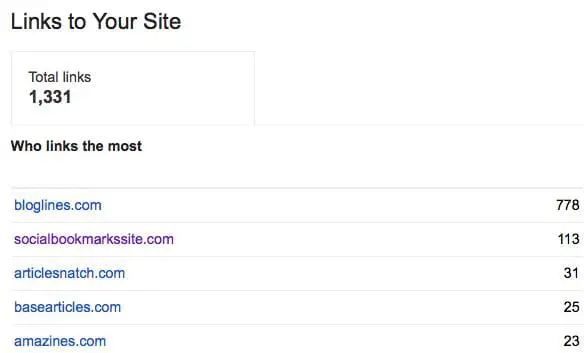
In fact, looking at this particular list of links to this site, I disavowed links to socialbookmarkssite.com, articlesnatch.com, basearticles.com, and amazines.com all back in January 2014, over six months ago. Yet they still appear in Google Webmaster Tools as links to the site. These links were disavowed because the site owners refused to remove the links or we were unsuccessful in getting those links removed. This was part of a reconsideration request because the site had received a manual action for it’s links. The manual action was revoked after we disavowed these links and removed other links to the site.
It would be really helpful if Google, in Google Webmaster Tools, were to remove those links from the list of “links to our site”. I understand it’s a random list of links, but the least they could do is remove the links we’ve disavowed. That would tell us that they’re taking our disavow file into account when they calculate the links to the site. Or, at least mark the links somehow so that we know that they’ve been disavowed. How hard is that to do?
Bill Hartzer is Globe Runner’s Senior SEO Strategist. Connect with him on Google+ or on Twitter as Bhartzer.
GOOGLE ADWORDS ADS, ORGANIC SEARCH, AND THE EBAY SEARCH PENALTY
Google has always maintained that paying for Google AdWords ads doesn’t have any effect on your organic search engine rankings. They just don’t share the same databases, so there’s no way for Google to know if you paid for AdWords ads and relay that information to the organic search team or its algorithm. I have to say that I agree with them–by mixing the two or allowing those two database to essentially “talk to each other”, there would be serious consequences and a lack of overall trust by the public in organic search.
As Google organic search begins to rely more on more “human factors” that are more and more measurable, it’s more likely that Google AdWords ads will come into play and start to have an effect on a site’s organic search engine rankings. For example, when a site starts seeing more visitors from paid search, users tend to initially come from paid search–but then they may go back later and perform some brand searches, which then affects organic search traffic. It’s those same visitors who may share the content and interact with it on the social media sites, which could then effect organic search traffic, as well. Then, finally, one theory I’m toying with is that Google is watching the overall traffic to a site and the level of engagement by humans. The more popular a web page, article, blog post, or site becomes, the better it will perform in organic search. As that traffic fades, so does the site’s organic search engine rankings.
So, when it comes to the correlation between Google AdWords and Google organic search, there may very well be a correlation between the two: but it’s traffic related, not because of the fact that Google AdWords and Google organic search shares the same database or the same data.
But let’s not forget a study that Google did back 2012, called Impact of Organic Ranking on Ad Click Incrementality:
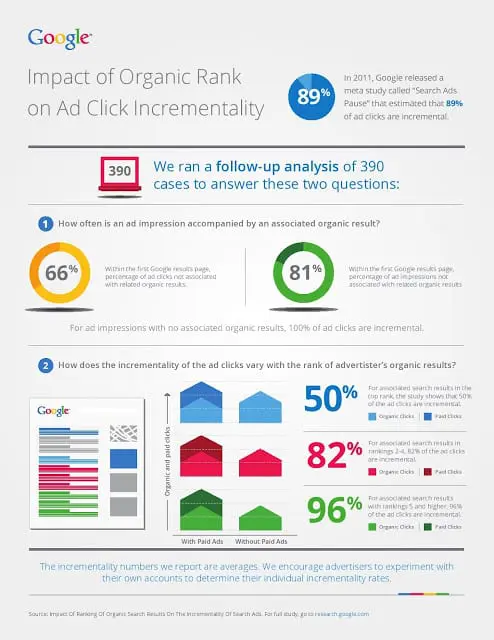
There is a strong correlation between organic search and paid ads when you’re running paid ads. You get clicks on your organic search results. And, guess what? Google tracks the clicks on your organic search listings. The more people who click (and don’t pogostick back to the search results), the better your organic search engine rankings. Or at least Google’s tracking the clicks on organic search and using that data somehow in the organic search algorithm.
It’s not surprising to me that if you stop paying for AdWords ads your visibility in organic search will go down as well.
Recently, there have been some interesting reports and comments regarding eBay and the fact that Google has penalized the popular online auction website in organic search. eBay stopped paying for Google AdWords traffic about a year ago. As a result of not participating in Google AdWords, I can see how eBay’s traffic started going down over time, as they just as visible as they were previously. eBay was recently penalized in Google’s organic search results either by an algorithmic penalty–or with a manual action (or both). eBay nor Google is commenting on what the current situation is. But, nonetheless, it’s clear that the site’s traffic from organic search has gone down.
According to SEMrush.com, eBay has suffered significantly with this last Google organic search update:
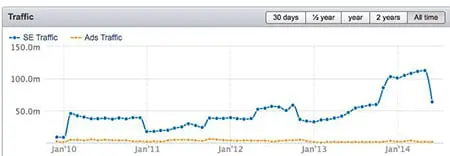
A SearchMetrics report shows that eBay has suffered a 78 percent loss in search traffic.
According to SE Roundtable, conspiracy theories exist around the loss in eBay’s organic search traffic. Apparently there are theories out there that say that this some sort of backlash or penalty for stopping paying for Google AdWords ads. Reports say that eBay spent over a billion dollars in Google AdWords ads. And they’ve stopped advertising in Google AdWords.
Frankly, I personally believe that Google wouldn’t be so bold as to do something like penalize eBay for not paying for Google AdWords ads. They just wouldn’t do that, as it wouldn’t make sense: if it were to be connected in some way, there could be strong repercussions and most likely some sort of legal action would come as a result.
My theory is that Google AdWords ads, and the traffic that it generates, has an effect on a site’s organic search, especially given the fact that “human interaction” with your website is so much more a part of the Google organic search algorithm than it has been before. The fact that Google has been cracking down more and more on low quality, thin content with Google Panda is related. How much unique content really is on eBay? Many sellers upload literally thousands of listings, with all sorts of duplicate content, and that content doesn’t stick around for that long. It eventually goes away when the auction is completed. That has to come into play here.
There’s no evidence that Google has consciously dinged eBay because they stopped paying for AdWords ads. There never will be. But think about it: if you stop getting traffic to the site, there’s less human interaction with your site, people don’t search for your brand as much as they did in the past, and they don’t socialize your site as much as they used to. And that’s what’s going to effect organic search traffic.
Sure, there could also be a Google algorithmic or manual penalty on eBay’s site, as well. Does it really matter? I don’t really care at this point if eBay ranks for a keyword phrase or not: I’m going to straight to eBay to bid and buy. I’m not going there because I found something in Google organic search.
Bill Hartzer is Globe Runner’s Senior SEO Strategist. Connect with him on Google+ or on Twitter as Bhartzer.
GLOBE RUNNER JOINS SMC DALLAS BOARD OF DIRECTORS
2014-2015 SOCIAL MEDIA CLUB OF DALLAS BOARD OF DIRECTORS WITH GLOBE RUNNER’S JEFF NUNN IN THE CENTER
On May 22, Globe Runner’s head of Business Development Jeff Nunn was welcomed to the Social Media Club of Dallas‘ 2014-2015 Board of Directors. Jeff will be responsible for Treasury.
Jeff is a seasoned sales and marketing professional with extensive experience in segments ranging from interactive marketing to retail. He joined Globe Runner in September 2013.
With Jeff’s new appointment, Globe Runner now sits on the boards of two prestigious organizations in Dallas Fort Worth: the DFW Search Engine Marketing Association and the Social Media Club of Dallas.
5 ASPECTS OF SUCCESSFUL WEB DEVELOPMENT PROJECTS
Building a new website can be a complicated process, requiring a lot of decisions based on a technical and creative process that many know very little about. While getting the web to shine light to billions of people across the planet in exactly the way that promotes your brand, platform, and business sounds daunting and overwhelming… it isn’t if you are doing it right. There is a certain energy to the teams that build successful web sites and applications, and if you are able to recognize it and harness it – you will create a quality result every time.
Aspect 1 – A Team
While no doubt, great websites have been built by one guy in his basement doing everything in a weekend with an IV of Red Bull and loud music, they typically don’t have long term success. The first aspect of building a great website is the recognition that it is the creation of a team and not of a single individual. The process is simply too large to be done well by a single individual in a reasonable time frame.
There are typically three to four groups involved in a building out a great website.
- The Customer – this is the person who has the most information about the website to be built because it is ultimately their creation. The website the customer wants is largely only obtained by communication with the customer. The customer often knows what the website should “feel” like before a single bit of design or work has been done. While this is the single most important piece of the process of building a website, very little attention is given to it and it is often overlooked. The best teams work to get the customers feeling in line with the technical, creative, and business aspects of the process.
- Design Team – this group is responsible for building the non-functional, initial diagrams of what the website will specifically look like. The best visual designers are those that can also do some of the technical work required, but are more idea driven than implementation driven. These guys spend a lot of time on the web and know what is going to be visually appealing and functional to the user of today.
- Technical Team – this is the group that typically exists in the dark catacombs of some cave with nothing but wires coming out, just kidding. The technical team is responsible for taking the feeling and vision of the customer and designer, and parsing it out into great technical detail so that it can be delivered to millions of people world wide. The technical team is concerned with ensuring the vision and design of the team is honed with what the real world can actually provide.
- Business Team (for eCommerce Sites) – while not always a separate group, the business team is concerned with aspects of how a site integrates, enhances, and encourages revenue-generation. This team is focused on the specifics of the eCommerce experience, such as order processing and fulfillment, analytics and marketing of the site to generate users, and how the site functions as the first-line customer service tool for the business.
Aspect 2 – A Goal
The customer doesn’t typically build a new website on a whim. Time must be taken by the customer to reason and analyze what their goals ultimately are. Do you want a better user experience? Are you looking to drive more traffic to your site? Are you simply tired of dealing with your current website? Do you want to enhance your eCommerce conversion? All great websites start with clear goals.
When I meet with a potential client that cannot communicate this in a very specific and well thought out plan, I will not take the job. The customer has to play the role of knowing what the customer wants. If the customer doesn’t know, than a professional engagement where they pay me to persuade them to believe that what I tell them is what they want… well its always been a bit strange to encounter this kind of proposal. But it does happen and it’s kind of scary when it does.
It is the customer’s job to the team to ensure every single member is informed of the goal at the very beginning. The customer needs to meet every person in the project and communicate this goal to them and simply ask, “How are you going to help me meet this goal?” If the designer can’t answer that question – its time for a new designer. If the technical team didn’t respond with questions about specific numbers or server technology to be used– time for a new technical team. If the business team didn’t respond with a question about conversion %, bounce rates, and what marketing outlets have and have not been explored…. Time for new business team.
Each member of the team needs to feel like they are playing their part in the successful team. Some guidelines for gaguing how your team is meeting this aspect
- Are they asking questions and proposing ideas? Are they actively engaging in the creative and technical process?
- Are they prompt in their communication with you? Are they proactive in their communication?
- Do they perform? Do they do what they say they are going to do? Are they proactive about keeping the whole team informed of anything that affects the process?
- What is their tone in the interaction with you? The tone is, in my experience, most indicative of the eventual result of the team.
Aspect 3 –Visual Design and a Functional Design
When the site is built, the designer should include a writeup on the various ways their drawing should function as a user interacts with it. Anything that moves on the site should be specified. Anything that needs to be computed, such as how a form should perform once it is submitted, should be specified. How should your blog look when its paged? If you want a sliding banner you have to say that. If you want a menu to fade in slowly, you got to say that.
Successful web design teams design what a site looks like and what it acts like.
Particular focus must be on providing the design to the variety of different web browsers that can be used. If you have analytics on the browser distribution of your current site, you need to make sure your team knows this so they can build the site to maximize effect on your specific traffic distribution. But this leads us to an even more important aspect of successful web sites…
Aspect 3.5 – Mobile Focused Team, Responsive Design
Almost every website I’ve seen analytics for in the last 2 years has undergone a very drastic and dramatic shift in the demographics of the browser used to view the site. Mobile devices are the primary way people are going to view your site in the period you have developed it to exist for. A successful team is going to be aware of this and will be bringing every single component of the design back to what it looks like. Many teams have started doing mobile first designs, largely amplified by the semantics of some of the more popular CSS frameworks like Bootstrap 3 and Framework. Some teams split it out into two endeavors or two sites… but all successful web sites are focusing on and enhancing how the site is being displayed on phones.
Sadly, I have not seen this in the eCommerce sector to the degree I think it needs to be done. Many people are still providing large hard to click tables of products to mobile devices – often to mask the fact their search and taxonomy are not relevant to interested customers. This is one of the clearest paths to eCommerce growth to me is maximizing the conversion of 50% of the traffic through simplification and optimization of the mobile experience.
A mobile user is going to spend less time on your site as well. That needs to be acknowledged, and the design needs to recognize the limitation so that it can capitalize on what the user sees. If a user has to hunt to figure out how to contact you, or has to zoom in to hit the next button on your product page and zoom in again to see the photos on it or read the text of the product names, your website will fail to capitalize on the opportunity with a majority of its traffic in the next 5 years.
Maximize the limited time you have with mobile users by greatly limiting the content that is presented to them– while at the same time not prohibiting their access to more detailed inquires. A regular user should be able to have a regular experience – which we can achieve through the use of site cookies – but a first timer needs to enticed into learning about your company or making a purchase by not overwhelming them with finger actions or text.
Aspect 4 – An Issue (Bug) Tracking System (preferably with integrated source control)
This is, in my opinion, the fatal pitfall many teams make… once development begins, the silence gap happens… and grows until the Customer appears disinterested to the developer and the developer unskilled to the Customer. A silence gap in the development process lends itself to many sub-optimal products. The way this is mitigated is through the DILIGENT use of an issue tracking system. All team members should be recording their plan for the next two weeks of work out to the issue tracking system, and regularly commenting on their progress. This allows every member to survey what’s going on… This reminds every team member that they are part of team that relies on them, so that gaps in communication are not possible.
While no web site is ever finished as they are living breathing things that are displayed on technologies that rapidly change….. for the initial build it is important that every member of the team is monitoring and engaging with the issue tracking system. If the visual designer has a quick question for the Customer, they can use the issue tracking system to record that. If it takes more than an hour or two to get a response, they can follow up with a quick phone call – and record the answer to their question in the task so the whole team is aware of the evolution of the creative process.
If you bundle your issue tracking system with your source control you really unlock the key of building a great web site. Great teams use a source control system they are actively committing to. Great teams watch the progress of every other team member’s commits to the source control and actively engage with them based on that. The source control is the component of the development process that allows the team to congeal into a unit that builds the great website. But it has to be wielded properly to do that.
I encourage developers to use the microcommit – commiting small amounts of work on a regular basis. This gives insight into what the developer is doing without interrupting their creative process. It also keeps the developer honest with themselves with what they have accomplished and what they are working towards. In short, it makes them better developers. Every development process has a narrative, and the developer tells that narrative through the commits of the source control.
Add to that the ability to track deployments and version releases and even drive the deployment of the site to a cluster of severs directly from your command line – with little effort – and the technical advantages of diligent source control use becomes crystal clear. This is an aspect of all great technical teams.
Aspect 5 – Testing, Sign Off, and Testing Some More
When a developer gives you a URL to visit to look at the site, that’s telling the team they should begin testing it and tracking issues in the issue tracking system. Remember the developer is in an intensely detailed creative process, so you don’t want to overwhelm them with the obvious or with egocentric urgency. But if you do see something wrong with the site that maybe you want to changed or added, or maybe you’re seeing that it doesn’t look good at all on your browser, log a ticket so they are aware.
All team members should be testing as soon as they can. Even if that’s just one page, the developer needs to hand that off to them as soon as they can. The sooner the developer engages testing in the development process, the less time they have to build something that is fundamentally flawed because it was built on something that was discovered in testing.
When all team members are actively engaged in honing the site, through this stage of the process is when the real magic of successful web sites begins to shine. This can be an immensely fun process where each team member gets to play the role of both painter and art critic simultaneously. When great teams work together closely to build a great product…. That energy has a lasting effect. I’ve seen people come back to companies after many years citing the experience of the time they built the website as one of the “coolest” things they did.
Even after its tested and tested (in IE 8,9,10,11 FF, Chrome, Safari my iPhone, iPad, Android, and a some guys archane Blackberry for some reason, and one guys Wii) and all tickets are resolved and the site is live and generating thousands of dollars of revenue a day…. TESTING IS NEVER OVER. Every member of the team should test the site from time to time and, if they see an issue, log a ticket. Web sites shine their light 24 hours a day, and only those who are diligently verifying the quality and accuracy of the light they shine…. Shine bright.
If you combine these 5 aspects into your web development process, it will create something great for your company for the next several years, serving as a platform for both revenue generation and brand recognition, and acting as a reminder to your team of what they can accomplish when they work together on a creative task.
Now speaking of testing, I have some bugs to fix on this web site. Take care.
WORLD CUP 2014 MARKETING: USMNT SOCIAL MEDIA MENTIONS QUADRUPLE IN 7 DAYS
What sport will people be talking about a month from now?
From the past week’s social media mentions, it’s going to be soccer, specifically the 2014 World Cup, and most particularly the US Men’s National Team’s upcoming match against Ghana in the Group of Death.
Social mentions of the US Men’s National Team (USMNT) leapt to 15,426 the week of May 10, a gobsmacking 476% increase over the previous week’s mentions of 2,675. Majority of these mentions were on Twitter — something to note for anyone conducting World Cup 2014 marketing campaigns for their brand.
The figures were derived from SociaLitmus, an omnibus social media command center that will run only throughout the 2014 World Cup. The social media command center will be keeping tabs on World Cup 2014 marketing promotions and activity online for the US, popular athletes and teams, trends and key developments.
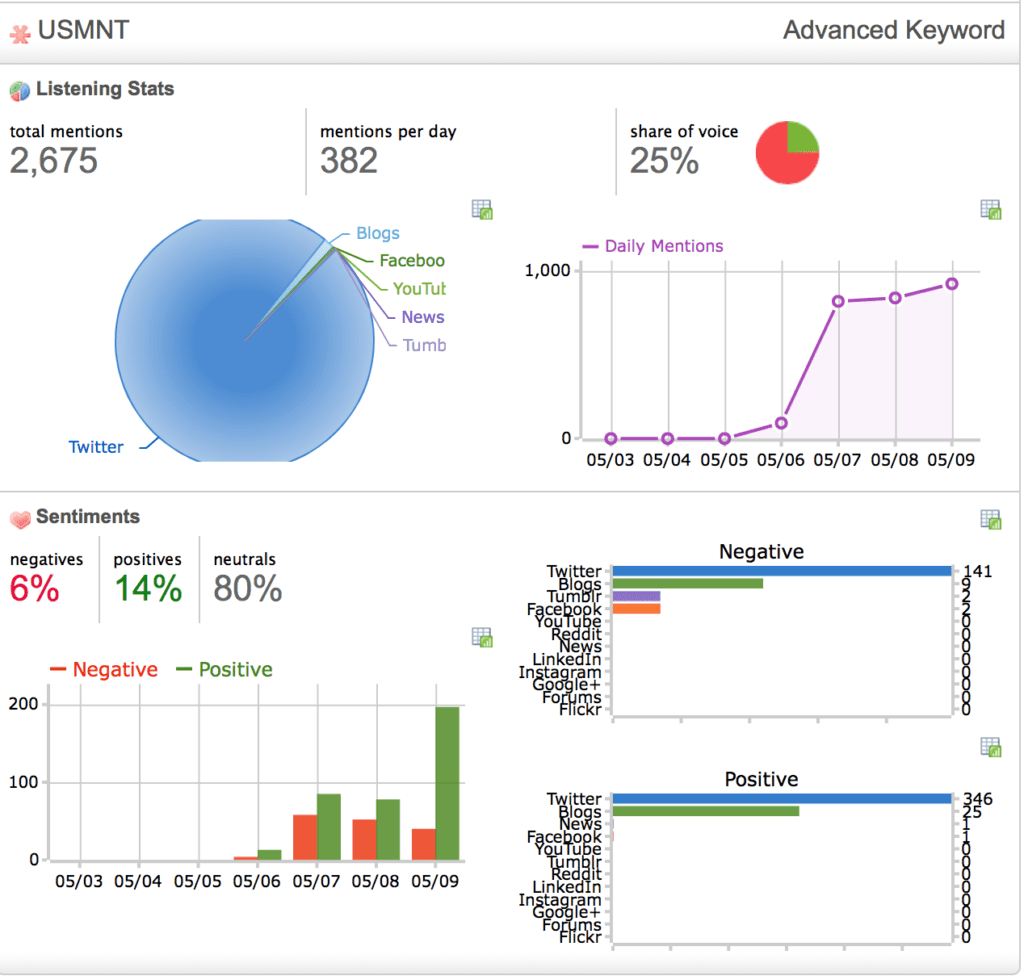

USMNT SOCIAL MEDIA MENTIONS FOR THE WEEK OF MAY 3-9, 2014: SOCIALITMUS<
USMNT SOCIAL MEDIA MENTIONS MAY 10-16, 2014: SOCIALITMUS
The most dramatic spike in mentions was on May 12, when team coach Jurgen Klinsmann announced his 30-man roster for the World Cup.
Sentiment about Klinsmann’s picks was largely positive, as social media data from May 12 show:

USMNT SOCIAL MEDIA SENTIMENT 12 MAY 2014: SOCIALITMUS
The numbers may seem negligible, but multiplied into impressions, the reach is not shabby. On Twitter, the USMNT earned over 73 million mentions in one week. Any brands looking for endorsers?
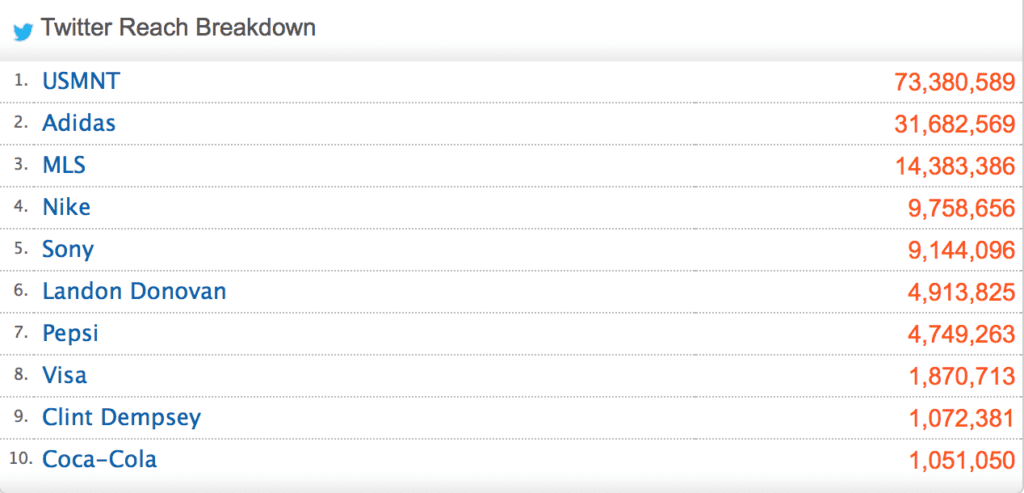
Sports network ESPN predicted last month in an AdAge interview that social buzz over the 2014 World Cup will outperform those of the 2010 World Cup and even the 2012 London Olympics.
The World Cup is fertile ground for marketers targeting fans of the Beautiful Game. Categories that will be out in full force are the usual suspects: Beer, fastfood, men’s personal care, sports brands (the Adidas vs Nike rivalry is a sport unto itself) and technology.
It will be interesting to see whether new categories, such as e-cigarettes, will see the same opportunities and make a play on social media.
- « Previous Page
- 1
- …
- 32
- 33
- 34
- 35
- 36
- …
- 45
- Next Page »