












5 WAYS TO PERSONALIZE YOUR WEBSITE AND BOOST YOUR CRO
All humans like to feel seen, valued, and dare I say, special. It’s one reason why targeting is such a huge part of effective marketing. Try to capture the attention of everyone, and you’re unlikely to impress anyone.
If you’ve been unknowingly – or willfully – gearing your web content toward an unspecified, broad audience, it’s time to get personal. Your CRO (conversion rate optimization) depends on it.
Think about it. Your target audience is bombarded daily with tens of thousands of ads that are all but screaming at them for a sliver of their fragmented attention. Successful brands know how to treat their websites like a handwritten love letter personally addressed to their ideal customers and clients.
Here’s how to break through the noise and capture the mind of your potential customer by personalizing your website.
- Stick the landing (page) by personalizing it. Load your landing page up with unnecessary details, and you’re likely to lose a user’s interest, quickly. Repeat information they already know, same story. To get the conversions you’re after, you need personalized messaging. That’s what ultimately turns browsers into buyers. Keep your text, short, sweet, and with a personal beat. Try adding a personalized CTA to the bottom of your copy and see how it impacts your conversion rate optimization. Something as simple as “Greetings, Googler! We appreciate you searching for Dallas SEO Companies. Here’s a free case study to show our gratitude. Enjoy!”
- Show some emotion. Emotions are the one thing we all have in common. They’ve evolved over eons to help us navigate the wilds of life. Today, the more you can relate on an emotional or personal level, the more likely you are to convert prospects into purchasers. Your messaging should center around positive sentiments that inspire confidence or evoke nostalgia. Show them you understand their pain points and tell them how you’ll swoop in to make the fix with the click of your CTA button. Here are some more examples of emotional marketing done well.
- Make your content buyer-specific. Read: time to bust out your buyer personas. Before you ever sit down to put pen to paper (or fingers to keyboard) pull out your personas and review their preferences. Pretend you’re writing to Erin Sanchez, young professional who loves cats, not 22 to 32-year-old females. It’ll help make your content more pointed and personal. While you’re at it, make sure the copy itself is broken up into bite-sized pieces that Erin, or any other reader, can easily take in. The larger your text blocks, the less likely she is to wade through them. Instead of straining her eyes, get to the point quickly, and make your ask as obvious as possible, as soon as possible.
- Speak to them through videos. The importance of video marketing is present on a lot of fronts. None so much as its ability to increase your conversion rate optimization. Users are likely to spend loads more time on a website with video. Be it product videos or video blog content, including vids can improve a customer’s chances of buying by up to 64%-85%. It’s a no-brainer way to literally speak directly to your target audience in a highly personal way. In fact, we do it every week! In essence, the more visually you can show off your products or get customers comfortable with the folks who’ll be performing your services, the better. Have your CEO speak, or better yet, let them hear from the rest of your staff, so they get to know the everyday people behind the brand!
- Provide local specials. What better way to connect than by addressing them on the home front? With geo-targeting, you can use available technology to post content that’s specific to the locales of your ideal consumer. While you’re at it, don’t forget to bring these changes directly to the hands of your customers. In other words, ensure all your content is mobile ready or be prepared to get left behind.
We live in a world where digital and personal are seemingly at odds. All the more reason to tailor-make your online spaces personalized. Not only will it help you stand out from the competition and improve your CRO, it’ll show you understand your customer, creating the long-term relationship that leads to brand loyalty.
Want some help writing your personals? Let us pen some compelling, personalized content to help you make contact!
AVOID THESE WEB COPY WORST OFFENDERS TO WIN CUSTOMERS WITH WORDS
The language-processing center is one of the most developed parts of the adult brain. It’s a highly advanced system that allows us to decipher meaning from pure silence. With little effort, black and white symbols take on all kinds of meaning.
- Prioritize your keywords over your customers. If you’re too focused on creating a keyword driven content calendar or devoting too much space to talking about yourself, it’s time to shift focus. Remember that your audience is more interested in what you can do for them rather than the keyword(s) that brought them to your site. Sure, you absolutely need to sprinkle in some specific turns of phrase that will ping the search engines. But it’s more important to use your words to show and tell customers how you’ll bring value to their lives. Do so in a storied way that grabs their attention. A keyword or two may have gotten them there, but it’s the rest of your words that will make the sell.
- Present a problem in an abstract way. All good stories need a little bit of tension. It adds interest and keeps readers engaged. Use the sections of your website to create mini-vignettes that bring your potential customer’s problem into focus. The quicker you do so, the more likely you are to hold their fragile and limited attention. The more crystalline your mission to address their pain points, the more likely you are to move them down the sales funnel.
- Forget to push readers to take action. In life, and good writing, action is almost everything. Pretty words count for a lot, but they alone aren’t enough to close the deal. For that, you need to be explicit about what you want your reader to do next. Simple instructions like ‘click here’ are banal and diluted from overuse. Instead, try turning your CTAs (calls to action) into problem-solving hybrids like “start getting more web traffic” or “increase your Google ranking.” Make an action item out of the pillars that matter the most to your potential customers.
- Hit them with a wall of words. Precise and concise is the name of the game here, folks. You may have a compelling backstory, but save it for your About Us page. When they first land on your website, you want to quickly move them through your most important offerings and on to the commitment portion of the evening. Create a labyrinth with your language, and you’ll lose them forever.
- Make mindless headlines and hyperlinks. For the text you do have, be sure to break it up with thoughtful headlines that are at once compelling and descriptive. That way if they only skim your text, which, let’s face it, is highly likely, they’ll at least get the main takeaways out the gate. It’s ok to pepper some hyperlinks into the copy, too. But just like salt, too much or too little is a problem. Over link and the search engines that get grumpy. It implies that your content is unoriginal. Too few, and you might not be able to back up your words with the right level of authority.
- Fail to let others speak. Few of us are really gifted at talking about ourselves. In fact, businesses do much better when they let at least a few other authors toot their horns in the form of compelling testimonials. The more past success you can show, the more future success you’re likely to have.
Still not sure how to use your words wisely? Let us do the talking for you! Our expert content marketers know how to write for both human and electronic readers to help you stand out.
IMPORTANCE OF EMPLOYER BRANDING FROM THE CEO DOWN
Top down isn’t just a leadership strategy it’s also a branding strategy. Though we typically refer to the top tier of the c-suite as a CEO, the acronym could easily be exchanged for CBA (Chief Branding Ambassador).
So much of a company’s overall reputation is attributed to the personal brand of its chief. Talent and client acquisition depend on it. Investors take notice of it. It even helps brands distinguish from the competition and solidifies their company values.
Whether as part of an overall brand rediscovery or an effort to drive sales, we recommend implementing these CEO branding tactics as part of your marketing plan.
Employer Branding in the Age of Transparency
There’s a reason why sites like Glassdoor and Yelp exist. Our industry is a review-driven culture. Potential employees, clients, or investors know this and can turn up a staggering amount of info with just a few clicks.
But this forced transparency doesn’t have to negatively impact your business. Your client-facing communications can encourage conversation and steer the dialog in your favor. What you may not realize is how ‘loud’ the social media profiles of your executive brand truly are.
While your marketing team focuses on your brand’s external messaging, it needs to be supported by the CEO’s online presence. If that’s been neglected or nonexistent thus far, time to start nurturing it.
Social Media and Company Reputation
Social media is making it harder and harder to divest a CEO’s reputation from the company’s reputation. Your executive leadership’s words have weight. People are always watching and listening, or at the very least, researching.
Here’s where social CEOs can make a big difference.
Through personal branding, your executive leadership can show how the company brand is reflective of their values. Take Tom’s give a pair, get a pair model as an example. With this 1/1 approach, Chief Shoe Giver, Joan Blake, has solidified his brand with generosity and philanthropy. Their company upholds a reputation of giving back to communities in need.
Similarly, Globe Runner CEO, Eric McGehearty, an MFA holding, award-winning artist, runs a digital marketing agency that doubles as an art gallery. He also uses his unique point of view as a dyslexic artist, entrepreneur and consultant to national non-profits to serve as an advocate for people with learning disabilities. These have helped shape the GR brand and bring their value-based marketing to the forefront.
Steps for Online Reputation Management
Now that we’ve established CEO reputation management as mandatory, here are some tangible next steps for how to manage your company reputation online.
- Register a website with your name. If you don’t get to it first, someone else might. And less scrupulous types could use it to tarnish your image.
- Get personal URLs on social media. Repeat after us, “vanity URLs aren’t vain.” Key social media platforms like Facebook, Twitter, and LinkedIn will allow you to personalize their domains with your name embedded in the web address. It’s an important step in solidifying your personal brand.
- Pay attention to search engine results. Set up a Google Alert that sends an email to yourself or someone on your team anytime your name is mentioned online. Monitor who’s saying what and insert yourself into the conversation when you don’t like where it’s headed. Don’t be shy about posting replies on reviews and comments. The more proactive and solution-oriented you appear, the better. Use your full, real name and double check that grammar before you post!
- Create positive content to counter negative comments. Of course, you want positive content about your CEO to turn up in search results. Plus, when undesirable or inaccurate articles come out, positive content is the best way to take away their power and push them off their first-page ranking. Publishing updated blog posts and company news is a good start. Remember that social media profiles will also populate first, so utilize those to their full extent. Don’t forget to update your CEO headshots and photo uploads, too!
Truth is, with one simple post, a poor customer experience or begrudging comment can reverberate across any number of social media platforms, taking your brand down with it. As the lines between company and CEO reputations begin to blur, CEOs have an ever-increasing impact on brand experiences.
Need a little help shaping your Executive Brand? Let us do the sculpting
GOOGLE TRENDS REDESIGN + INSIGHTS FOR A PROFITABLE Q3
Marketers spend a significant portion of their working lives attempting to get inside the heads of consumers. What better way to peer into the minds of internet users than to review their search histories?
Whether we realize it or not, every query we plug into a search engine is like a digital diary of our thoughts, our wants, our curiosities. Businesses looking to harness this information need look no further than the Google Trends tool.
Its recent redesign focuses on ‘editorial data-based stories’ helping content concerned marketers tailor their blog topics, key in on keywords, and solidify their social media strategies by utilizing trending data from trillions of online searches.
The data explorer lets you see what users around the world are querying in real-time and overtime – for free. It’s like looking at key topics in Google’s search engine with a magnifying glass. Newer features also let you drill down and get granular, as though you were analyzing searches with a microscope.
What else should you know about the Google Trends update and how can you use it to improve your digital marketing strategy? That’s what we aim to unpack.
Redesign Features
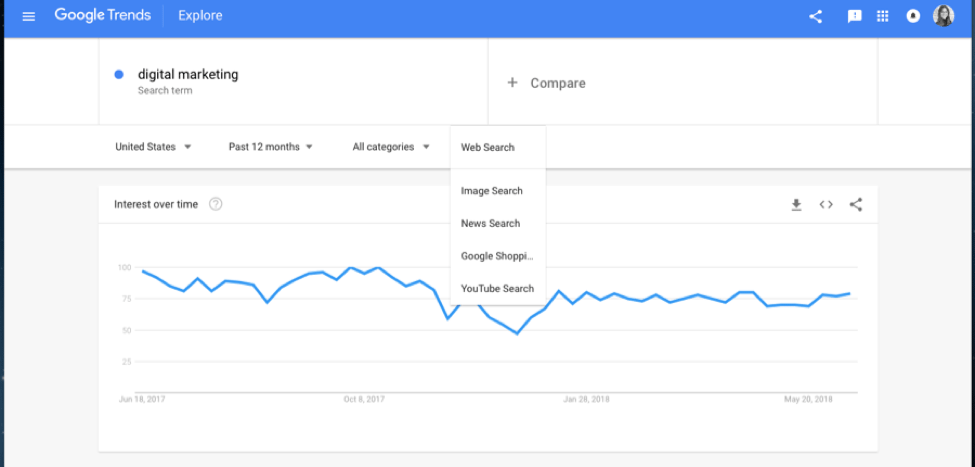
It all starts with a search term. Type your topic of choice into the search bar at the top, and you’ll see four subcategories below. These drop-downs let you contextualize trends based on geographic location, timeframe, different industries, and, most notably, types of search.
Since Google’s algorithms, and search results, are so multi-faceted it makes sense to broaden yours beyond web links alone. The update allows you to also refine your exploration across verticals like videos, news, and images.
In addition to these, other standout feature updates include:
- Real-time trending search data denoted by the word ‘breakout’.
- Curated data stories courtesy of the Google News Lab team. (Plus real-world visualizations created by international newsroom designers.)
- Aggregated official Year in Search information for the last 17 years, showing how various topics have performed over time.
- Intensity mapping and info graphs for meaningful topic comparison.
Once you have the data, it’s time to put it to good use!
Best Ways to use Google Insights
Internet users have done the work of popularizing certain terms. Now, it’s your job to put them to use. Next time you sit down with your team to create or present a content strategy, make sure you leverage Google Insights and Trends to help you pique the interest of your target audience.
Some of the best ways we’ve found to make use of Google trends are:
- Optimizing your keywords for your PPC and online advertising campaigns.
- Creating content calendars and press releases that resonate.
- Marketing to potential customers based on what they’re searching for in their location.
- Researching which keywords have grown in popularity from year to year.
- Seeking out new audiences that resonate with your products and services.
- Visualizing your product with new photos that correspond to different markets.
- Utilizing the related topics section to create compelling video content based on searches.
Simply put, anyone with a Google account has access to this wealth of info, and businesses looking to increase their web traffic and conversions have found it to be an invaluable part of their marketing plans. The way we see it, as far as free tools go, this one is more than a passing trend.
Want some help analyzing Google Trends? We’ll help you strategize into the stratosphere!
BUILDING BUYER PERSONAS: IT’S PERSONAL
Did you have an imaginary friend as a kid? If so, you probably remember them feeling a lot more real than a pretend person. In fact, if asked, you could have probably listed off everything about them from where they lived to what they ate for breakfast.
Buyer personas are the grown-up versions of this childhood pastime. They’re no less detailed (or fun!) and can help you actually make contact with the types of audiences that match your creative vision.
Thinking of creating buyer personas for your business? Here’s how to do them well.
Why are Buyer Personas Important?
We live in a world where content is king and paid advertising campaigns are the best way to speak directly to your target audience. But spending marketing monies to get in front of a random collection of consumers without first understanding who is most likely to buy your products and services is bad business. It’s like calling a wrong number and expecting them to contribute to your best friend’s birthday present.
Buyer personas help you do a deep and necessary dive into your core customer groups – the ones most likely to care about your brand. Though they’re mostly fictitious, these characterized generalizations are a great way to hone your marketing messages and zero in on your ideal market segments.
When you fully comprehend who your potential buyers are and what motivates them to purchase, you can hyper-target your PPC and social media campaigns, maximize your advertising ROI, and create compulsively compelling content.
The Buyer Basics
At Globe Runner, we make our buyer personas as thorough as possible. We start by fleshing out general demographics like the personas age, where they live, and how much they earn per year. At a minimum, you should have the following for each of your buyers (most companies have more than one profile).
- Age: We like to do a range of 10-15 years.
- Gender: Segmenting between males and females is one of the biggest distinctions when understanding your target market.
- Education: Are they high school graduates, do they have some college, or is your target audience all masters level or higher?
- Title/Income: Research sites like Glassdoor.com to get an idea of potential titles and annual earnings.
- Location: Dallas, Texas might be sufficient, but really think about whether they’re a family more likely to live in a suburb, or a young professional who prefers 75201 proper.
You might think e-commerce and the internet lessen the importance of location, but you’re wrong. In fact, it might be a good idea to add in an excluding location. This is especially true if you’re running a pay-per-click campaign. For instance, if you’re selling to farmers in Muenster, you might actually want to omit urban areas or cities like Dallas with larger population sizes.
Making Personas Personal
Where we really start to drill down is in the psychographic (psychological demographic) details. This is when your persona will really come to life. In our opinion, it’s also the most fun part. It allows you to occupy the headspace of another person and think as someone other than yourself in order to build the relationship with your customers IRL.
- Persona: These are the overarching angles like: teen girl end user or older farmer wholesaler.
- Interests: What would they spend their disposable time and income on? Travel? Fashion? Technology? Sports? Politics? Literature? DIY crafts?
- Personality: Are they open-minded or traditional? Informed or influential? Cautious or risk-taking? Describe them with a handful of adjectives.
- Profile: Here’s where you really create the “character.” What are they all about? Give us the highlight reel of what’s most important to him or her.
- Day-to-day: Then, describe a day in the life. From sunup to sundown, how is it they conduct the hours of their day. Are they just starting their career or bringing it to a close? Do they pour their energies into their families or are they devoted to getting back in shape?
- Goals: Think about how your product could specifically help them meet some of these goals. Do you provide a service that can give them more time with family? Do you sell a product that can help them elevate their social status?
- Challenges: What would prevent them from buying with you? Do they have limited internet access? Are they on a tight budget? Is their taste very specific or brand loyal?
- Objections/their questions: Try to pretend you were creating a FAQ for your website. Take the challenges listed above and create questions out of them.
Once you have given life to your persona, make sure to give them a name and add a photo. You’ll be surprised at how much you can connect with this fabricated person staring back at you.
Connecting to the Consumer
Your final step is to think through how you’ll make the rainbow connection.
- Why your product is right for them: Which needs or goals does it meet? How does it solve problems they didn’t realize they had?
- Elevator Pitch: You have just a few seconds to catch their ear. All the better if you can work in a little curiosity mixed with a call-to-action (CTA).
- How we reach them and convert to a sale: Here’s when you get to discover where your consumer congregates. Are they obsessed with Instagram contests or more likely to respond to an email campaign advertising a sale or discount?
In this last section, you’ll start to see some of your traditional and digital marketing strategies emerge. Just know that it may change over time as you review more sales data. That’s not only normal, it’s encouraged!
Point is, if you’ve ever written fiction, acted in a play, or had an imaginary friend you already know a bit about building buyer personas. Done right, they’ll help you be more responsive to your customers and get your brand in front of your ideal audience. Don’t forget to be creative, get personal, and have fun with them!
Need some help identifying your core consumers? Let us package your personas instead!
THE CURIOUS ENTREPRENEUR
I am so proud to announce my new show, The Curious Entrepreneur. I hope all of you enjoy.
What questions about digital marketing or content marketing do you have? We want to know what you want to know.
DIGITAL MARKETING TRENDS TO FUEL 2018: Q3
Part 3 of a quarterly digital marketing guide from our agency experts.
Is there such a thing as crystal clear digital marketing? We like to think so. That’s why all of us at Globe Runner map the digital landscape so closely. We have eyes in every corner of the internet, from SEO and Social strategies to PPC and web dev.
Whether you’re looking for some quick and clean lead generation or want to drive more traffic to your website, staying informed is mission critical. That’s why we do a deep dive with our hive mind once every few months, cataloging the digital marketing terms and trends rocketing our clients ahead of the competition.
Here’s your digital dose of everything fueling 2018 marketing trends in Q3:
Technical SEO/Link Building
1. Priority hints for page loading.
Soon developers will have the ability to give extra weight to the assets that are high-priority. Be it headers or images, soon Chrome Beta will allow values to be keyed to the code itself.
2. Removal of secure lock in chrome.
Used to be one little lock symbol was the best if only way to tell whether a website was secure (denoted by the ‘s’ in HTTPS). But now, secure sites are the rule, not the exception and you need an HTTPS site to rank on Google. As of September, Chrome 69 won’t be using the lock icon since SSL (secure lock layering) is the “new normal.”
3. New Google my business agency dashboard.
Earlier this month, local marketing agencies and local SEO managers got a productivity boost. Now, with the unlimited access to locations for each of their accounts, SEO pros have the ability to manage listing invitations, move business accounts into location groups, control access and permissions, and improve search abilities all from the new dashboard.
Local SEO/Citation Updates

1. Menus.
Put your services and offerings into your sites menu page if you want to define your competition and refine your keyword targets. In just a few sentences, you can even help solidify your Google category since Google My Business (GMB) is allowing local businesses more varieties to link to a menu URL.
2. FAQ Pages.
Whether you field a lot of frequently asked questions in person or online, a Q&A section helps Google and your customers understand what your business does, what it doesn’t do, and specifies your services. GMB administrators will also see new attributes listed.
For example, car dealerships can now specify if they sell certified pre-owned vehicles or brand new automobiles. Local businesses will see a Women-Led highlight feature. These attributes are sure to expand, so keep watch. Some in the future include same day service and free estimates or quotes.
Pay attention to the knowledge graph of your business, too. You’ll find it below reviews. One Dallas surgery clinic we work with has seen success using this area to answer questions about insurance, specific conditions, and treatments they offer.
3. Service Pages
Don’t have a service page on your website? Time to create one. This is your chance to speak in-depth about your offerings and lets you back them up with testimonials, case studies, or other rich media that can promote your brand.
You’ll also want to make sure and publish your services directly into Google My Business. The services section was added in April of 2018, but you have to be listed as an owner to see it.
Social/Content:

1. Snapchat cosmo after dark canceled.
The controversial channel was removed after only a week due to racy content and an outcry of parental concern.
2. Hootsuite updates.
You can now schedule, create boards, and post directly to Pinterest from the Hootsuite dashboard. No workarounds, just full integration.
Additionally, both Facebook and Instagram are changing the way partners, like Hootsuite, access data.
Want more tools to track mentions of your brand? Hootsuite Explore is hot on the case!
3. Thumb-stopping content.
The necessity for a reduced amount of text should be substituted with bolder, shorter wording and eye-catching visuals. Essentially, fewer words create a stronger impact. Focus on creative, visual content!
PPC
1. Import feeds with Bing Ads update.
Recently, Bing launched the ability to import product feeds from Google Merchant Center into Bing Merchant Center.
From the new Import tab in Bing Merchant Center (BMC), advertisers can sign into their Google Merchant Center accounts to pull in feeds directly. There is NO more having to upload product feeds to two separate places.
2. Google AdWords comments expanded.
Similar to Google Analytics annotations; Notes are now available at the account, campaign, and ad group levels in Google AdWords. This helps when changes are made that can affect results and allows for easier recollection to help understand why a metric may have gone up or down.
3. Bing Ads Editor now has the ability to add labels for MAC users.
(An added bonus PC users have been enjoying for years.)
4. In-market audiences debut.
Google first announced plans to release In-Market Audiences for search campaigns back at Google Marketing Next in May of last year. This month, Google and Bing rolled In-Market Audiences for Search out to all US advertisers.
Website/Development

1. Shopify sites.
The hosting platform is on fire right now with requests for e-commerce builds reaching a fever pitch. It’s a closed source system, but pretty user-friendly, and even handles a lot of the fulfillment legwork for you.
2. Fantasy.
For anyone following pop culture right now, you know Game of Thrones. It’s all about the mythical creatures, fantastical landscapes. In terms of the music, it’s epic orchestral music, and everybody is really excited about getting beyond the normal.
3. New Minimalism.
A lot of people will think about minimalism being a Scandinavian design concept with clean and crisp lines with lots of white. But now it’s still clean, but with more bold and vibrant colors and fluid styles.
4. Space.
With shows like Strangers Things and movies like Star Wars, the idea about space is that the future is now. We’ve got the field of robotics that is seemingly taking over our jobs and our careers, as well as automated cars that can function without us. People are really starting to explore this in their creative platforms.
Photography \ Creative

According to Getty Images, this year’s emerging visual trends are easy to spot in digital and social marketing campaigns.
For centuries, males have had their emotional complexity reduced to one problematic expression: anger. Now, images and ad campaigns are expanding stringent male stereotypes in an invitation for them to experience their full range of emotion. In other words, emoting males are the new normal.
Whether snaps are candid or carousel ads, those that gain the most traction are diverse, authentic, and inclusive. Many successful accounts and musicians are reimagining classical artworks and long-standing themes with traditionally underrepresented communities. An admonition to advertisers who have previously relied on whitewashed, homogenous campaigns – time to diversify.
Focuses on “authentic visual storytelling” (ie: images that are at once relatable and realistic). Be it through distortion, exaggeration, or reality-based imagery, we see, once again, strong social commentary leveraged to dislodge social milieus – like female menstruation – that were once taboo in the ad world.
Need a little help with your digital marketing launch? Let us send you into the stratosphere.
WHAT ARE YOUR SERVICES? GOOGLE AND CUSTOMERS WANT TO KNOW
It’s a simple question but is often left unanswered on a website’s FAQ page, services page and in Google. One of the first items we look for in a local search optimization audit is a menu of services. It helps define your competition, keyword targets, categories in Google and your secret sauce.
Some businesses such as an auto repair shop have a menu of services with 30 unique items. Other businesses are much more selective. One of my clients is a German auto repair business that only works on BMW, Audi and Porsche and no Mercedes!
Whether you offer a handful of services or a smorgasbord, clearly define how customers can buy from you. Be specific, what you offer and how you sell to make you different from the competition and improve search visibility!
One of Globe Runner’s clients is a private school. Which at first glance appears to only offer standard student enrollment. However, after a conversation, we discovered a summer camp, after-school programs for the community, virtual/extended classes, and driver’s ed.
Once You Define Your Services, Simplify and Publish
Menus
Drop your services into a worksheet. Write a title and a short description of no more than a few sentences. Boil down what you offer so it can be listed in a menu. Whether you are a restaurant or a real estate agent, a dedicated menu page on your website or a section within the service page are important. Important, because Google My Business (GMB) is allowing more categories of local businesses to link to a menu URL.
Even if you don’t see the option in your GMB dashboard, simplify your menu because it can help Google and customers better understand your business.
FAQ Pages
Frequently asked questions could be a section on your service page or a dedicated page if you have a lot of Q&A. It’s an area to define what you do, don’t do and the attributes of those services.
Attributes are also available in GMB for managers and owners. Browse the info section, because attributes are appearing for more local businesses. As an example, auto dealerships have the option of certified pre-owned vehicles and new vehicle purchases.
For all local businesses, Google has added a Women-Led highlight feature. While this is the only attribute available for some types of businesses, expect Google to expand this in the near future. In the meantime, plan ahead and think of attributes. Do you offer same day service? Is there a fee for an estimate or quote? Break down the common questions your team hears and answers at the front desk and put it on the website.
Another area to publish Q&A is directly in the knowledge graph of your business. Now available below reviews, Google questions can be posted and answered by the business manager/owner.
As an example, for a surgery clinic, we work with, questions help define the insurance, conditions, and treatments offered. Simply log in as the manager to you GMB account. Go to Google and post a question, it should have your business logo listed. Next, answer the question and voila. You have published FAQ’s directly into your knowledge graph.
Service Pages
The final necessity for a local business that is defining services, is a service page on the website. Service pages should clearly define a menu or link to a menu of services. Go more in-depth on each offering and include testimonials, case studies, and rich media to sell your service!
Next, publish your services directly into Google My Business. Available for owners of a GMB listing, a services section was added in April of 2018. If you don’t see a service menu, you likely aren’t an owner of the GMB listing, being a manager doesn’t cut it!
It isn’t clear as of June 2018, where the service menu will display or be published. Currently, it isn’t showing on a desktop or mobile phones in Google Maps or searches. However, giving Google more information about your business is positive. It will likely display on mobile devices as an extra tab in the knowledge graph.
5 STEPS TO HELP CREATE A BRAND VOICE CLIENTS CAN TRULY HEAR
Say you were to select a new friend simply based on their voice alone. More than the words they said, you’d be looking for someone who sounded approachable and relatable, right? The same is true of business’ brand voice. It’s less about specific words and turns of phrase you use than the tone with which you use to communicate and connect with your audience.
Looking to create more purposeful prose for your content marketing?
Listen up. These five steps will help you create a brand voice your clients can truly hear.
- Describe it well
Before you put pen to paper, start asking some questions. Do you aim to inspire or are you tapping into their adventurous side? What is your stance on the use of expletives? Punctuation? Will you punctuate your copy with emojis? How will your words connect with them on an emotional level?
When you have these mapped out, start by writing three adjectives about how you want to come across. Beside those, write out three more adjectives describing how you want the customer to feel.
For instance, if you’re an IT company you might want to come across intelligent and leave your audience feeling informed. Run a greenhouse? Try for fresh fodder that moves your customers to connect with your crops.
- Distinguish it authentically
The most unique thing about your voice is you. Project a bit of your personality into your copy and you’ll have a better shot at maintaining one of the brand voice fundamentals: authenticity. Often times it’s best to let your business’ core values inform the verbiage. This way, even if you look to other brands or competitors for inspiration, you’ll still be expressing your brand’s distinct personality. More importantly, you’ll be less likely to sound like you’re trying too hard. This is a big one. The overwhelming majority of consumers respond to genuineness above all else.
- Keep it consistent
From the character limits that restrain you to the landing pages that contain your mission statement, consistency is key. No matter which channel you’re chattering over, it’s important to communicate it with the same emotional expression. Flip-flopping back and forth between clever witticisms and an authoritative brand voice is sure to give readers whiplash. The inconsistency can also decrease your credibility.
Be sure to communicate your new brand voice to the team. It’ll help you prevent any rouge writers from running away with your words. You may even want to formalize an official style guide to keep everyone on the same page.
- Make it personal
If you find the idea of creating a disembodied voice difficult – or slightly creepy – try thinking about your brand voice as a flesh and blood person. Time to break out those buyer personas and get connected with your target audiences. Select one from each of your core consumers – working moms, rural millennials, small business owners, etc.
Re-familiarize yourself with each, then look at them through the following lenses:
- How do they look?
- What are their goals?
- How do they express themselves?
- Who do they ask when they have a problem?
- What do they do for entertainment?
- And, most importantly, how can your brand help solve their needs?
Exercise a little empathy to fully understand who it is you’ll be chatting at. It’s the best way to turn your marketing communication into a full-blown conversation.
- Revisit it often
No good brand is stagnant for long. In fact, one of the main reasons you’re honing in on your brand voice is to grow your business. As it expands, you’ll need to continue carving it up from time to time. Once you do, you’ll start to see ways you can help it naturally ebb and flow based on the data you’re collecting about your evolving audiences. This might mean reworking your blog strategy to accommodate new groups. Or, it could involve adopting a competitor’s successful campaign to help you get seen on a new marketing channel. Point is, creating a truly memorable brand voice isn’t a one-and-done activity. It’s a voyage in rediscovery.
Need help creating a strong brand voice? We hear you loud and clear. Contact us and soon your customers will, too.
- « Previous Page
- 1
- …
- 11
- 12
- 13
- 14
- 15
- …
- 44
- Next Page »