














How To Gain Customer Attention With A Business Youtube Channel
One billion hours. That’s how long we collectively spend consuming content on YouTube every day. The only statistic that rivals it? The 1.8 billion total monthly users that login to watch – that’s a quarter of the world’s entire population! What’s more, when it comes to reaching 18-49-year-olds, YouTube outpaces every other major cable network in the U.S. and 85% of American teens use it, too.
Whether these stats were old news or news to you, they’re undeniably compelling.
Have you been considering starting a business YouTube channel? Grab some popcorn and settle into your director’s chair as we show you how you can use it to capture the attention of your key consumer.
Getting Started
Google bought the video content site back in 2006, and since then the two have functioned as a unit.
Already have an existing Google account? You can easily use it to create your YouTube channel. If not, you can start a YouTube page from scratch and a Google account will be automatically set up for you as a result.
Let’s assume you already have at least a Gmail account set up. Time to create your YouTube business channel.
- Go to YouTube and sign in.
- Take your cursor up to the top right of the screen and click your user icon.
- Access the small gear icon to bring up your YouTube Settings.
- Select the option to create a new channel.
- Choose “Use a business or other name.”
- Enter your Brand name.
- Click create then start creating!
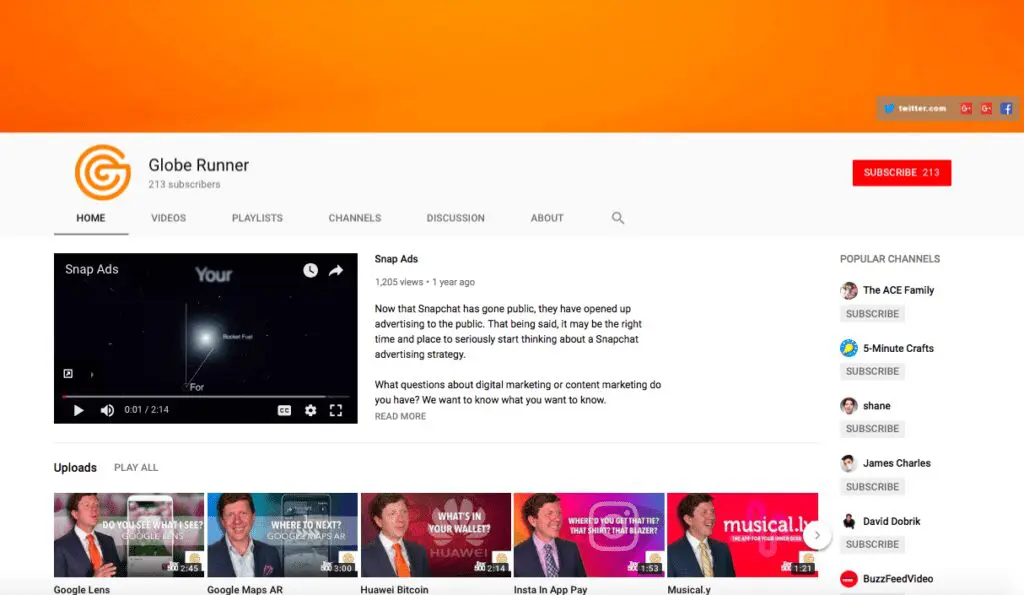
Be sure to fill out the ‘about’ section fully. Remember that since YouTube is a Google product, the more keyword rich your copy is, the more likely it will be to show up in search results. Remember, you can link out to your website and other social media channels, too.
Don’t ignore the cover photo either. This banner is prime real estate for branding – like a virtual billboard for your business.
Suggested Video Content to Upload
Just like any good content marketing strategy, the videos you upload after starting a YouTube channel for your business should cover various aspects of your brand.
Keep in mind that many users turn to YouTube as a source of education, not just entertainment. Whether they’re looking to learn how to make a killer casserole or change a flat tire, they are accustomed to learning a lot of the time.
Use this to your advantage! Have some knowledge base you’d like to share with your customers? Instead of writing a blog post or investing in online advertising like PPC campaigns, show them the best ways to make home repairs or build a brand on social media via vid. The more step-by-step instructions you can give, the better.
Your brand might also consider showcasing:
Product videos. Do your wares require some assembly? The more complex your product, the more you want to encourage your customers to understand the full breadth and depth of its benefits. Upload tutorials, how it’s made videos, and any influencer engagement.
Reviews and testimonials. No doubt your brand is well loved and respected. Make sure potential customers and YouTube viewers know it, too. Uploading video testimonials is a no-brainer. Whether they’re reviewing your products on-screen or singing your praises in person, it’s sure to leave a lasting impression.
Brand identity. From your brand story to behind the scenes footage of your day-to-day dealings, videos are a fantastic way to intro the people behind your products and services. Try telling the tale of how and why your business came into being. Endeavor to participate in charitable works? Share those too. You can even give a virtual tour of your office, warehouse, or production factory – anything that helps humanize your brand.
Whichever combination you choose, make sure you’re creating content that aligns with your business’ target demographic. It’ll entice them to do a little deeper dive into your brand.
Optimize YouTube Videos for SEO
So, you’ve started a YouTube account for your brand. That’s great! You’ve created some clever content and uploaded it to your channel. Next, you have to implement a few easy SEO steps to ensure it gets seen.
Similar to the SEO strategy for your site, take the time to complete each section’s back-end parameters. Start by checking that you optimized the video’s title, description, and tags. They’re essential for drumming up discovery by user and search engine alike. Take your time and ensure each video is supported by keyword rich descriptions and carefully copyedited so as not to hurt your credibility.
Ideally, your goal should be to rank high in Google’s SERP as well as YouTube searches. Though the prior owns the latter, you’ll ideally want to turn up first in both.
Feel like your business’ YouTube channel will a little help getting noticed? Our video and SEO experts can help get the camera rolling.
MAKING THE LEAP TO LIFESTYLE BRAND
Don’t take it personally. Most brands are having trouble increasing engagement with their pop-ups and online ads. That is, everyone except Lifestyle Brands. Some have even proven they can forego them all together, continue attracting repeat buyers, and circumvent the 83% of consumers who say they would block all ads if they could.
How do they manage? Simple. Lifestyle brands are experienced experts. They’re also skilled at identifying their target audience’s deepest cravings and motivating purchasing habits. They use this decidedly personal data to facilitate experiential and emotional connections that engender respect and loyalty from their customers.
So how do these harbingers of inspiration align themselves with culture and promise to help their customers achieve their personal bests? Here are some rules of the road to help you make the leap to a lifestyle brand.
Rule #1 it’s not a product, it’s a way of life
Here’s where a traditional product-first marketing strategy can derail you. Lifestyle brands understand that it’s less about expressly selling products than it is about illustrating how said product can enrich their customer’s lives. In some cases the product may take a backseat entirely, allowing the experience to remain the focal point. Try reverse engineering your marketing plan to prioritize the day-to-day life of your average buyer then figure out how you can connect with and improve it.
Rule #2 you don’t have to be a luxury brand to be a lifestyle brand
If Sour Patch Kids has taught us anything it’s that there’s no requirement that says you have to be a luxury brand to qualify as a lifestyle brand. A few years ago they launched a genius lifestyle marketing plan centering around “The Patch”, a crash pad for musicians in two major music markets: Austin and Brooklyn. Bands were welcome to stay so long as they shared their experience with fans on social media. In doing so, SPK were able to infuse themselves into a hotbed of hip that existed long before the gummies were making mouths water.
Rule #3 align yourself with ideal identities
Self-improvement is often an element of your customer’s ideal identity. Whether that be more altruistic and green, fit and healthy, or creative and adventurous your brand should exemplify what it means to embody said traits. Subaru does a particularly good job of this. Not only are their cars designed to stand up to the great outdoors, they also have a huge charity component. Their Share the Love event crystalizes their spirit of giving, but they also uphold these standards to the smallest detail (can you say composted coffee grounds?).
Rule #4 create a community
So, you’ve solidified your identity and created a compelling brand story that shows customers how you’ll be of service to their long-term goals and values. Now it’s time to get a community rallied around it. At this stage in the game, remember that a little strategic influencer marketing never hurt anyone. In fact, they kind of go hand-in-hand. Just be sure to do your research before reaching out to any lifestyle bloggers. You want to make sure they’re sending the right message to the right target audience.
Rule #5 invest in those invested in your brand
Apple does this well. Since 2009 they have hosted an annual iPhone Photography Awards (IPPAWARDS) ceremony, granting prizes in multiple categories from architecture to sunsets. In this way, their product is really secondary to the creativity of their users, which in turn becomes the main attraction. By encouraging photographers of all to skill sets to submit, they’re rewarding and investing in those that are most loyal to the brand.
In short, today’s most successful brands have discovered the secret sauce to becoming a well-known lifestyle brand focuses far less on pushing product and concentrates its efforts on ideas and ideals.
Still not sure how to make the leap? Let us help you ascent from basic business to the way of life.
CHATTING ABOUT CHATBOTS: MECHANIZE YOUR DIGITAL MARKETING IN 2019
Worried a robot is going to eventually take your job? This blog post may or may not allay your fears. However, if you’re ready to improve your digital marketing strategy in 2019, better build a bot.
If chatbots still sound too 2049, simply think of them as a form of marketing automation.
You probably already use automation in your email drip campaigns to help reach your target audience and generate leads. Bots work similarly.
Chatbots are inexpensive, programmable software that can be designed to automatically carry out any number of tasks quickly and accurately. Their conversational nature can save you tons of time, and early adopters have seen benefits from increased conversion rates to streamlined operations. (More on these in a bit!)
Not sure if automation is right for your business? Let’s talk about just six of the ways chatbots can help take your brand into the future.
1. Never miss an inquiry.
No need to have your employees work the graveyard shift or pay them time and a half for a holiday. Chatbots work 24/7 365 days a year and you’ll never hear them asking off in the middle of your busy season. They’re also helpful in fielding floods of inquiries, so whether you’re getting more web traffic from that cute and clever copy you wrote or from a potent new product, you’ll be ready for the deluge.
2. Do more without hiring more employees.
Hiring new staff means taking a chance on potentially ill-suited personalities. It also comes with more time-off requests (see above) and increased expenses. Whereas chatbots are like a team of employees who always do exactly as they’re told (programmed) for a fraction of the cost. In most cases, a bot can be bought for a few hundred to a few thousand dollars depending on functionality.
3. Market to Millennials.
The overwhelming majority of millennials would rather converse via text than over the phone. Live chat satisfies their instant gratification expectations and allows them to conduct their comparison shopping without commitment. From your end, it’s simply another touch point in which to promote your brand and squelch any concerns that might impede the sale.
4. Increase conversions.
Having a hard time getting traction with your email marketing campaigns? According to Chatbotslife, “Chatbots are seeing open rates of 80%+ and CTR’s of 25%+.” Now, imagine several hundred repeat customers seeing your latest promotional offering. You could be staring down some serious sales.
5. Make internal communications simpler.
With all this talk of digital marketing, it can be easy to overlook the real machine that makes your operation run: your team. Having a system in place to streamline and enhance your internal communications can mean the difference between duplicated tasks and redundancies, and everyone being on the same page working toward the same goal. Bots can be particularly helpful if some or all of your team work remotely.
6. Personalize your online ads.
Who prefers personalized ads? 71% of consumers. You can happily and easily oblige with chatbots on your site. Not providing a customized user experience? You can be sure your competitors are, so time to chat up or bot out. Chatbots can even help you with the preliminary task of information gathering about your core demographic. Their simple if/then formula makes it easy to base responses on the answers users provide in your initial questioning.
Still think bots are bits of dark magic designed to put you out of a job? Try shifting your perspective a little and seeing them for the engagement and traffic tools they are. Use them wisely and let the results speak for themselves.
Not sure which bots are best for your biz? Let’s have a chat.
6 SIGNS YOU NEED A FULL-SERVICE AGENCY
Over the years, our full-service marketing agency has seen a lot of good businesses suffer from bad marketing. Their products are top-of-the-line, their services are the best in the biz, and their customers are wildly happy. Problem is, no one knows about them.
How can it be that a company who performs so well in every other respect struggles to get their name out?
Simple. They don’t have the in-house digital marketing abilities they need to stay competitive. Not that we’re blaming them. Most companies are rightfully focused on the core of their business. They may not have the time or staff to help with anything that feels ‘extraneous.’
But a myriad of SEO algorithm updates, social media changes, and digital marketing trends power our modern day marketplace. Successful businesses, small and large, must have a command of the digital landscape or get left in the dust.
Have you been considering making a change to your marketing strategy in the New Year? See if any of these following scenarios sound familiar. Any one of them could be an indication it’s time to hire a full-service agency.
1. Your freelance staff can’t keep up. There’s no shortage of independent contractors available for hire. While using them as a temporary stopgap may make sense for a time, there eventually comes a point when even they can’t take your business to the next level. They may become overwhelmed with the work and unable to educate themselves on important industry updates at the same time. For that, you need a digital agency who’s already rocketed ahead of the curve, anticipating changes and making adjustments before updates negatively impact your brand.
2. You don’t have the budget for a full-time marketing department. Between benefits, payroll taxes, and training or relocation expenses even a one-person department can cost you a fortune. You also have to spend valuable time and energy onboarding and risk disrupting your team’s established dynamic. When you work with an SEO agency, you get all the benefits of a fully-fledged department without any of the expenses or complexities.
3. You’re feeling creatively uninspired. It takes a lot of mental reserves to consistently supply the kind of compelling content that increases your web traffic and conversions. If you’re already leaving the office every day mentally drained, attempting to create a campaign in your beleaguered state could actually hurt your brand’s reputation. An agency is a cornucopia of creativity with naturally clever marketers who all feed off one another’s ideas. It’s an environment that encourages and cultivates creativity in an ever-renewing cycle.
4. Your core business needs some extra attention. Most folks start a business because they’re really good at a particular job. Neglecting this foundation in order to try and create mediocre marketing materials is likely to cause a collapse. Leaving this role in the capable hands of a full-service digital marketing agency ensures you’re able to concentrate on the core of what makes your brand so great.
5. Your branding isn’t consistent. You only have one chance to make a first impression. These days, that first impression is happening online more and more. If a prospective customer is getting conflicting messages when they research your brand, they’re likely to find someone for the job. By contrast, a marketing or advertising agency will make sure you’re represented professionally and consistently across all applicable social media platforms and online channels.
6. Your business is rapidly expanding. Whether your brand has just landed a huge account or you’re poised for a huge expansion, you’ll need to scale your marketing deliverables to keep up. If you’re looking to grow your business but aren’t sure how, try working with a full-service digital agency who can improve your Google ranking with high-powered online advertising campaigns, masterful content marketing, and more!
Does one or more of these ring true from your business? Time to make contact, and expand your brand.
TALKING TESTIMONIALS: WHY THEY’RE IMPORTANT AND HOW TO GET THEM
Testimonials are like a 24-hour online marketing team who’s always working, but you never have to pay. Still, many small businesses make the costly error of leaving them off their website, not realizing the power of peer praise.
How effective are they? According to Nielsen research, “92% of people will trust a recommendation from a peer, and 70% of people will trust a recommendation from someone they don’t even know.”
Could customer testimonials be the key to increasing your conversion rates or generating more leads? Test these testimonial and content marketing tips to see for yourself!
Show off your Social Proof
Even if you’ve been marketing under a rock and haven’t heard the term “social proof,” you’ve probably already leveraged it to promote your products and services at some point.
Tech Crunch describes the phenomenon as, “the positive influence created when someone finds out that others are doing something. It’s also known as informational social influence…In other words, people are wired to learn from the actions of others, and this can be a huge driver of consumer behavior.”
Put simply, it’s word-of-mouth marketing at its most basic level.
Testimonials are a compelling form of social proof. Here are some others you might recognize (or use):
- Celebrities and social media influencers. Celebs have long heralded trends and helped solidify brands. But, thanks to social media, how we define celebrity is changing. From YouTube sensations to Instagram stars, there’s a new social sway afoot. Read more about cultivating influencer marketing strategies for your business.
- Crowds and masses. It’s an “all these people can’t be wrong, join us” mentality that’s been used by big brands from McDonalds (1 Billion Served) to record companies (Platinum status records).
- Friends and acquaintances. You, just like your customers, probably trust the opinions of people you know more than anyone else. Size those personal recommendations up against pretty much any digital marketing tactic and it’s no contest which will win out.
- Experts and industry leaders. Though you may not know them individually, experts like doctors are great for giving your brand more credibility. The same goes for anyone who is well known in your industry like a CEO or thought leader.
- Users and past customers. Here’s where testimonials really take off. Getting a vote of confidence from someone you’ve already worked with speaks volumes. This goes double if the recs come from someone “just like you.”
But how do you go about getting them? That’s our next point of discussion.
Gathering Testimonials
Ask for testimonials and you’ll receive. That is if you request them from the right folks in the right way.
You see, a random selection of customers just won’t do. You’ll need to be more strategic in your ask.
Start with clients or customers you’ve done business with recently. Get them while you’re fresh on their mind and they’re more likely to take the time to give you feedback about their experience. You can use a site like Survey Monkey or simply make your own using Google Forms.
You might also consider creating an email drip campaign that will go out to anyone with whom you’ve completed a sale or project. You can set it up to send a few follow-up reminders, but don’t flood their inbox with requests lest the become tone deaf to your email marketing entirely.
It’s always best if you reach out to customers that you worked with directly, but getting a marketable testimonial may require some probing.
Giving them the following parameters about what they saved and what they gained could help you solicit a more compelling response:
- Did you save/time money? How much, specifically?
- Were you able to gain leads/increase your sales/etc? By what percentage?
- What was the biggest benefit of working with us?
- What did you enjoy most about our brand? (e.g. : Customer service, finished product, speed of delivery, etc.)
Make sure you also collect pertinent info like name, title, location, the date of service, and if at all possible, a photo of the person giving the recommendation. It’ll help personalize the testimonial.
Working with a business? Include their logo as part of the praise.
Marketing Customer Testimonials
Once you’ve gathered your endorsements, time to have your marketing department (or digital marketing agency) show them off.
There’s technically no wrong way to display your customer accolades, but here are some avenues that will give it the most exposure.
1. Case studies. Customer case studies can be as in-depth or condensed as you like. Whether you pull some compelling stats or give readers the play-by-play, they’re great ways to showcase customer successes.
2. Video testimonials. Audio and video testimonials from happy clients are much more intimate than the written word. Just make sure you have a prepared interviewer and good editor on staff to make sure it translates on film.
3. Social media. It’s a big part of your online presence. Whether you upload that vid rec you just wrapped or simply post a candid photo with your product and heartfelt quote, this is a surefire way for your testimonial to gain traction.
4. Site sidebars. You never want an endorsement to be distracting. However, the sidebars of your blog reel (or really anywhere with ample white space) are great reminders to your increasing unique monthly visitors.
5. Individual pages of your website. You might consider giving your testimonials and case studies their own individual pages on your site. You can also add them to your products and services page, strategically placed near CTAs that urge a potential customer to commit.
Though features like Google Reviews and sites like Yelp are a great way to get eyes on your brand, you don’t have to wait for customers to submit a review on their own. Armed with the right ask and good implementation, you can take testimonials into your own hands!
Need some help marketing your hard-earned testimonials? We can help.
7 TIPS FOR CREATING A SUCCESSFUL BUSINESS PODCAST
You’ve done your podcast reconnaissance, and are convinced that this is the year you’ll start your own podcast for your business. Whether you’re looking to monetize said podcast, increase your conversion rates, or bolster your content strategy, podcast production is the precursor.
But, let’s be real. There’s a big difference between releasing a recording and branding a successful podcast.
How do you accomplish the ladder – and avoid the former? Ahead are a few shared characteristics of successful business podcasts.
- Consistent release. Some podcasts, like Alanis Morissette’s ‘Conversation with Alanis Morissette’ are uploaded once a month. Others, like ‘On Being’ with Krista Tippett drop every single week. So long as your listeners know when to tune in, they’ll become accustomed to downloading yours as consistently as you publish it. If you are traveling or need to take time off, pre-record podcasts so you’ll have them ready and your listeners don’t have to miss a week.
- Choosey topics. Most podcasts adopt one of a few different styles. Some, like Search Engine Nerds, operate on a more traditional interview, interviewee talk show format. Others, like the ever popular S*town, lend themselves better to storytelling. You can change up your style depending on the topic du jour (or week). However, it’s always good to consider whether a specific set of material would be better communicated in a YouTube video or blog post. With an endless array of topics, there’s no such thing as too niche. The goal is to make sure it aligns with the interests of your audience and is delivered in a professional manor. Which brings us to our next point.
- Quality audio. There’s no way around this one. If your podcast sounds like it was recorded at the bottom of a well, there’s no guest or topic interesting enough to save you. Investing in some good equipment and learning how to produce are steps one and two. Research and procure tools specific to creating and editing audio content. At minimum, budget for microphone, headphones, and software to help you craft quality material.
- Invested audience. If a podcast airs and no one listens, did it really make a sound? You don’t have to get philosophical to realize that a podcast without an audience is essentially you talking to yourself. So, how do you build an invested podcast audience? New listeners can come from just about anywhere, but one of the best strategies is to tap the established audiences of your podcast guests or book yourself as a subject matter expert on a podcast in your field. Don’t be shy about reaching out and asking how to get booked as a guest. Most podcasts are receptive so long as it fits within their content calendar.
- Expert guests. Even if you’re not an expert on a particular subject, your guests should be. What you can specialize in is steering the conversation in the right direction. Keep your chat focused and have a plan to draw out the most interesting pieces and parts from their background to future predictions.
- Organized preparation. This ties into our point above. Don’t depend on your guest to carry the conversation. Know where you’d like to begin and end at the very least. Come prepared with questions of all variety and make sure your guest has access to them in advance. Do your research and make sure to leave a little room for the unexpected, too.
- Overall excitement. The more you genuinely enjoy recording your business podcast, the more it’ll translate. Literally. You’ll emote a detectable excitement in your voice if you’re having fun. And if not, well, that’ll come through too. When you need a little reminder about why you do what you do, remember that meeting new people and sharing their stories is always a worthwhile endeavor.
Are you more visual than auditory? Subscribe to our YouTube channel for Season 5 of our weekly digital marketing video series where SEO and CEO extraordinaire, Eric, shares the latest in industry news and marketing strategies. On the docket: insights on the new PageRank Patent Update, Facebook’s Cryptocurrency, and Netflix’s investment in billboards.
TIME MANAGEMENT APPS TO MAKE 2019 YOUR MOST PRODUCTIVE YEAR YET
Sometimes less is more. Except when it comes to time. In which case, more is always more. But just like money, time can’t be created. It simply has to be saved. And as a vital ingredient to any truly productive workday, an extra few hours here and there can accumulate into big bucks.
Searching for some tech tools to help you make 2019 your most productive to date? These new or updated time management apps can do just that.
1. Google Calendar. Ok, ok hear us out. No, it’s not new and has even been the staple of many scheduling platforms. However, the almighty Google Calendar has finally released an iPad app complete with iOS notifications. Alongside the widget is a drag and drop feature and a fresh, modern makeover to modernize this longtime favorite. We wouldn’t be surprised to see other third-party calendar applications step up their game to stay competitive.
2. Grammarly. Any successful digital marketing strategy requires consistent and compelling content marketing. From web copy and blog posts to social media profiles and press releases, words work to increase traffic and sell more. That is, provided you use them appropriately. Grammarly lets you spend less time editing your content and more time writing it. Download the app or extension for a built-in editor that will help ensure your spelling, punctuation, and, yes, overall grammar are by the book.
3. Linkio. Link building is integral to any effective SEO strategy. For the last two years, Linkio has been at the forefront of SEO project management – and for good reason. After all, how can you secure more links to your website if you can’t track your progress? Download Linkio to help you plan which sites to contact, give you the status of each at a glance, and even generate reports to tell you how effective your link building campaign is doing. It’s also perfect for multiple users, making it ideal for your entire team.
4. RescueTime. If time is money then RescueTime is worth its weight in gold. The internet is a black hole of distractions – distractions which can cost you big if not corralled. If you suspect you or your team is getting sidetracked, RescueTime can help you monitor and amend your unproductive online habits. Let it run in the background of your laptop or smartphone and it’ll track how long you spend in certain platforms, websites, or applications. Reports are generated at the end of each day to show you how you’ve been spending your time. Can’t seem to quit that mid-day Facebook scroll? The app also lets you block specific sites or apps based on parameters you set for yourself. Talk about self-discipline!
5. InTime. We don’t know about you, but commutes to our Dallas digital marketing agency are brutal in North Texas traffic. The InTime app aims to change all that. Now, you have the ability to set your alarm based on real time traffic flows so you’ll never again be late because of an incident. It’s especially helpful if you travel out of town for work a lot and are unfamiliar with the typical rush hour traffic patterns. Simply set the destination to your next appointment and it’ll calculate when it’s time to leave so that you arrive on time or early.
6. Universal Password Manager. Data breaches impacted some “765 million in the months of April, May and June alone”, according to USA Today. Even credit reporting agencies like Equifax had unprecedented hacks in 2017. All the literature warns to have different passwords for each account, passwords that are complex and varied in numbers, symbols, letters, and capitalization. But how is one to keep track of all the variations? And what application can possibly be safe enough to house such sensitive information? Universal Password Manager. Its encrypted database operates on multiple platforms, safely housing your usernames and passwords. It can even furnish you a specific password to keep you safe while logging in on public or shared devices.
If you’re really prioritizing your productivity this next year, consider hiring a digital marketing agency to handle all your SEO tactics. Make contact to see how we can help your business blow the lid off 2019.
PINTEREST FOR DADS
When most people consider the social media platform Pinterest, they typically think of a decidedly female demographic. And that’s not unreasonable; the majority of Pinterest users are, in fact, women. But interestingly enough, Pinterest has reported that around 42% of American dads use the site, as well.
In today’s video, we’ll explore this surprising statistic. Spoiler alert: it can be attributed primarily to the fact that more and more millennial guys are becoming fathers. Men of that generation are typically more involved with child-rearing and housekeeping duties than their progenitors, necessitating the need (and desire) for research in these areas. Pinterest-savvy dads often search for many of the same things that their wives, girlfriends, and other female peers do: cooking techniques, cleaning tips, and DIY Instructables. A father may not be particularly interested in creating a cutesy scrapbook or assembling centerpieces for a garden party, but he might be intrigued by instructions for building a child-sized playhouse or a recipe for a romantic Valentine’s Day dinner.
The bottom line? Don’t assume that you should completely discount Pinterest as an effective marketing platform just because your product or service is aimed at men. You may wind up denying yourself access to a significant number of “dear old dads” that would be very interested in what you have to offer.
COZY UP TO THESE WINTER EMAIL MARKETING BEST PRACTICES
This year, email marketing drove roughly 25% of Cyber Monday sales. By some estimates, effective email campaigns are responsible for about the same in overall holiday sales, too.
Let’s put that into perspective. The National Retail Federation reported $691.9 billion in holiday sales from November to December 2017 alone.
Could your business use a quarter of $700 billion? Of course it could. Use these winter email marketing best practices to get your cut.
‘Tis the Season for Sending
The power of email marketing is best captured by its ability to increase conversions, generate new leads, and improve customer lifetime value. But at a time of year when you’ll be competing with some 41 billion other holiday promotional emails, you can’t afford to not be on your A game.
Good email marketers also know that if they do their job right, they’re likely to make up to 20% more sales during November and January than any other time of the year. These increases are largely fueled by the relative success of their Fall and Winter marketing campaigns. The more they can capture and hold a customer’s interest now, the better they’ll be able to plan future campaigns when the calendar rolls over.
Below are some tips to give your holiday email campaigns their highest revenue-boosting chance during this peak sales period.
1. Keep it personal.
Personalize your email messages and you’re likely to increase your open rates to about 19%. This is roughly 5% higher than those non-personalized promos.
Try sending customers curated offers and promotions that complement purchases or services of Christmases in the past. You’ll also want to make sure you’re using email segmenting to target folks who’ve shown interest in a particular product but have yet to make a purchase. (More on this in a bit.)
2. Give Tuesday tidings.
Over and over again, email automation studies show that Tuesdays are the best day of the week to send promotional emails. More specifically, 10 am seems to be the sweet spot for firing off holiday, or year-round, email campaigns.
If you’re feeling skeptical, you can always test and track your open rates and CTRs. This will give you an idea of when your audience is likely to be the most receptive.
3. Refresh your mailing list.
No matter how clever your copy, regardless of how great your graphics, you’re still likely to have some inactive recipients. Whether they’ve changed email addresses or simply can’t be persuaded to hear you out, you need to get them off your mailing list. (And maybe on to your naughty list.) If you don’t, you run the risk of it severely dragging down your deliverability rates. Plus, the only real value is marketing to the right people.
Here’s where we continue to sing the praises of email segmentation. It’s an evergreen way to improve your email marketing, and that goes double during the holiday rush. When you segment your email list, you’re able to target your messages to recipients who are primed to receive it – and act on it!
If you’re not sure where to start, use your buyer personas to help you figure out the most strategic way to segment your products or services.
4. Make sure it’s mobile-friendly.
There’s just no getting around this one. If you want your email campaigns to land, they need to be optimized for mobile.
Not only do some 75% of Gmail users access their accounts through their phones, Google’s “How People Use Their Devices: What Marketers Need to Know” study revealed that users are fixated on their phones for about 3 hours every day. About 2/3rds more time than they’re spending on their computers.
Mailchart’s Holiday Email Marketing Report also showed an impressive 63% of emails are read on mobile devices. There’s even been a 65% increase in smartphone sales since 2015. But herein lies the problem: of those targeted, strategically sent emails, less than half were optimized.
A few things you can do to optimize your holiday email marketing campaigns for mobile include:
- Using alt text. This way graphics that load slowly will still convey a message. You can also optimize the images themselves to cut back on load time and come through more crisp.
- Sending responsive templates. Otherwise, your content can get distorted to an illegible degree.
- Shortening your subject lines. They’re the biggest determining factor as to whether your email gets read or recycled. It’ll also help break up content in a digestible way.
Finally, don’t forget to check out your holiday marketing emails on your own phone. Bonus points if you look on an android and apple model!
5. Don’t forget less common holidays.
Sure, Black Friday and Cyber Monday are heavy-hitters, but they’re certainly not the only seasons to send. In fact, there are lesser known events during the holiday whirlwind that are less competitive, in terms of email influx, but no less potentially lucrative.
Think about creating some winter solstice promos. Or make a special full moon related coupon. You can also celebrate the starts of the seasons. Keep an eye on the weather, too. Unusual or intense weather events may be the perfect excuse to offer something extra cozy.
6. Create time-sensitive offers.
Few folks get away from feeling rushed during the holidays. Email marketers can put the pressure on by promoting early bird prices or installing an interactive countdown clock to their email template. At the very least, make sure your subscribers are aware of your holiday shipping cut off dates, lest they wake up Christmas morning to an empty stocking.
Before you hit send on your next holiday email marketing campaign, remember that executing it effectively can mean the difference between high engagement and more momentum for the new year, and a lump of coal in your inbox.
- « Previous Page
- 1
- …
- 8
- 9
- 10
- 11
- 12
- …
- 44
- Next Page »