









GOOGLE GIVES WEBMASTERS BETTER SEARCH QUERY DATA IN WEBMASTER TOOLS
Maybe this is could be called a late Christmas present from Google, but the search engine is now giving website owners more detailed search query data. If you have verified your website in Google Webmaster Tools, then you’ll be able to log in, view the search query report, and see more accurate data.
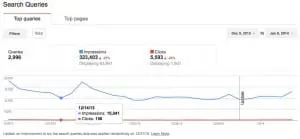
Above is an example of the Search Query report in Google Webmaster Tools. To see this report, do the following:
1. Log into Webmaster Tools.
2. Click on the Search Traffic link on the left.
3. Click on the Search Queries link on the left side.
On the graphic, you’ll see a “Update” line. If you mouseover this, you will see the following:
“An improvement to our top search queries data was applied retroactively on 12/31/2013.”
According to the Google announcement blog post on the Google Webmaster Central blog, “The search queries feature gives insights into the searches that have at least one page from your website shown in the search results. It collects these “impressions” together with the times when users visited your site – the “clicks” – and displays these for the last 90 days.”
Apparently we were not seeing the actual number of impressions and clicks before (although I thought we were seeing that data). But apparently now, the actual data is presented here in the Google Search Queries report.
Bill Hartzer is Globe Runner’s Senior SEO Strategist. Follow him on Google Plus.
IS GOOGLE AUTHORSHIP PHOTO SNIPPET QUERY DEPENDENT, NOT CONTENT QUALITY OR AUTHOR DEPENDENT?
Google has recently confirmed, and Search Engine Land has reported back in December that Google “has applied a 15% reduction in the amount of rich snippets displayed in the search results.” Some have even called that an Authorshippocalypse is going on. Eeeek! Oh, the horror! There are changes going on.

So, many website owners and bloggers who have verified their Google Authorship are not always having their photo appear in the search results. Blog posts that show the author’s photo in the search results get more clicks. And even maybe less clicks for authors who have verified authorship and only have their name linked (but no photo) show up in the search results.
There are even times when someone has verified their Google Authorship but they’re not seeing a snippet at all show up in the search results (no photo and no name). If this is the case, the author can verify that Google Authorship is working by going to the Rich Snippets Testing Tool. Entering a URL will show whether Google Authorship is working or not.
There appears to be three different “classes” of Google Authorship now:
1. The Google search result shows the verified author’s photo and name in the search result, like the one below:

2. The Google search result shows the verified author’s name, but no photo, like the one below:

3. The Google search result does not show the verified author’s name or photo in the search results.
There is some speculation out there as to why exactly the Google shows the photo of the author in the search results and in some cases shows the verified author’s name only. In other cases, there are no author details shown. So what can you do to “force” Google to show your photo in the search results if you’ve verified Google Authorship? Well, from what I can tell, it’s NOT the quality of your posts or content, and whether your photo appears is not dependent on the quality of the author.
From what I can tell, it’s query dependent, and not author or content dependent. Let’s look at some proof of search queries that show the same exact URL, the same exact verified author, but different search results.
Let’s look at an example of one particular search query (of one of my prior blog posts) that shows the author snippet but NO photo (look at the LAST search result shown below, it has no photo):
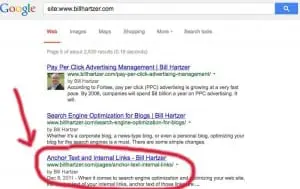
In the case above, you can see the search query, which, in this case, was “site:billhartzer.com”. So, it looks like this blog post, about anchor text and links, is NOT “good enough” to force Google to show the author’s (my) photo in the search result.
But wait.
Let’s do a search query for something else. Let’s use another search query to force this same exact blog post to show up in the search results. Let’s use something that someone would actually search for:
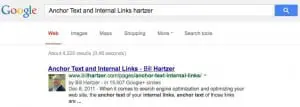
This just goes to show (or prove) that whether or not the Google Authorship photo appears in the search results DEPENDS ON THE SEARCH QUERY and does NOT depend on the quality of the article or the quality of the articles that the author writes (and posts).
Granted, in order to have your Google Authorship show up in the search result and have your photo show up, you have to verify authorship (that part is a given) and it has to be working properly. However, the quality of the content doesn’t matter. Google will, in fact, decide to show your photo in the search results based on the actual search query.
Added – January 8, 2014
Let’s look at another example of when the search query causes a photo to show in the search results and when it doesn’t show the photo:

In the case above, I’m not searching my site like I did previously. I searched for something that didn’t involve a search of my blog site. In the case below, however, let’s look at another query that is perhaps longer but still brings up the same “about” page on my blog:
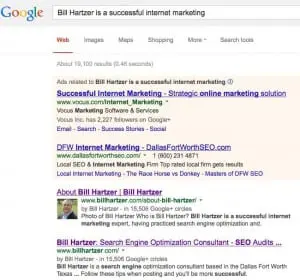
So, these are two different search queries that pull up the same exact URL in the search results, the “about” page on my personal blog. It appears to me that whether or not the photo appears in the search result depends on the actual query. As Mark suggests below in the comments, since I’m using the same site to show the difference between a search query that has the photo and a search query that does not have the photo, this is not the Google Authorship reduction.
Bill Hartzer is Globe Runner’s Senior SEO Strategist. Follow him on Google Plus.
10 SEO POSTS THAT SHAPED 2013
A lot happened in the search engine optimization industry during 2013. There were changes that happened that will forever change the way SEOs do their jobs–and how we market websites in the future. Many of these changes were predicted by many, and then there were changes that we didn’t expect. Here is my list of the 10 SEO-related blog posts that shaped the SEO industry during 2013. I chose these blog posts and articles not because the articles themselves did the shaping: but the topic they covered shaped the industry. However, in the case of Moz, I think that posts speaks for itself.
FTC Sets Sights on Native Advertising, But Outcome Unclear – It’s not just Google that has issues with Advertorials. I have seen a lot of sites get manual penalties from Google in 2013 because of Advertorials and not being compliant with the FTC guidelines for disclosure. This was a very big issue during 2013 and I fully expect it to be even a bigger issue during 2014.
SEO’s Dilemma – Link Building vs. Content Marketing – Whiteboard Friday – This Whiteboard Friday details a really big issue that online marketers, SEOs, and web marketers had to deal with in 2013. Link building, link earning, or Content Marketing? I saw a lot of SEOs jump from link building to content marketing during 2013. Maybe those still offering article submissions will finally jump to content marketing during 2014. What do you think?
Goodbye SEOmoz, Hello Moz. Yes, way back in 2011 I predicted it and during 2013 they finally rebranded. This was not only a big deal for Moz, but a big deal for the industry. Could a company such as SEOmoz pull off such a major brand change? Absolutely. And they did it in style during 2013.
Penguin 2.0 rolled out today – May 22nd, 2013 was a big day for many sites. Not because of the traffic they received that day–but that was about the last day that they’ve seen lots of traffic to their site. Google Penguin hit quite a lot of sites during 2013 and many sites still have yet to recover. Definitely a topic that everyone in the SEO industry will remember for 2013. Lucky for some SEOs who help sites recover from Google Penguin, such as Globe Runner. But 2013 was very unlucky for those sites who suffered as a result of Google Penguin.
Google Humminbgird FAQ by Search Engine Land – Google Hummingbird was announced in September 2013. Sites weren’t really affected too much that they knew about–but this new algorithm will shape the future of Google’s organic search. Definitely worth mentioning in 2013.
Why Google’s New Hummingbird Algorithm is Good News for Serious Content Creators – Hummingbird is good news for those of us who create content. Here’s why. Eric Enge, posting on Copyblogger.com, nails it this time.
Want to Rank in Google? Build Author Rank Now – 2013 is also the year of Author Rank. If you have not already started paying attention to Google Author Rank, you need to in 2014. This is a great post by Eric Enge that does a great job of explaining why verified authors are going to be important.
Study Shows No Clear Evidence That Google+ Drives Ranking – 2013 is not only the year of Google Plus, Authorship, and Author Rank, it’s also the “Year of Enge”. That’s Eric Enge, mind you. During 2013, Mr. Enge’s Stone Temple Consulting put together a study showing that Google Plus doesn’t drive search engine rankings in Google organic search. Well, even though apparently Google Plus isn’t a driver of rankings, 2013 is definitely the year of Google Plus and the year that we’re starting to see more SEOs embrace it as a social network. I personally saw more SEOs start posting regularly during 2013 on Google Plus than they did previously.
Optimized Links in Press Releases & Guest Posts Can Harm Your SEO, Says Google – Another big story was the fact that Optimized Anchor Text in press releases was targeted by Google. One major SEO tactic for a lot of SEO firms in the past had been writing press releases for PRWeb and other “press release sites”, and adding optimized anchor text. Google shut down that pretty quickly during 2013, and the press release services such as PRWeb.com started adding the nofollow attribute to all links in press releases.
Google Warns Against Large-Scale Guest Posting, Advertorials & “Optimized Anchor Text” In Press Releases – Not only did Google shake up the Press Release industry for SEOs, Google also took aim at guest posts and advertorials, as I previously mentioned. 2013 is the year that Google changed some of the link strategies of some SEO firms, and many of their clients got penalized as a result.
So, not only was 2013 a year of Google updates, but those updates changed forever how the SEO industry builds links to client sites. I have to admit, though, that it was a long time coming. Those SEO firms who were relying on press releases, advertorials, and guest posts for rankings were relying on unnatural link building. And not the content marketing and link earning that all of us should be doing.
Bill Hartzer is Globe Runner’s Senior SEO Strategist. Follow him on Google Plus.
HOW TO: ADD DO FOLLOW LINKS ON LINKEDIN
I’m really a big fan of LinkedIn now. I’ve been on LinkedIn for about 10 years now, even when it was not “cool” to have a listing on LinkedIn. Sure, I have a lot of connections, and I admit that there certainly were “tricks” or “tips” to building your LinkedIn network. But that’s really not why I’m so much of a fan of LinkedIn. In fact, it’s because LinkedIn has become a social network of sorts, where you can add updates to your home page when you log in. It’s those updates that are actually bring traffic to sites. If I share an article from my blog, for example, if the post is good, I can see the traffic that comes from LinkedIn. Especially if it’s a good post. So, posting on LinkedIn can bring you traffic. But what’s one of the other benefits? Adding a link. And, if you add the link in a certain way, you can actually make that link a “do follow” link. Here is how to add a “do follow” link to LinkedIn.
Once you log into LinkedIn, your home page will like something like this:
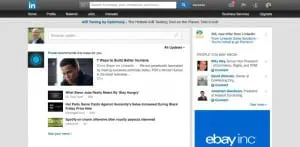
Notice the form filed where it says, “Share an update”. This is just like Facebook, Twitter, or Google Plus. You can actually share an update, post something, or, if you prefer, say something and add a link to a news article, your website, or, like I do, a post on your blog. Once I post a blog post, I usually go over to Twitter, Facebook, Google Plus, and, now, LinkedIn to add a link to the blog post I just wrote. In fact, I’m going to do just that when I’m done writing this post. But I digress.
In this case, on LinkedIn, it’s important to make sure that you have some sort of image in the post or article that you’re going to share. People like to see a small thumbnail of the post or something interesting–it helps with the important “click thru rate” on your update.
When you share your update, say something unique about the blog post or the article that you’re linking to.
In order to make the post’s link be a “do follow” link, simply add the URL of the link right after whatever you say about the post. Let’s look at an example of this.
In a recent post, I shared a blog post that I posted on the Globe Runner blog. Here’s what I posted:
Is content marketing on your wish list this year? Well, here is how to take advantage of content marketing for your site and how to promote that content. https://globerunner.com/content-marketing-wish-list/
Notice that what I actually posted includes a full URL at the end of it. LinkedIn automatically changed that link to http://lnkd.in/bPJPNGj which is really not a big deal. That short URL actually 301 redirects to the URL that you added in the share/update. But, I’m not too concerned about the fact that it’s a 301 redirect. What’s important here is that if you look at what I posted you’ll see that the “short URL” is actually “do follow” link.
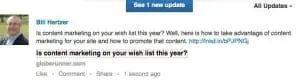
I have a Firefox add-on installed on my browser that puts a red outline around all links that have the “nofollow” link attribute attached to them. In this case, you’ll notice that the link in the share/update, the short URL, has no red outline. But, the link below that DOES have the red outline, meaning that it’s a nofollow link.
Just to clarify, there really is no such thing as a “dofollow” or “do follow” link. Those are just links that do not have the “nofollow” link attribute added to them. It seems that many SEOs have adopted the terminology of “do follow” or “dofollow” to make it clear that it’s a “good” link.
So, if you you want a “do follow” link on LinkedIn, all you have to do is post the URL at the end of what you say about the URL.
Bill Hartzer is Globe Runner’s Senior SEO Strategist. Follow him on Google Plus.
10 CLEVER LAST MINUTE HALLOWEEN COSTUMES
For my first ever blog post I’m going to keep it simple and by simple I mean a lot of pictures with few words. In honor of Halloween I’ve compiled a list, picture list that is, of the top 10 easiest/most clever last minute costumes. Enjoy!
10. A little face paint + a deep v-neck and you’re French Kiss…

9. For all you powerful women out there, grab a blue button down and a red headband. You can do it!

8. Put on a little yellow face paint, a fake mustache, and some glasses and Hey-Diddly-Ho, you’re Ned Flanders.

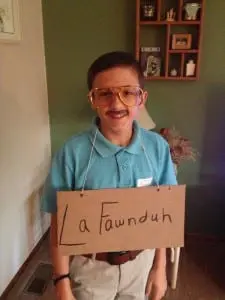
7. Or trade the yellow paint for a cardboard sign Goshhhh…
6. If you have access to ceiling tiles, find some electrical tape and learn how to spell debt.

5. This next costume is great if you’re looking to steal beer all night without getting in trouble. After all you’re just staying in character!

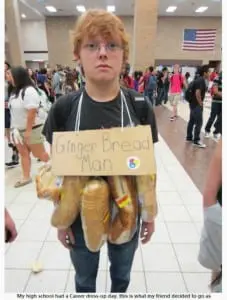
4. For all you gingers out there looking for a last minute costume on a budget, this one’s for you!
3. You know that red flannel t-shirt you like to wear every other day of the year? Why should today be any different?

2. I can always appreciate a great nerd costume and this one is by far the easiest.
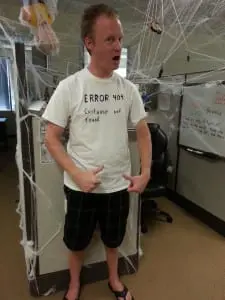
1. And the easiest and most clever costume for all you last minute party goers…

Well I feel pretty good about this first ever blog post. I hope you enjoyed it as much as I did!
Picture Sources:
http://sarcasticcharm.com/17-halloween-costumes-that-are-actually-clever
http://sarcasticcharm.com/25-best-homemade-halloween-costumes-ever-totally-awesome
https://www.businessinsider.com/tech-halloween-costumes-2013-10#simple-nerdy-oh-so-funny-2
https://www.huffpost.com/entry/best-halloween-costumes-o_n_4170143
GOOGLE GLASS AT SMC DALLAS
I’ve always been a bit of a gadget girl. I love tech toys. So when Google Glass came out, I read the articles, watched the videos, and “liked” (a bit enviously) the picture a college friend posted on Facebook showing a Google Glass box. I hoped I would somehow get the chance to play with Google Glass. Then last night it happened!
I went to a Social Media Club of Dallas meeting, and there was not one but two guys walking around wearing Google Glass. Within a couple minutes and some awkward please notice me staring moments, one of the guys walked over to the group I was with. I tried really hard to wait an appropriate amount of time and have enough polite conversation before asking with what I hoped was innocent curiosity but probably came out as slightly over-eager, “Aren’t you wearing Google Glass?”
This guy must be used to this or could sense my determination and intense desire to get my hands on his Google Glass because a minute later this was happening:
Glass was surprisingly difficult to use, I’m hoping it was due to all of the noise in the Angelika lobby, but then again, I’m not sure…
It doesn’t seem like my experience was that unique.
That video pretty much sums up my success rate using Glass. I tried to navigate to my house, but since I don’t have an android phone to connect, that was unsuccessful. I couldn’t look up anything due to Glass’ inability to understand my commands. I did, however, inadvertently share a picture to G+.
And the “coolest” thing I tried to do with Glass?

Yes, that’s a selfie of me trying to take a picture of me taking a picture of me. An attempted selfie of a selfie.
Have you tried Google Glass? What did you think? What’s the coolest thing you’ve done with Glass?
~~~~~~~~~~~~~~~~~~~~~~~~~~~~~~~~~~~~~~~~~~~~~~~~~~~~~~~~~~~~~~~
Thanks again to the incredibly accommodating @chrisgoulet for the use of his Google Glass and @andyodom7 and @theedcelmer for indulging my need to document every second of my Google Glass experience.
FEBRUARY-MARCH MONTHLY SUMMARY
SEO Updates
Experts in the search marketing world have been watching the last major manual Panda Refresh the past three days. This was the 25th and final announced and published update to Panda, Google’s anti-web spam algorithm. Google has stated that “Panda is becoming more of a ‘rolling’ update.” Google Distinguished Engineer, Matt Cutts, is quoted at SMX saying:
Rather than having some huge change that happens on a given day. You are more likely in the future to see Panda deployed gradually as we rebuild the index. So you are less likely to see these large scale sorts of changes.
This is encouraging to us at Globe Runner, we are monitoring all of our clients’ sites and have not been hit by the major Panda updates and with only small tweaks coming in the future, we are confident that we can keep doing what we are doing to rank well. Google is recognizing our clients’ quality sites.
Social News
Pinterest has finally announced an analytics tool! The analytics will show verified website owners the information they have been waiting for since Pinterest began: the number of people who have pinned items from the site, the items/images that are the most popular to pinners, how many people have visited your site from Pinterest, and even the most popular repins. For businesses looking to quantify the value or traffic coming from Pinterest to their site, the process just became much easier. At Globe Runner, we are encouraging our clients to contact us if they have questions about their Pinterest strategy or would like to begin using Pinterest.
Google+
There were also a few updates to Google+ this month. The three main updates are a new local reviews tab, an easier interface to update your information, and a new aspect ratio for cover images. The new aspect ratio is enormous. Photos can now be 2120 x 1192 pixels, this means your cover photo can now cover the entire screen “above the fold” of the Google+ page.
Globe Runner Internal Update
Our CEO Eric McGehearty was featured February 28 in the Upstart Business Journal for an article he authored on why young entrepreneurs are “too dumb to fail.” The article tells Eric’s story from artist to entrepreneur two times over before the age of 30. Read the full article.
Just for Fun
If you have ever wondered how Google Search works and did not want to engage in a long and involved technical conversation with an algorithm engineer, Google has released a website entitled How Search Works. The site is interactive and allows you to follow a search query through the process to the results. Google’s Inside Search blog describes the content as including:
- An interactive, graphical explanation of Google Search
- A view into major search algorithms and features
- A 43-page document explaining how we evaluate our results
- A live slideshow of spam as we remove it
- Graphs illustrating the spam problem and how we fight it
- A list of policies that explain when we’ll remove content
Resources
https://www.seroundtable.com/google-panda-update-rolling-16495.html
http://www.webpronews.com/google-panda-update-is-rolling-out-report-2013-03/
JANUARY-FEBRUARY MONTHLY SUMMARY
Globe Runner SEO Updates
Meet the newest member of the Globe Runner team, Claire Elizabeth McGehearty! She joined the team in Lewisville, Texas on February 15, 2013. She is by far the smallest member at only 7lbs 9oz and 21 inches long. She and her three big brothers keep founders Eric and Heather very busy!
CLAIRE ELIZABETH MCGEHEARTY
PPC Update
This month Google announced Enhanced PPC Campaigns. These campaigns will be “smarter” and multi-device friendly. A single campaign will now support different locations and devices, thus replacing the old system of creating duplicate campaigns for each location and device for which you want your ad to run. Within an Enhanced PPC campaign, you will be able to customize your ads and bids based on the time, device, and location of the customer. Enhanced campaigns will also offer advanced reporting that will allow comparisons between different types of conversions; for example, app downloads vs. phone calls lasting longer than 60secs. All of these changes are geared towards reducing the number of campaigns and the complexity of your Adwords account.
Google plans to roll out the Enhanced campaigns slowly by first giving advertisers the option to switch some of the campaigns to the Enhanced version to test out the new system. At Globe Runner, we are excited for this change and have already switched a couple of accounts to play with the new system and prepare for every account to be Enhanced. By the middle of this year, Google plans to upgrade every account.
Social News
The most famous adverting day of the year, the Super Bowl was this month. This year’s Super Bowl ads sold for $3.8 million per 30 sec spot. However, the now infamous 34 minute blackout opened up a unique opportunity for real time marketing. The brands that were able to react quickly to the black out with relevant and creative content have been praised by the social media industry. Social media is the ideal real-time marketing platform.
By far, the most praised real time marketing and social media “win” during the Super Bowl blackout was Oreo’s tweet, “You can still dunk in the dark.” This tweet was a win because it highlighted a current event in a non-disparaging way and tied it into the brand’s message in a creative way.
A great social media strategy incorporates current events that can be easily tied to a brand’s message in a way that makes sense and provides a positive feeling about the brand. The brand’s message should not be lost in the “noise” of the surrounding issue. Only a few brands have done this well, and Oreo is the most recent example.
Just for Fun
The high price tag of a Super Bowl ad spot had those of us in the digital space talking about how much further that $4 million would go if used on internet marketing. A few examples of this are an 8 day homepage ad on YouTube (which is one of the top five most visited pages on the web), 200 pieces of Buzzfeed-sponsored content (which is a personal favorite and highly shared site for those of us Globe Runner), and a spot on Twitter’s Promoted Trending Topic every day for a month! For more on what $4 million can buy online, see https://digiday.com/marketing/what-a-4-mil-superbowl-ad-could-buy-in-digital/.
Resources
DECEMBER MONTHLY SUMMARY
Globe Runner SEO Year in Review
Before we look ahead to the New Year, we felt it appropriate to spend a moment and review some of the successes of 2012. A banner year in many respects, some of the largest changes came internally, where three of our own were promoted to new positions, with the advancement of Cody Sharp to SEO Team Lead, Felipe Rocha to Lead Developer, and Damon Gochneaur to Director of Marketing. With strong leadership in place, Globe Runner added some core team members in Andy Odom, Account Strategist, Claire Parker, Communications Specialist, and Cameron Fergus, Web Developer.
While growing our team and client list, we were also proud to maintain a key position in the industry, with our CEO, Eric McGehearty, being re-elected to the DFWSEM Board of Directors as Vice President of Sponsorship. DFWSEM is the largest regional Search Engine Marketing professionals group in the country and helps to validate our role in both our local community as well as our professional circles
2013 SEO Trends
A study conducted at the end of 2012, has shown that SEO is increasing in recognition in importance as a part of an overall marketing strategy. This is illustrated by survey participants: 66% indicated that their marketing budgets were increased for 2013, 6 out of 10, reported that they were increasing their SEO budget for the following year, and 16% of organizations now have a dedicated Search department. Search as a marketing strategy continues to grow. At Globe Runner we are prepared for this and are staying ahead of the curve and continuing to develop our strategies to help our clients rank ahead of the competition.
Two trends that are predicted to take a major role in 2013 are link diversification and content marketing. At Globe Runner, we have always taken a diversified anchor text link strategy, believing that it was best to diversify back link profiles and have anchor text links to relevant content that our clients’ customers are searching. Globe Runner’s content marketing strategy has been focused on encouraging and assisting our clients in publishing and optimizing quality content often, keeping a company site fresh and useful for customers. We also stress the importance of publishing relevant, interesting company news as press releases.
Big Data is another important topic for 2013. More and more data is now available from search and social platforms. These platforms are no longer in their infancy and for the first time reliable data is available. The challenge will be to analyze and apply this data in data driven decision making. The statistics below illustrate just how much data is available and what the industry is describing as “Big Data.”
This data is really staggering when you think about its implications. New tools like Facebook Graph Search will help with the applications of this data.
Big Data Stats:
- 1 billion Facebook users
- 500 terabytes of data per day
- 2.7 billion “Like” actions per day
- 2.5 billion pieces of content per day
- 300 million photos per day
- 500 million Twitter users
- 400 million tweets per day
- 156 million Public Blogs
Social News
Facebook announced a new search tool on Tuesday: Facebook Graph Search. Graph Search will allow Facebook users to search for information about their friends within the platform. Searches can be done for information about people, photos, places, and interests. For example, within Graph Search, a user will be able to search for which of their friends like the show, How I Met Your Mother and are from Denton. The search results will display your friends. You will also be able to search friends of friends. The search tool will not violate Facebook privacy settings in anyway because the only information that will show up in search results is data that is normally viewable on Facebook based on users’ privacy settings.
The implications for social media strategy with the Graph Search tool are exciting. The tool is currently in beta mode, but once it is available, brands will be able to use the search data to highly target certain fans in a much more personal way. Watch the demo from Facebook.
Resources
- « Previous Page
- 1
- …
- 35
- 36
- 37
- 38
- 39
- …
- 45
- Next Page »